
.svg)
Physics can sometimes feel overwhelming, but remember, it's really just the science of how the world around us works. The chapter from cbse syllabus class 11 physics Mechanical Properties of Fluids may sound heavy, but it’s actually about things you see every day - why ships float, how airplanes fly, why raindrops are spherical, and even how blood flows in your body.
Fluids are everywhere. Water you drink, air you breathe, even the sap in plants. By understanding how fluids behave under pressure, how they flow, and how they interact with objects, you get to see the hidden science behind common experiences.
So, instead of stressing out, let’s look at fluids as our companions in life, quietly teaching us fascinating science with every drop and every gust of wind.

Mechanical Properties of Fluids Summary
Fluids are substances that can flow. They include both liquids and gases. Unlike solids, fluids do not have a fixed shape; instead, they take the shape of the container in which they are placed. They also cannot resist shear stress indefinitely, when subjected to such stress, they start flowing.
The study of the mechanical properties of fluids deals with how fluids behave when subjected to external forces, pressure, or motion. This includes understanding pressure in fluids, buoyancy, fluid dynamics, and various laws governing the flow of fluids.
Pressure in Fluids
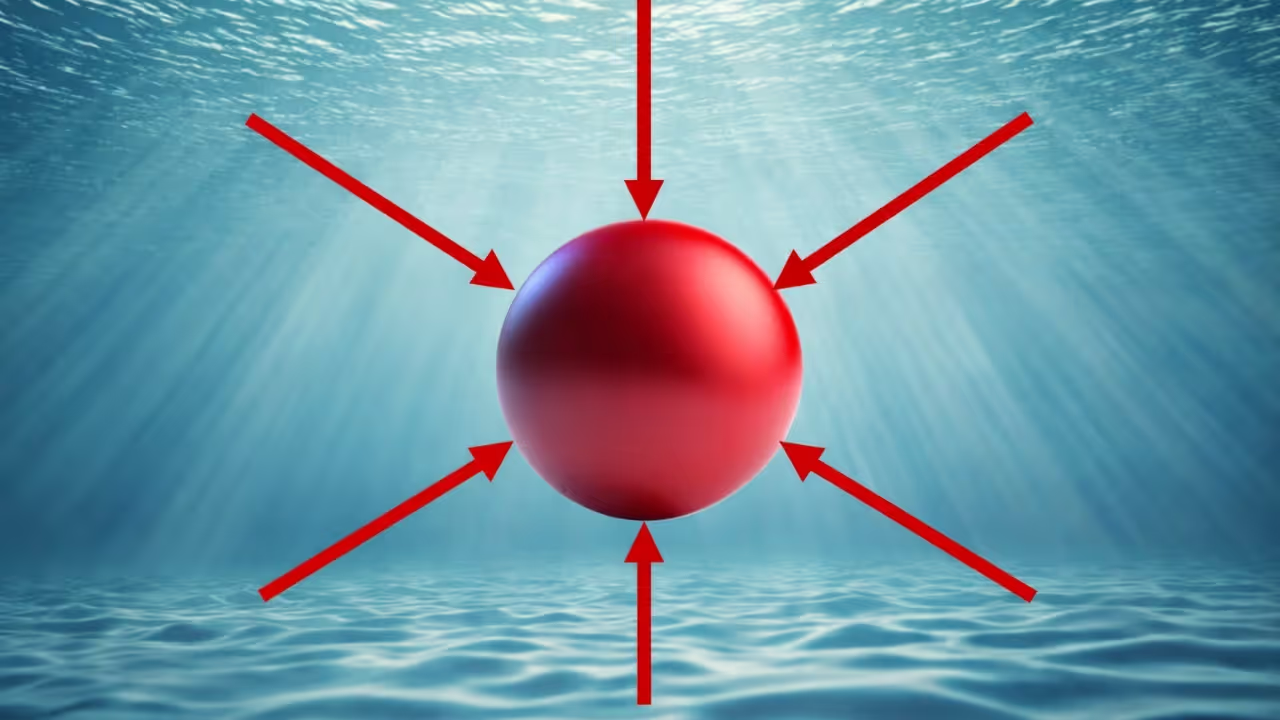
When a force is applied perpendicular to a surface in contact with a fluid, the fluid exerts a reaction force known as pressure. Mathematically, pressure is defined as:
P = F/A
where F is the normal force exerted and A is the area over which it acts.
Pressure is a scalar quantity because it has magnitude only. Even though force is directional, pressure at a point in a fluid acts equally in all directions. In fluids at rest, pressure acts equally in all directions. The SI unit of pressure is the Pascal (Pa).
Pascal’s Law
According to Pascal’s Law, pressure applied to a confined fluid is transmitted undiminished in all directions throughout the fluid.
This principle is the basis of hydraulic lifts, hydraulic brakes, and other hydraulic machines. For example, in a hydraulic lift, a small force applied on a piston of small area produces a much larger force on a piston of large area, because the pressure transmitted is the same.
Variation of Pressure with Depth
In a fluid at rest, pressure increases with depth due to the weight of the fluid column above.
Consider a fluid of density ρ\rho at a depth hh below the surface:
P = P0 + ρgh
Here, P0 is the pressure at the free surface (usually atmospheric pressure), g is acceleration due to gravity, and ρ is the fluid density.
Thus, pressure in a fluid depends only on the depth, density, and gravitational acceleration, and not on the shape of the container. This is why deep-sea divers experience enormous pressure.
Atmospheric Pressure and Barometer
The air surrounding us exerts pressure due to its weight, called atmospheric pressure. At sea level, the standard atmospheric pressure is:
1 atm = 1.013×10⁵ Pa
To measure atmospheric pressure, Torricelli’s barometer is used. It consists of an inverted mercury-filled tube placed in a mercury reservoir. The height of the mercury column in the tube (about 76 cm at sea level) gives atmospheric pressure.
Gauge Pressure and Absolute Pressure
The pressure measured relative to atmospheric pressure is called gauge pressure. When a car tyre is said to have a pressure of 32 psi, it means 32 psi above atmospheric pressure.
The total pressure including atmospheric pressure is known as absolute pressure:
Pabs = Pgauge + Patm
Buoyancy and Archimedes’ Principle
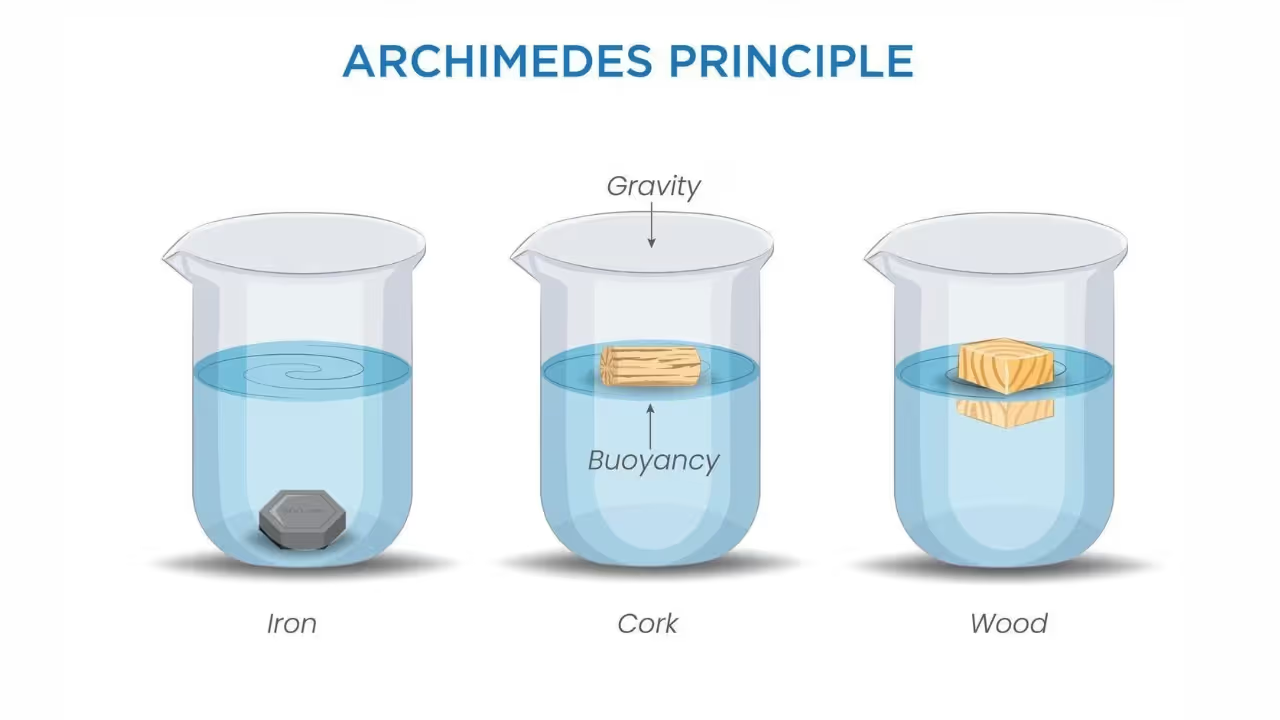
When a body is immersed in a fluid, it experiences an upward force called buoyant force. This arises because pressure increases with depth, so the pressure on the lower surface of the object is greater than on the upper surface.
Archimedes’ Principle states:
A body immersed partially or fully in a fluid experiences an upward buoyant force equal to the weight of the fluid displaced by the body.
This explains why objects float or sink:
- If buoyant force equals the weight of the object, it floats
- If buoyant force is less than the weight, it sinks
- If buoyant force is more, the body rises until equilibrium is reached
Applications include ships, submarines, hydrometers, and hot-air balloons.
Fluid Dynamics
Fluids in motion are studied under fluid dynamics. The flow of fluids can be of two main types:
- Streamline or Laminar Flow: The flow in which each particle follows a smooth path, and the paths never cross each other. At any point, velocity, pressure, and density remain steady.
- Turbulent Flow: An irregular flow with random mixing of fluid particles. This occurs at high speeds or when obstacles are present.
The quantity that decides whether flow is laminar or turbulent is the Reynolds number (Re):
Re = (ρvD) / η
where ρ = density, v = velocity, D = diameter of the pipe, η = viscosity.
- For Re < 2000: flow is laminar.
- For 2000 < Re < 3000: flow is unstable.
- For Re > 3000: flow is turbulent.
Equation of Continuity
The principle of conservation of mass in fluid flow leads to the Equation of Continuity:
A1 v1 = A2 v2
where A is the cross-sectional area and v is the fluid velocity.
It shows that when a fluid passes through a narrower pipe, its velocity increases, and when it passes through a wider section, velocity decreases. This explains why river water flows faster in narrow regions.
Bernoulli’s Principle
Proposed by Daniel Bernoulli, this principle is a consequence of the law of conservation of energy applied to fluids.
It states that for an incompressible, non-viscous fluid in streamline flow:
P + ½ ρv2 + ρgh = constant
Here, P is pressure energy per unit volume, ½ρgh is kinetic energy per unit volume, and ρgh is potential energy per unit volume.
Applications:
- Flight of airplanes (wings are designed so that air moves faster above the wing, creating lower pressure, resulting in lift)
- Atomizers and perfume sprays (liquid rises due to pressure difference created by fast-moving air)
- Venturi meter (measures the flow rate of fluid)
Assumptions of Bernoulli’s Theorem
Bernoulli’s equation is valid only when:
- Fluid is incompressible
- Fluid is non-viscous
- Flow is steady
- Flow is along a streamline
If viscosity is present, energy loss occurs.
Viscosity
Viscosity is the internal resistance to flow offered by a fluid. A highly viscous fluid (like honey) flows slowly, while a low-viscosity fluid (like water) flows easily.
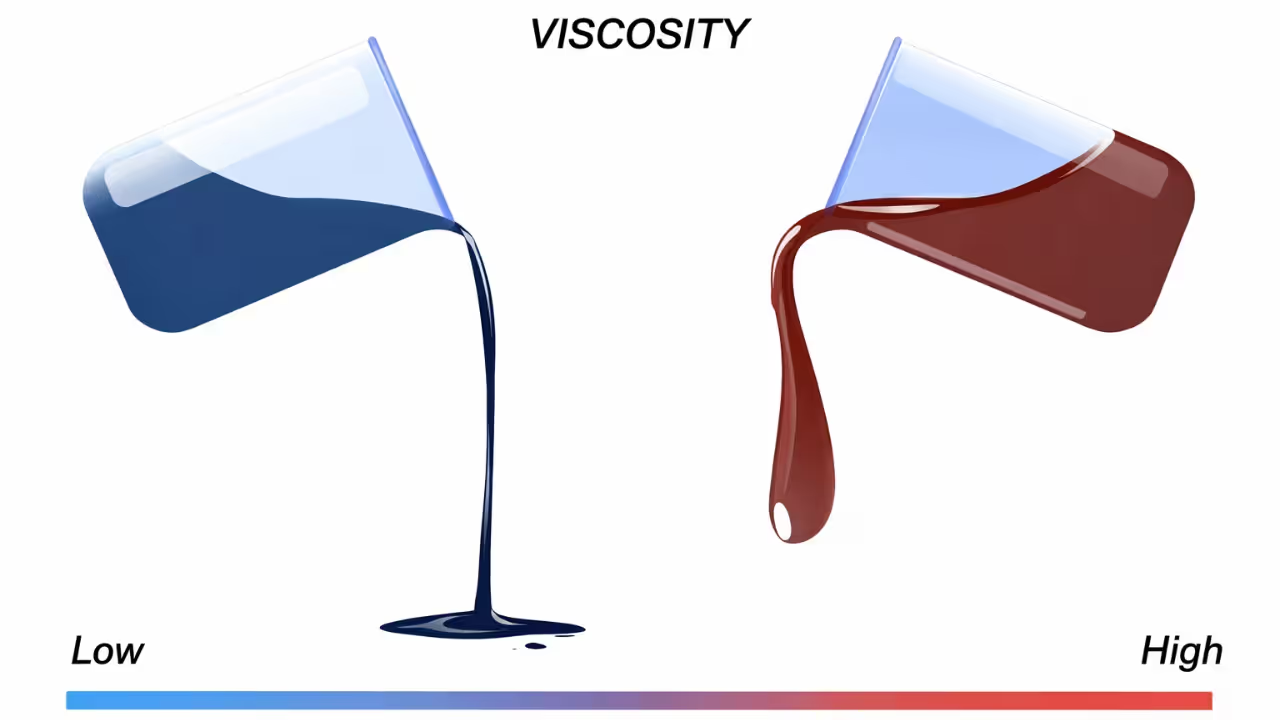
According to Newton, viscous force is proportional to the velocity gradient:
F = ηA (dv/dx)
where η is the coefficient of viscosity. Its SI unit is Pa·s (Pascal second).
Poiseuille’s Law gives the volume of liquid flowing per second through a capillary tube:
Q= πr4ΔP/8ηl
where r = radius, l = length of tube, P = pressure difference.
Viscosity decreases with temperature in liquids, but increases with temperature in gases.
Stokes’ Law
When a spherical body moves through a viscous medium, it experiences a drag force given by Stokes’ Law:
F = 6 π η r v
where r is the radius of the sphere and v is its velocity.
This law is useful in understanding raindrops, the settling of particles in fluids, and determining viscosity experimentally.
Terminal Velocity
A body falling through a viscous fluid eventually attains a constant velocity when the net force becomes zero. This velocity is called terminal velocity.
For a sphere of radius rr:
Vt = 2r2 (ρs − ρf)g / 9η
where ρ is density of the sphere, σ is density of the fluid, and η\eta is viscosity.
Surface Tension
Surface tension is the property of a liquid surface that makes it behave like a stretched elastic sheet. It arises due to molecular cohesion.
It is defined as the force per unit length acting along the surface of a liquid:
T = F / L
Surface tension explains many natural phenomena:
- Formation of spherical soap bubbles and raindrops (minimizes surface area)
- Capillary rise of liquids in narrow tubes
- Action of detergents (they reduce surface tension)
Surface Energy
Surface energy is the work required to increase the surface area of a liquid. Surface tension is numerically equal to surface energy per unit area.
SI unit: J/m²
Liquids try to minimize surface area to reduce surface energy - that’s why droplets are spherical.
Capillarity
When a capillary tube is dipped in a liquid, the liquid either rises or falls in the tube due to surface tension and adhesive forces.
The height hh of the liquid column is given by:
h = 2T cosθ / ρgr
where θ is the angle of contact, T is surface tension, r is radius of the tube.
Water rises in a clean glass capillary (θ < 90°), while mercury falls (θ > 90°).
Angle of Contact
Angle of contact is the angle between the tangent to the liquid surface and the solid surface inside the liquid.
- For water in glass: θ < 90° → rise
- For mercury in glass: θ > 90° → depression
It depends on cohesive and adhesive forces.
Excess Pressure Inside Drops and Bubbles
Due to surface tension, pressure inside drops and bubbles is higher than outside.
For liquid drop:
ΔP = 2T/r
For soap bubble:
ΔP = 4T/r
The soap bubble has two surfaces, so pressure is double.
Conclusion
Mechanical Properties of Fluids connects physics to real life - from floating ships to flying airplanes. Focus on understanding concepts first, then practice formulas. Once the logic becomes clear, this chapter becomes one of the easiest scoring units in Class 11 Physics.
So take a deep breath, relax, and remember: You’re doing great, and with steady effort, these concepts will stay with you far beyond exams. Keep going. You’ve got this.
FAQs
Q1. What is pressure in fluids?
Ans. Fluid pressure is the force exerted by a fluid per unit area on the walls of its container or on any object immersed in it.
Q2. State Pascal’s law.
Ans. Pascal’s law states that pressure applied to a fluid at rest is transmitted equally in all directions throughout the fluid.
Q3. What is Archimedes’ principle?
Ans. Archimedes’ principle states that a body immersed in a fluid experiences an upward buoyant force equal to the weight of the fluid displaced by it.
Q4. What is Bernoulli’s principle?
Ans. Bernoulli’s principle states that in a steady flow of an incompressible, non-viscous fluid, the sum of pressure energy, kinetic energy, and potential energy per unit volume remains constant.
Q5. What is surface tension?
Ans. Surface tension is the property of a liquid surface that makes it behave like a stretched elastic sheet due to cohesive forces between molecules.












.svg)

