
.svg)
Class 9 Maths Ganita Manjari Chapter 5: I’m Up and Down, and Round and Round, introduces students to the geometry of circles. The NCERT solutions consist of exercise-wise, step-by-step answers to each question given in the new Ganita Manjari textbook prescribed for the 2026-27 session. It explains all 12 theorems in a simple format, with opportunities for students to think, reason, and prove with confidence. This page provides comprehensive solution material for Chapter 5, which is completely aligned with the CBSE syllabus 2026-27, be it for revision, lesson preparation or helping your child learn.
Download NCERT Solutions for Class 9 Maths Chapter 5 PDF
NCERT Class 9 Maths Chapter 5 solutions can be downloaded by students for free in PDF format. From answering questions to revising before exams or using them to practice questions from the Maths textbook, these solutions can enhance your grasp of circle geometry.
Circles are everywhere: from the wheels that move us forward, to the ripples that occur on a pond. “Up and Down, and Round and Round” is an old favourite shape that is investigated and explored in its mathematical context. The chapter introduces students to the concepts of chords, arcs, angles, symmetry and cyclic figures, allowing them to appreciate how simple geometric concepts combine to create beautiful and logical patterns.
NCERT Class 9 Maths Ganita Manjari Chapter 5 Solutions include answers to each Exercise Set 5.1, 5.2, 5.3, 5.4, 5.5, 5.6 and End-of-Chapter exercises given in the Class 9 Ganita Manjari textbook. Solutions to constructions, proofs and numerical questions are explained step-by-step, making it easy for students to see the logic behind the results.

What Topics are Covered in Chapter 5?
Class 9 Maths Ganita Manjari Chapter 5 (Circles) develops the concept of circles using chords, arcs, angles, symmetry and cyclic figures. Here are some essential topics covered in this chapter:
- Major and minor arcs.
- Angles under arcs
- Angle in a semi-circle
- Concyclic points
- Cyclic quadrilaterals
- Understanding circles and their basic elements
- Centre, radius, chord, and diameter
- Locus and points at the same distance
- Rotational and reflection symmetry of a circle
- Circles passing through two or three points
- Circumcircle and circumcentre of a triangle
- Position of the circumcentre in acute, right, and obtuse triangles
- Chords and the angles created at the centre
- Equal Chords and equal central angles
- Midpoint and perpendicular bisector of a chord
- Distance of a chord from the centre
- Angle at the centre and angle at a point on the circle
- Opposite angles of a cyclic quadrilateral
- Questions related to construction of circles
- The non-linear relationship between the chord length and its distance from the centre
- Proof-based questions on congruence and the Baudhāyana–Pythagoras theorem
These concepts are built up in eight sections of the chapter and accompanied by 12 theorems and six exercise sets. Utilising NCERT Solutions for Class 9 along with the Ganiota Manjari textbook helps strengthen your conceptual understanding and boost confidence for school exams.
NCERT Class 9 Maths Ganita Manjari Chapter 5 Solutions
Exercise Set 5.1
Q1. Draw ΔABC with AB = 5 cm, ∠A = 70° and ∠B = 60°. Draw the circumcircle of ΔABC. Is the centre inside or outside the triangle?
Solution:
Construction steps:
1. Draw segment AB = 5 cm.
2. At A, construct ∠A = 70°; at B, construct ∠B = 60°. Let the two rays meet at C.
3. ∠C = 180° − (70° + 60°) = 50°.
4. Draw perpendicular bisectors of any two sides (say AB and BC); they meet at point O.
5. With O as centre and OA as radius, draw the circumcircle. It passes through A, B and C.
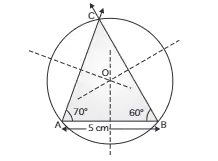
Since all three angles (70°, 60°, 50°) are less than 90°, triangle ABC is an acute-angled triangle. Therefore, the circumcentre O lies inside the triangle.
Q2. Draw ΔABC with AB = 5 cm, ∠A = 100°, AC = 4 cm. Draw the circumcircle of ΔABC. Is the centre inside or outside the triangle?
Solution:
Construction steps:
1. Draw AB = 5 cm.
2. At A, construct ∠A = 100°, and mark C on this ray with AC = 4 cm.
3. Join BC to complete ΔABC.
4. Draw the perpendicular bisectors of AB and AC; they intersect at point O.
5. With O as centre and OA as radius, draw the circumcircle.
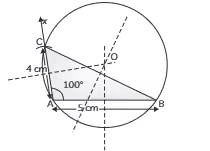
Since ∠A = 100° > 90°, ΔABC is an obtuse-angled triangle. Therefore, the circumcentre O lies outside the triangle.
Q3. Draw ΔABC, with AB = 6 cm, BC = 7 cm and CA = 7 cm. Draw the circumcircle of ΔABC. Let the circumcentre be O. Measure OA, OB, OC.
Solution:
Construction steps:
1. Draw BC = 7 cm.
2. With B as centre and radius 6 cm, and with C as centre and radius 7 cm, draw arcs that intersect at A. Join AB and AC.
3. Draw perpendicular bisectors of any two sides; their intersection O is the circumcentre.
4. Draw the circumcircle with centre O and radius OA.
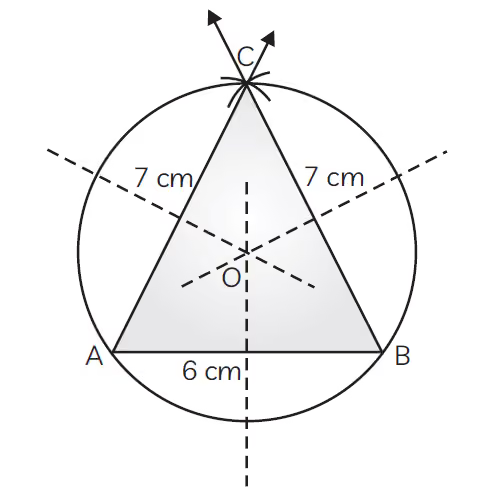
Since, O is the circumcentre, it equidistant from all three vertices.
Therefore, OA = OB = OC ≈ 3.72 cm (circumradius).
They must be equal because each is a radius of the circumcircle.
Q4. What is the least possible radius of a circle through two points A and B?
Solution:
The smallest circle passing through A and B is the one having AB as its diameter. In this case the centre is the midpoint of AB and the radius equals half the length of AB.
Therefore, the least possible radius = AB/2.
Exercise Set 5.2
Q1. Show that the triangle formed by a chord and the centre of the circle is isosceles.
Solution:
Let AB be a chord of a circle with centre O. Consider triangle OAB.
OA = OB (both are radii of the circle).
A triangle having two equal sides is an isosceles triangle.
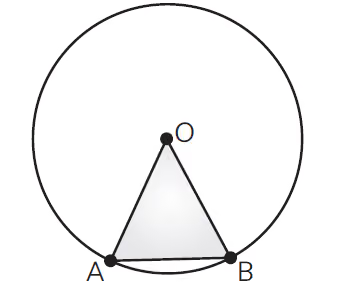
Hence, ΔOAB is isosceles.
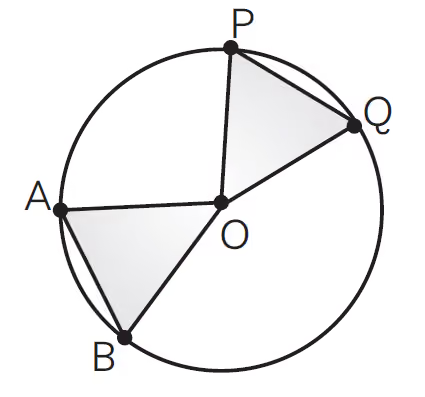
Q2. Show that if two such isosceles triangles (from Q1) have equal base length, they are congruent to each other.
Solution:
Let ΔOAB and ΔOPQ be two triangles formed by chords AB and PQ of the same circle with centre O, such that AB = PQ (equal bases).
OA = OP [Radii of the circle]
OB = OQ [Radii of the circle]
AB = PQ [Given]
By SSS congruence, ΔOAB ≅ ΔOPQ.
Exercise Set 5.3
Q1. Can you explain why the converse to Theorem 4 is true: why does the perpendicular from the centre of a circle to a chord of the circle bisect the chord?
(Hint: Use Fig. 5.12. You are told that ∠CMA = ∠CMB = 90°. You need to show that AM = BM.)
Solution:
Let C be the centre and AB be a chord. Let CM ⊥ AB with M on AB.
We need to show that AM = BM.
In triangles CMA and CMB,
CA = CB [Radii of the circle]
CM = CM [Common side]
∠CMA = ∠CMB = 90° [Given]
By RHS congruence, ΔCMA ≅ ΔCMB.
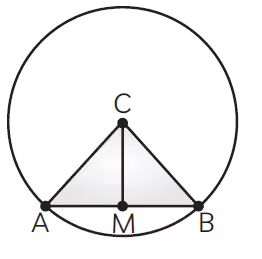
Hence, AM = BM [CPCT]
So, M is the midpoint of AB.
Therefore, the perpendicular from the centre bisects the chord.
Hence, proved.
Q2. An isosceles triangle ABC is inscribed in a circle, with AB = AC. Show that the altitude from A to BC passes through the centre of the circle.
Solution:
Let O be the centre of the circle. Since ABC is isosceles with AB = AC, A is equidistant from B and C. So, A lies on the perpendicular bisector of BC.
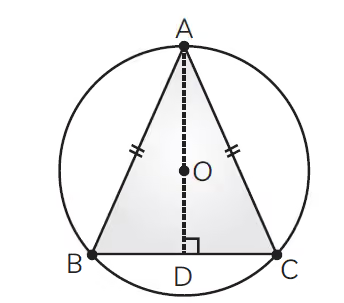
Since O is the centre, OB = OC (radii), so O also lies on the perpendicular bisector of BC.
Therefore, A and O both lie on the perpendicular bisector of BC, which means the line AO is the perpendicular bisector of BC.
The altitude from A to BC (in an isosceles triangle with AB = AC) coincides with the perpendicular bisector of BC.
Hence the altitude from A passes through O, the centre of the circle.
Q3. Two parallel chords of lengths 6 cm and 8 cm are on opposite sides of the centre of a circle. If the radius of the circle is 5 cm, find the distance between the midpoints of the chords.
Solution:
Let O be the centre of the circle.
Length of the two chords are AB = 6 cm and CD = 8 cm.
Given: Radius of the circle OA = OC = 5 cm
The perpendiculars from the centre O to the chords AB and CD bisects the chords at M and N respectively.
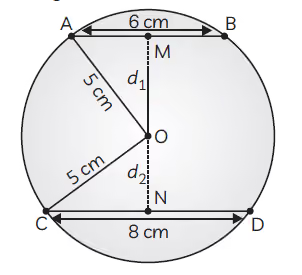
For chord CD = 8 cm: CN = 4 cm.
Using Pythagoras in ΔOCN:
ON² = OC² − CN² = 5² − 4² = 25 − 16 = 9
So, ON = 3 cm.
For chord AB = 6 cm: AM = 3 cm.
Using Pythagoras in ΔOAM:
OM² = OA² − AM² = 5² − 3² = 25 − 9 = 16
So, OM = 4 cm.
Since, the chords are on opposite sides of the centre and their centres lies on same line.
So, the distance between the midpoints = ON + OM = 3 + 4 = 7 cm.
Exercise Set 5.4
Q1. Use the Baudhāyana–Pythagoras theorem to show why Theorem 6 must be true.
Solution:
Theorem 6: Chords of equal length are at equal distance from the centre.
Let AB and FG be two chords of a circle with centre C, such that AB = FG. Let E and H be the feet of perpendiculars from C to AB and FG respectively. By Theorem 5, E and H are midpoints of AB and FG.
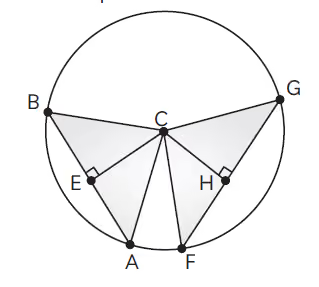
So, AE = AB/2 and FH = FG/2. Since AB = FG, we get AE = FH.
Also, CA = CF = r (radii of the circle).
In the right triangle CEA (right-angled at E), by the Baudhāyana–Pythagoras theorem:
CE² = CA² − AE² = r² − (AB/2)²
Similarly, in right triangle CHF:
CH² = CF² − FH² = r² − (FG/2)²
Since AB = FG, we have CE² = CH², and therefore CE = CH.
Hence, equal chords are equidistant from the centre.
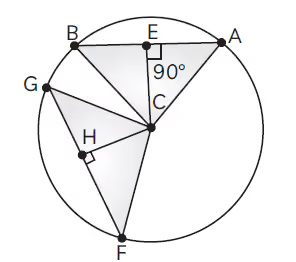
Q2. In given figure, if CE is perpendicular to AB, CH is perpendicular to GF, and CE = CH, show that AB = GF.
Solution:
In triangles CEA and CHF:
CE = CH [Given]
CA = CF [Radii of the circle]
∠CEA = ∠CHF = 90°
By RHS congruence, ΔCEA ≅ ΔCHF.
So, AE = FH.
Since, the perpendicular from the centre to a chord bisects the chord.
Hence, E is the mid-point of AB and H is the mid-point of GF.
So, AB = 2AE and GF = 2FH
Thus, AB = GF.
Q3. Solve the previous question using the Baudhāyana–Pythagoras theorem.
Solution:
Given: E and H are midpoints of AB and GF, so AE = AB/2 and FH = GF/2.
In right triangle CEA (right-angled at E), by the Baudhāyana–Pythagoras theorem:
CA² = CE² + AE²
⟹ AE² = CA² − CE² = r² − CE² ...(i)
In right triangle CHF (right-angled at H), by the Baudhāyana–Pythagoras theorem:
CF² = CH² + FH²
⟹ FH² = r² − CH² ...(ii)
Since, CE = CH
From (i) and (ii),
AE² = FH²
⟹ AE = FH
⟹ AB/2 = GF/2
Therefore, AB = GF.
Hence, proved.
Exercise Set 5.5
Q1. Find the length of the chord of a circle where the radius is 7 cm and perpendicular distance is 6 cm.
Solution:
Let O be the centre, AB be the chord, and M be the foot of perpendicular from O to AB.
Then OM = 6 cm and OA = 7 cm.
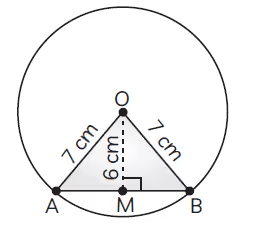
In right triangle OMA:
AM² = OA² − OM² = 7² − 6² = 49 − 36 = 13
AM = √13 cm
Since, the perpendicular from the centre to a chord bisects the chord.
Therefore, AB = 2AM = 2√13 cm
Hence, the length of the chord is 2√13 cm.
Q2. Explain why the following statement is true: If the perpendicular distance of a chord from the centre is d and the radius is r, then the chord length is 2√(r² − d²).
Solution:
Let O be the centre, AB be the chord, and M be the foot of perpendicular from O to AB.
Then, OM = d and OA = r.
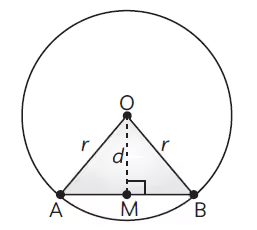
Since, the perpendicular from the centre to a chord bisects the chord.
i.e., AM = AB/2
In right triangle OMA (right-angled at M), by the Baudhāyana–Pythagoras theorem:
OA² = OM² + AM²
r² = d² + AM²
AM² = r² − d²
AM = √(r² − d²)
Therefore, chord length AB = 2AM = 2√(r² − d²).
Q3. In a circle, if the distance of chord AB from the centre is twice the distance of another chord CD from the centre, then can we conclude that CD = 2AB? Give reasons.
Solution:
No, we cannot conclude CD = 2AB.
Let the distance of CD from the centre be d, so the distance of AB is 2d.
Let r be the radius.
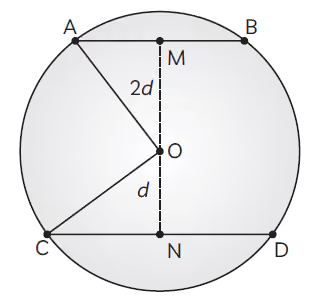
Using the formula from Q2:
AB = 2√(r² − (2d)²) = 2√(r² − 4d²)
CD = 2√(r² − d²)
Since, CD = 2AB
2√(r² − d²) = 4√(r² − 4d²)
√(r² − d²) = 2√(r² − 4d²)
r² − d² = 4(r² − 4d²) = 4r² − 16d²
15d² = 3r²
⟹ r² = 5d²
⟹ r = d√5
This only holds for one specific relationship between r and d.
In general (for arbitrary r and d with d < r/2), CD ≠ 2AB.
Example: Let r = 5 and d = 1. Then AB = 2√(25−4) = 2√21 ≈ 9.17 cm
and CD = 2√(25−1) = 2√24 ≈ 9.80 cm.
Here, 2AB ≈ 18.33 cm ≠ CD.
Hence, the conclusion does not hold in general.
Exercise Set 5.6
Q1. In a circle with centre O, the central angle AOB is 60°. If the radius of the circle is 12 cm, what is the length of the chord AB?
Solution:
In ΔOAB, OA = OB = 12 cm (radii), so the triangle is isosceles. The angle at the vertex
∠AOB = 60°.
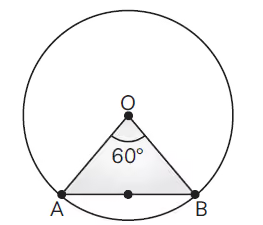
The base angles are ∠OAB = ∠OBA = (180° − 60°)/2 = 60°.
So, all angles are 60° i.e., ΔOAB is equilateral.
Therefore, AB = OA = OB = 12 cm.
Length of chord AB = 12 cm.
Q2. Let A and B be two points on a circle with centre O.
(A) Are there points X, Y on the circle, on the same side of AB, such that ∠AXB is different from ∠AYB?
Solution:
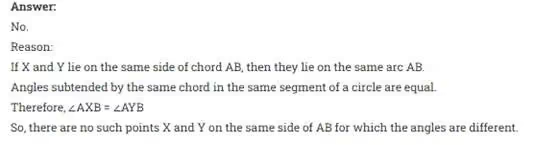
(B) Is it true that if ∠AXB = ∠AYB, then X and Y lie on the same side of AB?
Solution:
Not necessarily. X and Y may lie on opposite sides of AB with ∠AXB = ∠AYB if each angle equals 90° (if AB is a diameter) — or more generally, on opposite arcs the subtended angles are supplementary (they add up to 180°). So, it is possible that ∠AXB = ∠AYB when each equal 90°, even if they lie on opposite sides.
However, whenever they are on the same side, the angles are equal.
So, the statement is false in general.
(C) If ∠AXB = ∠AYB, and X and Y do not lie on the circle, does the circle through A, B and X also pass through Y?
Solution:
Yes. If X and Y lie on the same side of AB and ∠AXB = ∠AYB, then by Theorem 10 (the converse of the angles-in-same-segment result), A, B, X, Y are concyclic. So, the circle through A, B, X also passes through Y.
End-of-Chapter Exercises
Q1. In a circle, a chord is 5 cm away from the centre. If the radius of the circle is 13 cm, what is the length of the chord?
Solution:
Let d = 5 cm (perpendicular distance), r = 13 cm.
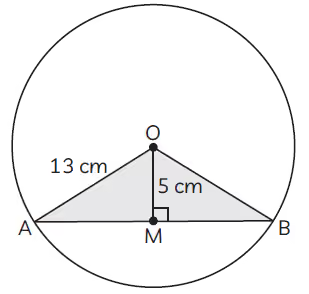
Using the chord length formula: Chord = 2√(r² − d²) = 2√(169 − 25) = 2√144 = 2 × 12 = 24 cm.
Length of the chord = 24 cm.
Q2. An arc of a circle subtends an angle of 70° at the centre. What is the measure of the angle subtended by the arc at a point on the circle?
Solution:
By Theorem 9, the angle subtended by an arc at any point on the remaining part of the circle is half the angle subtended by the arc at the centre.
Angle at the circumference = 70°/2 = 35°.
Q3. The diameter of a circle is 26 cm. A chord of length 24 cm is drawn in the circle. Find the distance from the centre of the circle to the chord.
Solution:
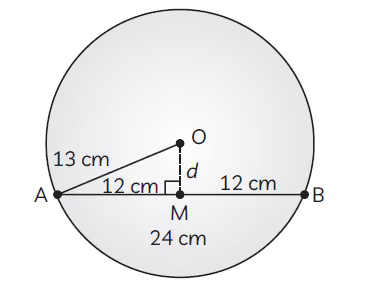
Radius r = 26/2 = 13 cm. Chord length = 24 cm, so half-chord = 12 cm.
Using Pythagoras: d² = r² − (chord/2)² = 13² − 12² = 169 − 144 = 25.
Distance d = 5 cm.
Q4. A circle has a radius of 15 cm. A chord is drawn. The distance from the centre of the circle to the chord is 9 cm. What is the length of the chord?
Solution:
Using chord = 2√(r² − d²) = 2√(225 − 81) = 2√144 = 2 × 12 = 24 cm.
Length of the chord = 24 cm.
Q5. Prove that the perpendicular bisector of a chord passes through the centre of the circle.
Solution:
Let AB be a chord of a circle with centre O.
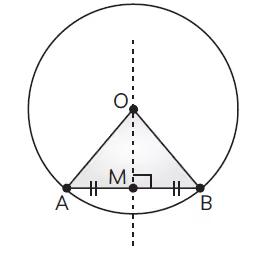
Since OA = OB (both are radii), O is equidistant from A and B. Therefore, O lies on the perpendicular bisector of AB (by the locus property of the perpendicular bisector).
Hence, the perpendicular bisector of the chord AB passes through the centre O.
Q6. The diameter of a circle is AB. Point C is on the circumference. What is the measure of ∠ACB? Explain your reasoning.
Solution:
∠ACB = 90°.
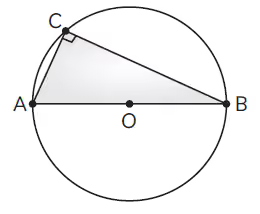
Reason: By the corollary to Theorem 9, the angle subtended by a diameter at any point on the circle is 90°. The diameter AB subtends a straight angle (180°) at the centre, so the angle it subtends at any point C on the circle is 180°/2 = 90°.
Q7. ABCD is a cyclic quadrilateral inscribed in a circle. If ∠A measures 75°, what is the measure of ∠C? If ∠B measures 110°, what is the measure of ∠D?
Solution:
In a cyclic quadrilateral, opposite angles sum to 180°.
∠A + ∠C = 180° ⟹ ∠C = 180° − 75° = 105°.
∠B + ∠D = 180° ⟹ ∠D = 180° − 110° = 70°.
Q8. Quadrilateral PQRS is inscribed in a circle. If ∠P = (2x + 10)° and ∠R = (3x − 20)°, find the value of x and the measures of ∠P and ∠R.
Solution:
Opposite angles of a cyclic quadrilateral sum to 180°.
∠P + ∠R = 180°
(2x + 10) + (3x − 20) = 180
5x − 10 = 180
5x = 190
⟹ x = 38.
Now,
∠P = 2(38) + 10 = 86°.
∠R = 3(38) − 20 = 114 − 20 = 94°.
Q9. The distance of a chord of length 16 cm from the centre of a circle is 6 cm. Find the radius of the circle.
Solution:
Chord length, AB = 16 cm
Half chord, AM = 8 cm
Distance from centre to chord, OM = 6 cm
Let r be the radius
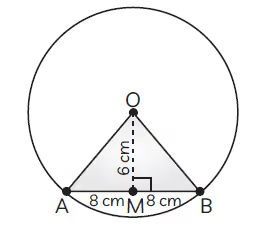
In the right triangle OAM,
OA2 = AM2 + OM2
r2 = 82 + 62
r2 = 64 + 36
r2 = 100
r = 10 cm
Hence, the radius of the circle is 10 cm.
Q10. A cyclic quadrilateral has sides 5, 5, 12, 12 units. Find its area.
Solution:
Since the cyclic quadrilateral has sides 5, 5, 12, 12, its semiperimeter is
s = (5 + 5 + 12 + 12)/2
s = 34/2
= 17
For a cyclic quadrilateral, area is given by Brahmagupta's formula:
Area = √[(s − a)(s − b)(s − c)(s − d)]
Substituting the values, we have:
Area = √[(17 − 5)(17 − 5)(17 − 12)(17 − 12)]
= √[(12)(12)(5)(5)]
= √3600
= 60
Hence, the area of the cyclic quadrilateral is 60 square units.
Q11. Consider a cyclic quadrilateral. Without drawing its circumcircle, how can we find out whether the centre of the circumcircle lies inside the quadrilateral or outside? What is the best way of finding out?
Solution:
To determine if the centre of the circumcircle of a cyclic quadrilateral lies inside or outside the quadrilateral without drawing it, you need to examine the measures of its interior angles.
Condition for Circumcentre Location:
- Circumcentre Inside: The centre of the circumcircle lies inside the quadrilateral if and only if all four interior angles of the quadrilateral are acute (less than 90∘).
- Circumcentre Outside: The centre of the circumcircle lies outside the quadrilateral if and only if at least one interior angle of the quadrilateral is obtuse (greater than 90∘).
- Circumcentre on an Edge: If one of the interior angles is a right angle (90∘), the centre of the circumcircle lies at the midpoint of the diagonal opposite that angle.
The best way to find out is to:
- Measure or calculate the four interior angles of the cyclic quadrilateral. Let these angles be ∠A, ∠B, ∠C, ∠D.
Check the type of each angle:
- If ∠A < 90∘, ∠B < 90∘, ∠C < 90∘, and ∠D < 90∘, then the circumcentre is inside.
- If any of ∠A, ∠B, ∠C, ∠D is greater than 90∘, then the circumcentre is outside.
- If one angle is exactly 90∘ and the others are acute, the circumcentre is on the midpoint of the opposite side.
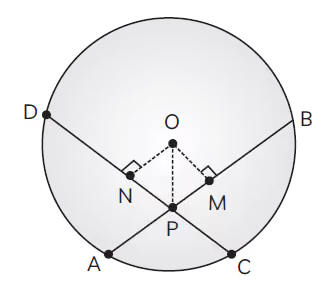
Q12. When two chords intersect, each of them is divided into two-line segments. Show that if the intersecting chords are of equal length, then the line segments of one chord are equal to the corresponding line segments of the other chord.
Solution:
Let two chords AB and CD of a circle with centre O intersect at a point P inside the circle.
Given: AB = CD ...(i)
Since, the perpendicular distances from the centre are equal.
i.e., OM = ON
Consider triangles OMP and ONP,
OP = OP [Common sides]
OM = ON [Proved above]
∠OMP = ∠ONP = 90∘
By RHS congruence, ΔOMP ≅ ΔONP.
Hence, MP = NP [By CPCT] ...(ii)
Since, M is the midpoint of AB
AM = BM = AB/2 ...(iii)
and CN = DN = CD/2 ...(iv)
From (i), (iii) and (iv),
AM = CN ...(v)
and BM = DN ...(vi)
Adding (ii) and (vi),
MP + BM = NP + DN
BP = DP
Subtract (ii) from (v),
AM - PM = CN - PN
AP = CP
Hence, proved.
Q13. Draw a circle in which a chord of 6 cm length stands at a distance of 3 cm from the centre.
Solution:
Using the formula chord = 2√(r² − d²):
6 = 2√(r² − 9)
⟹ 3 = √(r² − 9)
⟹ 9 = r² − 9
⟹ r² = 18
⟹ r = √18 = 3√2 cm
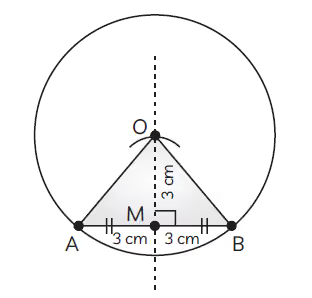
Construction steps:
1. Draw a circle with centre O and radius 3√2 cm (≈ 4.24 cm).
2. Mark a point M inside the circle with OM = 3 cm.
3. Draw the line through M perpendicular to OM.
4. This line intersects the circle at points A and B. AB = 6 cm is the required chord.
Hint verification: Consider an isosceles triangle with vertex at O and base AB. The altitude from O has length 3 cm and the base = 6 cm. The triangle's circumcircle has radius r = √(3² + 3²) = 3√2 cm, matching.
Q14. Show that rectangle is the only parallelogram that can be inscribed in a circle.
Solution:
Let ABCD be a parallelogram inscribed in a circle.
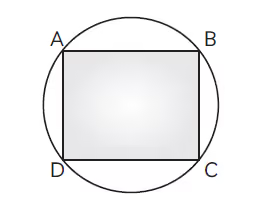
Since, ABCD is a cyclic quadrilateral.
∠A + ∠C = 180° [Opposite angles of a cyclic quadrilateral] ...(i)
Since, ABCD is a parallelogram.
∠A = ∠C [Opposite angles of a parallelogram are equal] ...(ii)
From (i) and (ii),
2∠A = 180°
∠A = 90°
Similarly, ∠B = ∠D = 90°.
A parallelogram with all angles 90° is a rectangle.
Hence, only a rectangle among parallelograms can be inscribed in a circle.
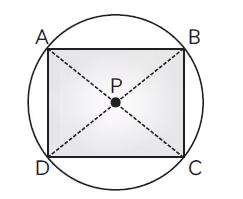
Q15. Show that if a rectangle is inscribed in a circle, then the point of intersection of its diagonals must lie at the centre of the circle.
Solution:
Let ABCD be a rectangle inscribed in a circle. Let the diagonals AC and BD intersect at P.
dtp: centre O ki place pr P likhe
In a rectangle, the diagonals are equal and bisect each other.
So, AP = PC, BP = PD, and AC = BD.
Also, each angle of the rectangle is 90°, so ∠ABC = 90°. By the converse of the corollary (angle in semicircle theorem), AC is a diameter. Similarly, BD is also a diameter.
Two diameters of a circle intersect at the centre of the circle. Therefore P (the point where AC and BD intersect) is the centre of the circle.
Q16. Consider all chords of a circle of a fixed length. What is the shape formed by the midpoints of all these chords?
Solution:
Let the radius of the circle be r.
Let each chord have fixed length x.
The perpendicular from the centre to a chord bisects the chord.
So, for every chord, half chord = x/2.
Let d be the distance of the midpoint of the chord from the centre.
Using Pythagoras theorem:
r² = d² + (x/2)²
So, d² = r² − (x/2)²
Since r and x are fixed, d is also fixed.
Therefore, every midpoint is at the same distance from the centre.
Hence, the midpoints form a circle with the same centre as the original circle.
Q17. In a circle with centre O, chords AB and AC are congruent. Explain why this statement is true: 'The centre of the circle lies on the angle bisector of ∠BAC.'
Solution:
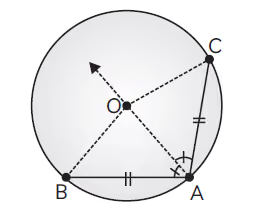
In triangles OAB and OAC:
OA = OA [Common]
OB = OC [Radii of circle]
AB = AC [Given]
By SSS congruence, ΔOAB ≅ ΔOAC.
Hence, corresponding angles are equal i.e., ∠OAB = ∠OAC.
This means the line AO bisects ∠BAC, i.e., the centre O lies on the angle bisector of ∠BAC.
Q18. Two parallel chords of lengths 10 cm and 24 cm are on the same side of the centre of a circle. The distance between the chords is 7 cm. Find the radius of the circle.
Solution:
Let r be the radius and let d₁ and d₂ be the perpendicular distances from the centre to the chords of length 10 cm and 24 cm respectively.
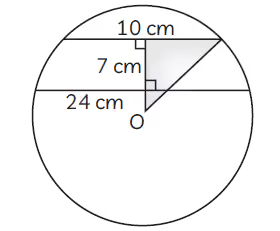
Half-chord for 10 cm chord = 5 cm; for 24 cm chord = 12 cm.
r² = d₁² + 25
⟹ d₁² = r² − 25 ...(i)
r² = d₂² + 144
⟹ d₂² = r² − 144 ...(ii)
Since, the longer chord (24 cm) is closer to the centre, d₂ < d₁.
Both chords are on the same side, so distance between them = d₁ − d₂ = 7.
So d₁ = d₂ + 7 ...(iii)
Substituting eq. (iii) in eq. (i),
(d₂ + 7)² = r² − 25
d₂² + 14d₂ + 49 = r² − 25
(r² − 144) + 14d₂ + 49 = r² − 25 [From eq. (ii)]
14d₂ − 95 = −25
14d₂ = 70
⟹ d₂ = 5
Then r² = 5² + 144 = 25 + 144 = 169, so r = 13 cm.
Radius of the circle = 13 cm.
Q19. A regular hexagon is inscribed in a circle of radius r. Find the length of the sides of the hexagon and the distance of each side from the centre of the circle.
Solution:
In a regular hexagon inscribed in a circle of radius r, the vertices divide the circle into 6 equal arcs, each subtending 360°/6 = 60° at the centre.
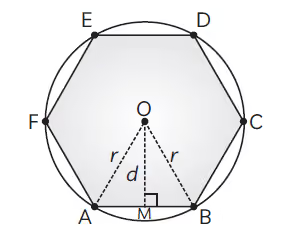
For each side, the triangle formed by the centre and the two endpoints of the side is isosceles (two sides equal to r) with vertex angle 60°. Hence the triangle is equilateral, and the side = r.
Length of each side of the hexagon = r.
Using Pythagoras:
d² = r² − (r/2)² = r² − r²/4 = 3r²/4
d = (√3/2)r
So, distance of each side from the centre is (√3/2)r.
Q20. A quadrilateral MNOP is inscribed in a circle. If MN is a diameter, what can you say about ∠MOP and ∠MNP? Explain your reasoning.
Solution:
Since MNOP is inscribed in a circle, it is a cyclic quadrilateral.
So, opposite angles of a cyclic quadrilateral are supplementary.
Therefore,
∠MOP + ∠MNP = 180°
Hence, ∠MOP and ∠MNP are supplementary angles.
Q21. Let ABCD be a cyclic quadrilateral. Explain why the exterior angle at any vertex is equal to the interior opposite angle (e.g., ∠CDE = ∠ABC, where E is a point on the extension of side CD).
Solution:
In cyclic quadrilateral ABCD:
∠ABC + ∠ADC = 180° ...(1)
Since E lies on the extension of CD,
∠ADC and ∠CDE form a linear pair.
So, ∠ADC + ∠CDE = 180° ...(2)
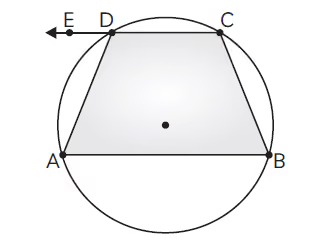
From (1) and (2), we have
∠ABC + ∠ADC = ∠ACB + ∠CDE
Subtracting ∠ADC from both sides, we get
∠ABC = ∠CDE
Therefore, the exterior angle of a cyclic quadrilateral is equal to the interior opposite angle.
Hence proved.
Q22. 'There is no chord of a circle that is longer than its diameter.' How do you justify this statement?
Solution:
Consider any chord AB of a circle with centre O and radius r. In triangle OAB, OA = OB = r. By the triangle inequality,
AB ≤ OA + OB = 2r.
The equality AB = 2r holds iff O lies on AB, i.e., AB passes through the centre O, which means AB is the diameter.
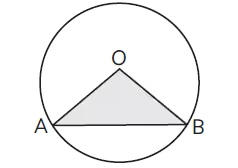
Hence no chord can be longer than the diameter (2r). The diameter is the longest chord.
Alternate argument: By Theorem 8, the chord nearest to the centre is the longest; the closest a chord can get to the centre is when it contains the centre (distance = 0), which is the diameter. Hence the diameter is the longest possible chord.
Q23. Let A be any point within a given circle with centre O. Show that the shortest chord of the circle that passes through point A is the one that is perpendicular to OA.
Solution:
Let r = OB be the radius. Consider any chord PQ passing through A, and let M be the foot of perpendicular from O to PQ. Let d = OM.
By Theorem 5, M is the midpoint of PQ, and PQ = 2√(r² − d²).
Now in right triangle OMA, OA² = OM² + MA² = d² + MA², so d² = OA² − MA² ≤ OA² (equality iff MA = 0, i.e., M = A).
Actually, we need the other direction. Let OA = a (fixed). Then OM² + MA² = a², so OM² = a² − MA² ≤ a², with equality iff MA = 0, i.e., the foot of perpendicular from O to PQ coincides with A. That happens precisely when OA ⊥ PQ.
Wait, we want to minimise PQ = 2√(r² − d²), which is minimised when d is maximised. From d² = a² − MA², d is maximum when MA = 0, i.e., d = a = OA.
This maximum is achieved when the foot of perpendicular from O to the chord PQ is A itself, i.e., OA ⊥ PQ.
Hence, the shortest chord through A is perpendicular to OA, and its length is 2√(r² − OA²).
Q24. How would you use the given figure to justify that the angle in a semicircle is 90°?
Solution:
In Fig. 5.30, AB is a diameter of the circle with centre O, and A (in the figure called the apex) is a point on the circle forming triangle A–left endpoint–right endpoint, with O the midpoint of the diameter.
In the figure, OA = OB = O(apex) = r, all equal to the radius. So the figure shows two isosceles triangles meeting at the apex.
Let the two base angles at the endpoints of the diameter be a and b. By the isosceles triangle property:
The angle at the apex on the left-side isosceles triangle = a (because that triangle has two equal sides = r).
The angle at the apex on the right-side isosceles triangle = b.
So the total angle at the apex = a + b.
But in the big triangle formed by the diameter and apex, the three angles sum to 180°:
a + b + (a + b) = 180° ⟹ 2(a + b) = 180° ⟹ a + b = 90°.
So the angle at the apex = a + b = 90°. This justifies that the angle in a semicircle is 90°.
Q25. In a circle, two chords CC' and DD' are drawn perpendicular to a diameter AB. Prove that the segment MM' joining the midpoints of the chords CD and C'D' is perpendicular to AB.
Solution:
Let AB be a diameter of the circle with centre O. Since CC' ⊥ AB, the diameter AB is perpendicular to chord CC'; hence by Theorem 5, AB passes through the midpoint of CC'. Similarly, AB passes through the midpoint of DD'.
Now, reflecting across the line AB (a line of symmetry of the circle), C ↔ C' and D ↔ D'. So, the chord CD maps to the chord C'D' under reflection in AB.
The midpoint M of CD maps to the midpoint M' of C'D' under this reflection. A point and its reflection across a line are joined by a segment perpendicular to that line (the line is the perpendicular bisector of the segment joining them).
Therefore, MM' ⊥ AB.
Q26. How would you use given figure to justify the statement that the sum of the opposite angles of a cyclic quadrilateral is 180°?
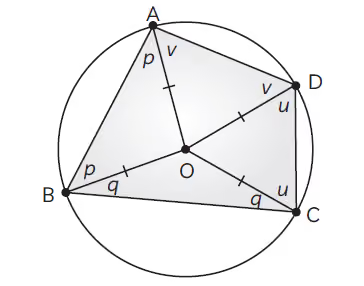
Solution:
Let ABCD be a cyclic quadrilateral with centre O.
Join OA, OB, OC and OD.
Since OA, OB, OC and OD are radii of the same circle,
OA = OB = OC = OD
So, the triangles formed with the centre are isosceles triangles.
From the figure:
Let ∠AOB = p and ∠BOC = q.
Let ∠COD = v and ∠DOA = u.
Using the angle-sum property in the triangles around the centre, the full angle around O is:
360°
The angle at the centre corresponding to the arcs gives twice the angle at the circumference.
Thus, ∠A = x + ∠B = 2? [The text in the image is unclear here.]
Similarly, ∠B + ∠D = 180°
Therefore, the sum of opposite angles of a cyclic quadrilateral is 180°.
Hence proved.
Key Learning of Chapter 5: I’m Up and Down, and Round and Round
1. Circle and Its Basic Element
A circle consists of a set of points in a plane that are at the same distance from a fixed point called the centre. The distance from the centre of the circle to any point on the circle is its radius. A line segment that connects two points on the circle is a chord; a chord that goes through the centre is a diameter.
2. Symmetry of a Circle.
A circle is a shape that has full rotational symmetry. It is also bisected by all its diameters, so that it is symmetrical with respect to each diameter. Chords and points in a circle are equidistant from the centre and share similar geometric relationships, which underlie its symmetry.
3. Circumcircle and Circumcentre
The circumcircle of a triangle is the circle that passes through the three vertices of the triangle, and its centre is called the circumcentre.
The position of the circumcentre depends on the type of triangle:
- For an acute-angled triangle, it lies inside the triangle.
- For a right-angled triangle, it lies at the midpoint of the hypotenuse.
- For an obtuse-angled triangle, it lies outside the triangle.
4. Equal Chords and their Angles
Equal chords of the same circle subtend equal angles at the centre. The converse is also true: chords corresponding to equal angles at the centre are equal.
This is often applied in proof-based questions involving chord and central angle.
5. Perpendicular from the Centre to a Chord
The perpendicular drawn from the centre of a circle to a chord bisects the chord. Likewise, the perpendicular bisector of a chord goes through the centre of the circle.
This is especially helpful when working on problems that involve the length of a chord or the distance of a chord from the centre.
6. Angles Subtended by an Arc
The angle subtended by an arc at the centre is twice the angle subtended by the same arc at any point on the circle.
One of the special cases is an angle in a semi-circle, which is always 90°.
7. Cyclic Quadrilaterals
A quadrilateral with its vertices all on a circle is called a cyclic quadrilateral.
One of the most critical properties is:
- Opposite angles of a cyclic quadrilateral are supplementary
- Therefore, the sum of each pair of opposite angles is 180°.
Key Results and Formulas: Class 9 Maths Chapter 5
Students are advised to keep in mind the following results obtained in Class 9 Maths Ganita Manjari Chapter 5 I’m Up and Down, and Round and Round:
1. Diameter and radius
Diameter = 2 × Radius
2. Radius and diameter
Radius = Diameter ÷ 2
3. The length of a chord using radius and distance
When the radius of the circle is r, and the perpendicular distance from the centre of the circle to the chord is d:
Chord length = 2√(r² − d²)
4. Angle at the centre, angle at the circle
Angle at a point on the circle = ½ Angle at the centre
5. Angle in a semicircle
The sum of the angle measures in a semicircle is 90°.
6. Cyclic quadrilateral
Opposite angles = 180°
7. Equal chords
Chords of the same circle are equally spaced from the centre.
8. Longer chord
The longer chord is nearer to the centre of a circle.
9. At right angles from centre to chord
The perpendicular from the centre to a chord bisects the chord.
10. Circumcentre
The point in a triangle where the perpendicular bisectors of the sides intersect is called the circumcentre.
Things to Remember When Solving Chapter 4 Questions
- First draw the figure: When the centre, chord and radius are clearly marked on this figure, the questions become a lot easier.
- Find the theorem: Before calculating anything, first consider whether the equation involves equal chords, perpendiculars, arcs or cyclic quadrilaterals.
- Remember the 90° result: An angle at any point on the circle subtended by a diameter is always 90°.
- Draw half the chord: A perpendicular from the centre to the chord bisects the chord. It is important in numerical questions.
- Carefully use Pythagoras: Radius, half the chord, perpendicular distance form a right triangle.
- Investigate the position of the circumcentre: It depends on whether the triangle is acute, right or obtuse.
- Write reasons in proofs: Do not just write the result. State the theorem, congruence criterion or property applied at each step.
- Find supplementary angles: If the four points are coplanar, determine if the quadrilateral is cyclic and whether opposite angles add upto 180°.
Frequently Asked Questions
Q1. What is Class 9 Maths Chapter 5 about?
Ans. The new Class 9 Maths Ganita Manjari Chapter 5 “I’m Up and Down, and Round and Round” explains the concept of a circle to students, along with chords, circumcircles, arcs, angles and cyclic quadrilaterals.
Q2.Which are the important theorems in Class 9 Maths Chapter 5?
Ans. Properties of equal chords, perpendicular from the centre to a chord, distance of a chord from the centre, angles subtended by arcs, angle in a semi-circle, and properties of cyclic quadrilaterals are some important concepts.
Q3.What is the length of a chord in Class 9 Maths?
Ans. For a radius of r and the perpendicular distance of the chord from the centre d, the length of the chord is 2√(r² − d²). This is due to the application of the Baudhāyana–Pythagoras theorem to the right triangle formed by the radius, half the chord and the perpendicular distance.
Q4. What is the Angle in a Semicircle?
Ans. Angle at any point on the circumference of a circle is 90° at the centre of the circle passing through that point. This is called the angle in a semicircle property.














.svg)

