.svg)

Chapter 11 of Class 9 Mathematics Syllabus, "Surface Areas and Volumes," is a key topic for understanding the properties of 3D shapes. This chapter introduces formulas to calculate the surface areas and volumes of shapes like cubes, cuboids, spheres, cylinders, cones, and hemispheres. These concepts are essential for solving real-world problems such as determining the capacity of containers or the cost of materials required for construction.
Chapter 11 of Class 9 Surface Area And Volume is very important as many questions are framed in final examinations. In this chapter, you will learn how to calculate the lateral surface area, curved surface area, and total surface area of various shapes. The PDFs will also cover Important Questions of Surface Area and Volume Class 9 for extra help.
PREMIUM EDUCART QUESTIONS
(Important Questions of this Chapter from our book)
We have added the links to Important Questions PDFs for Surface Area and Volume Class 9 most Important Questions in the table given below. You can download them without having to share any login info.
Chapter 11 Surface Areas and Volumes Important Questions
1. The side length of the square is 20 cm. What is the total surface area of the square?
Sol.
Total surface area of the square= 6a2
Total surface area of the square= 6(20)2
Total surface area of the square= 6(400)
Total surface area of the square= 2400 cm2
Raghav bought this planter.
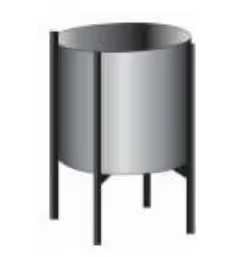
The radius of the rim is 14 cm. The curved surface area of the planter is 1848 cm².
2. What is the height and volume of the planter?
Sol.
Curved surface area of a cylinder is: 2πrh
1848=2π(14)h
1848=28πh
Using π≈3.14
1848=28×3.14×h
1848=87.92h
h= 1848/87.92
≈21cm
The formula for the volume of a cylinder is: V=πr2h
V=3.14×(14)2×21
V=3.14×196×21
V≈12914.64cm3
A company manufactures wooden boxes. Below is a picture of an open wooden box
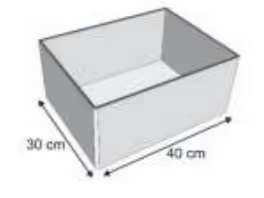
The height of the box is 25 cm
3. A shopkeeper stores cubes in it. The side length of one cube is 9 cm. What would be the maximum number of cubes the shopkeeper can store in a box? (All cubes should be inside the box.)
Sol.
Volume of box=Length×Breadth×Height
=40cm×30cm×25cm
=30,000cm3
Volume of cube=Side length3
Number of cubes= Volume of box /Volume of cube
= 30,000/729
= ≈41.14
Along length (40 cm):
Cubes along length=Length/Side Length
= 40/9
≈4.44
⟹4cubes (integer part)
Along breadth (30 cm):
Cubes along breadth=Breadth / Side Length
= 30/9
≈3.33
⟹3cubes (integer part)
Along height (25 cm):
Cubes along height=Height / Side Length
= 25/9
≈2.78
⟹2cubes (integer part)
Total cubes=Cubes along length×Cubes along breadth×Cubes along height
=4×3×2
=24
4. Rajan packs a football into a cubical cardboard box. The radius of the football is 11 cm. Rajan keeps a margin of 1 cm from all the sides of the box while packing.
What is the side length of the cardboard box?
a. 11 cm
b. 20 cm
c. 22 cm
d. 24 cm
Sol.
(d) 24 cm
Explanation
The radius of the football is 11 cm, and Rajan keeps a margin of 1 cm from all sides of the box.
The diameter of the football is:
Diameter=2×Radius
=2×11cm
=22cm
Rajan keeps a margin of 1 cm on each side of the box. This adds 1+1=2 cm to the diameter of the football.
Side length of the box=Diameter of football+2cm
=22cm+2cm
=24cm
The side length of the cardboard box is 24 cm.
Raju designs a hut for homeless people. The hut is a combination of a cuboid and a right cone. The top of the hut is a cone with a radius of 4 m and a height of 1 m. It is made of economical material. The floor of the tent is covered with rugs. The total height of the tent is 4.5 m. The cuboidal part of the tent is 6 m long and 5 m wide.
5. The length and width of a rug used for the floor are 2.6 m and 2 m respectively. What is the minimum number of rugs required to cover the floor of the tent house?
Sol.
Area of floor=Length×Width
=6m×5m
= 30cm2
The area of one rug is:
=Length×Width
=2.6m×2m
=5.2m2
The number of rugs required is: Area of floor/Area of one rug
Number of rugs= 30/5.2
≈5.77
Since rugs cannot be cut into pieces and the floor must be fully covered, round up to the nearest whole number:
Minimum number of rugs=6
Chapter 11 Surface Areas and Volumes Important Questions: Concepts
This chapter introduces the concept of measuring the surface area and volume of different three-dimensional shapes. It helps us understand how much space a shape occupies (volume) and the area covered by its surface (surface area). Here's a breakdown:
Key 3D Shapes Covered:
Cuboid and Cube:
Surface Area:
A cuboid has six rectangular faces, so its surface area is calculated as 2(lb+bh+hl), where l, b, and h are the length, breadth, and height.
For a cube, since all sides are equal, the surface area is 6a2, where a is the side of the cube.
Right Circular Cylinder:
Surface Area: The total surface area includes the curved surface and the circular bases. It is 2πr(h+r), where r is the radius and h is the height.
Volume: πr2h
Right Circular Cone:
Surface Area: The curved surface area is πrl, where l is the slant height. The total surface area is πr(l+r).
Volume: ⅓ πr2h
Sphere and Hemisphere:
Sphere:
Surface Area: 4πr2
Volume: 4/3πr3
Hemisphere:
Surface Area: 3πr2
Volume: ⅔ πr3
Chapter 11 Surface Areas and Volumes Important Formulas
Here’s a list of the essential formulas for Class 9 Mathematics Chapter 11:
Cuboid
Lateral Surface Area (LSA): 2h(l+b)
Total Surface Area (TSA): 2(lb+bh+hl)
Volume: l×b×h
Cube
Lateral Surface Area (LSA): 4a2
Total Surface Area (TSA): 6a2
Volume: a3
Right Circular Cylinder
Curved Surface Area (CSA): 2πrh
Total Surface Area (TSA): 2πr(h+r)
Volume: πr2h
Right Circular Cone
Curved Surface Area (CSA): πrl
Total Surface Area (TSA): πr(l+r)
Volume: 1/3πr2h
Sphere
Surface Area: 4πr2
Volume: 4/3πr3
Hemisphere
Curved Surface Area (CSA): 2πr2
Total Surface Area (TSA): 3πr2
Volume: ⅔ πr3
Hollow Cylinder
Curved Surface Area (CSA): 2πh(R+r)
Total Surface Area (TSA): 2π[(R2−r2)+h(R+r)]
Volume: πh(R2−r2)
Chapter 11 Surface Areas and Volumes Important Questions: Why
Studying and practising important questions from Chapter 11, "Surface Areas and Volumes," is crucial because this chapter combines theoretical concepts with practical applications, making it both a scoring and an essential topic. Here's why these questions matter:
1. Builds Conceptual Clarity
- The chapter helps you understand how to measure the space a shape occupies (volume) and the area its surface covers.
- Practising important questions reinforces the correct application of formulas for different 3D shapes like cubes, cylinders, spheres, cones, and combinations of shapes.
2. Real-Life Relevance
The concepts of surface area and volume have everyday applications:
- Calculating the capacity of water tanks, bottles, or storage boxes.
- Estimating the material required to make an object or paint its surface.
- Designing structures and objects in fields like engineering, architecture, and manufacturing.
3. Exam Focus
- Surface areas and volumes are commonly tested in board exams, making this chapter a scoring section.
- Important questions provide a focused way to prepare for exams, covering both basic and advanced problem-solving skills.
4. Strengthens Problem-Solving Skills
Questions often involve:
- Straightforward formula application (e.g., finding the volume of a sphere).
- Multi-step problems (e.g., combined shapes or melting and recasting problems).
Solving these helps improve analytical and mathematical reasoning.
5. Preparation for Higher Studies
Understanding these concepts is foundational for advanced mathematics and subjects like physics, chemistry, and engineering in higher classes.
We hope that you practice the above Surface Area and Volume Class 9 Important Questions and achieve your dream marks.
All the Best!












.svg)

