Class 9 Science Chapter 11 Reproduction: How Life Continues explores important biological concepts, definitions, and diagrams which require strong conceptual clarity. Students use CBSE notes to study the NCERT chapter, revise important topics, practise diagrams, and prepare for school examinations.
Chapter 11 in Class 9 Science teaches students about reproduction in living organisms, reproductive systems, fertilisation, and asexual and sexual reproduction. These Class 9 Science Ch 11 Notes will help students build a strong grasp of the chapter and revise for last-minute exam preparation.
Download Reproduction: How Life Continues Class 9 Notes PDF for 2026-27
Download Class 9 Science Ch 11 Notes PDF to revise important definitions, biological processes, diagrams and exam-oriented topics. These notes PDFs are organised in a clear, structured format and aligned with the latest CBSE Class 9 Science syllabus to help students understand concepts easily.

CBSE Class 9 Science Ch 11 Notes at a Glance
Chapter 11 - Reproduction: How Life Continues is an important chapter in Class 9 Science that introduces students to how living organisms produce offspring and continue their generations. It includes different methods of reproduction in flowering plants, animals, and humans. Learning these concepts is essential for school exams and helps students build a foundation for studying biology in future classes.
11.1 Asexual Reproduction
Asexual reproduction is a process in which a single parent produces new individuals without the fusion of reproductive cells. The offspring are genetically identical to the parent and are called clones. This process is generally based on mitosis.
There are three main methods of asexual reproduction:
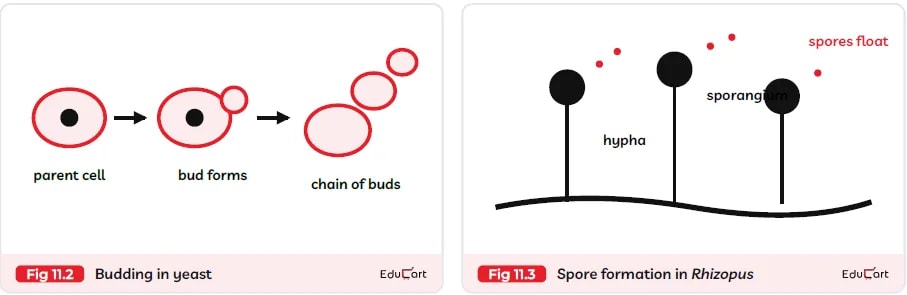
Budding in Yeast: A small bud develops on the parent yeast cell. It grows gradually and eventually separates to form a new cell. Sometimes, buds remain attached and form chains.
Spore Formation in Rhizopus: Rhizopus, commonly known as bread mould, produces spores inside a sac-like structure called a sporangium. When the sporangium breaks open, spores spread through the air. Under favourable conditions, they germinate and develop into new organisms.
11.1.1 How is vegetative propagation in plants helpful in agriculture?
Vegetative propagation is a type of asexual reproduction in which new plants grow from vegetative parts such as roots, stems and leaves. It can occur naturally or through artificial methods used in agriculture.
Natural Vegetative Propagation: Some plants naturally produce new individuals from their vegetative parts.
Artificial Methods of Vegetative Propagation: Farmers use different methods to grow plants with desirable characteristics.
11.2 Sexual Reproduction
Sexual reproduction involves the contribution of genetic material from two parents. Male and female reproductive cells, called gametes, fuse during fertilisation to form a zygote.
The offspring inherit characteristics from both parents. Therefore, they are similar to their parents but are not genetically identical. Sexual reproduction also creates variations among individuals of the same species.
It occurs in flowering plants, animals and human beings.
11.2.1 How does meiosis help create variations in sexual reproduction?
Meiosis is a special type of cell division that produces gametes with half the number of chromosomes found in normal body cells.
In humans:
- Body cells contain 46 chromosomes arranged in 23 pairs.
- Sperm and egg cells contain 23 chromosomes each.
- During fertilisation, the male and female gametes combine to restore the chromosome number to 46.
During meiosis, each gamete receives one chromosome from each pair. The combination of chromosomes is random, so different gametes carry different sets of genetic information.
How Does Meiosis Create Variations?
The number of possible chromosome combinations can be calculated using:
Possible combinations = 2ⁿ
Here, n represents the number of chromosome pairs.
For example:
This explains why siblings can have different combinations of inherited characteristics, even though they share the same parents.
11.2.2 Sexual reproduction in flowering plants
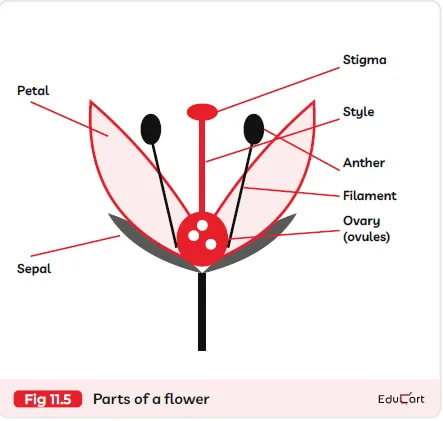
Flowers are the reproductive structures of flowering plants. They contain male and female reproductive parts that help in pollination, fertilisation and seed formation.
Main Parts of a Flower
The stamen has two parts:
- Anther: Produces pollen grains containing male reproductive cells.
- Filament: Supports the anther.
The pistil has three main parts:
- Stigma: Sticky surface that receives pollen grains.
- Style: Connects the stigma to the ovary.
- Ovary: Contains ovules, which hold the egg cell.
11.2.3 How does the process of pollination occur in flowers?
1. Self-Pollination
Self-pollination occurs when pollen grains reach the stigma of the same flower or another flower on the same plant. It generally produces less genetic variation.
2. Cross-Pollination
Cross-pollination occurs when pollen grains are transferred from a flower on one plant to a flower on another plant of the same kind. It requires agents such as wind, water, insects or birds and generally produces greater genetic variation.
11.2.4 Pollination strategies and reproductive success
Plants use different methods to transfer pollen grains from one flower to another. Wind, water, insects and birds are common agents of pollination. Flowers have different characteristics that help them attract or use these pollinating agents.
Wind-pollinated plants produce large quantities of pollen because much of it gets scattered and does not reach a suitable flower. In insect-pollinated plants, insects carry pollen more directly between flowers.
11.2.5 Fertilisation, seeds and fruits
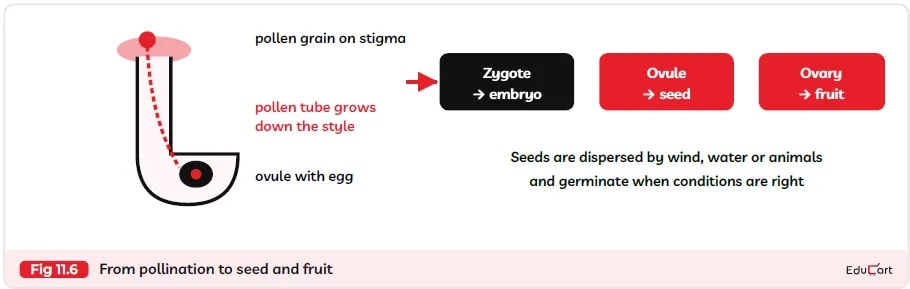
After pollination, fertilisation takes place inside the flower. The pollen grain on the stigma develops a pollen tube that grows through the style towards the ovule.
The male gamete travels through this tube and fuses with the egg cell inside the ovule. This process is called fertilisation.
Main Steps of Fertilisation in Flowering Plants
- A pollen grain reaches the stigma.
- A pollen tube grows through the style towards the ovule.
- The male gamete travels through the pollen tube and reaches the egg cell.
- The male gamete fuses with the egg to form a zygote.
- The zygote develops into an embryo.
11.3 Sexual Reproduction in Animals
Sexual reproduction in animals involves the fusion of male and female gametes. Depending on where fertilisation takes place, it is classified into two types.
1. External Fertilisation
External fertilisation occurs outside the female's body, usually in water. Animals such as frogs and most fish release their gametes into the surrounding water, where fertilisation takes place.
These animals generally release a large number of eggs because many eggs and young ones may not survive.
2. Internal Fertilisation
Internal fertilisation takes place inside the female's body. The male gamete fuses with the female gamete within the reproductive system.
It occurs in reptiles, birds and mammals. Generally, fewer eggs are produced, and the developing embryo receives better protection.
11.4 Variations in Reproduction in Animals
Animals show different reproductive patterns depending on how their young ones develop and receive nourishment.
1. Role of Egg Yolk
In egg-laying animals, the developing embryo receives nourishment from the yolk present in the egg. It provides the nutrients needed for growth before hatching.
2. Larval Stages and Metamorphosis
Some animals pass through a larval stage before becoming adults. A larva is an early stage of development that may look different from the adult animal.
The process through which a larva changes into an adult is called metamorphosis.
For example, a butterfly passes through four stages:
Egg → Caterpillar → Pupa → Adult
3. Parental Care
Some animals become independent soon after birth or hatching, while others depend on their parents for food and protection. Mammals, for example, feed their young ones with milk.
11.5 Reproduction in Human Beings
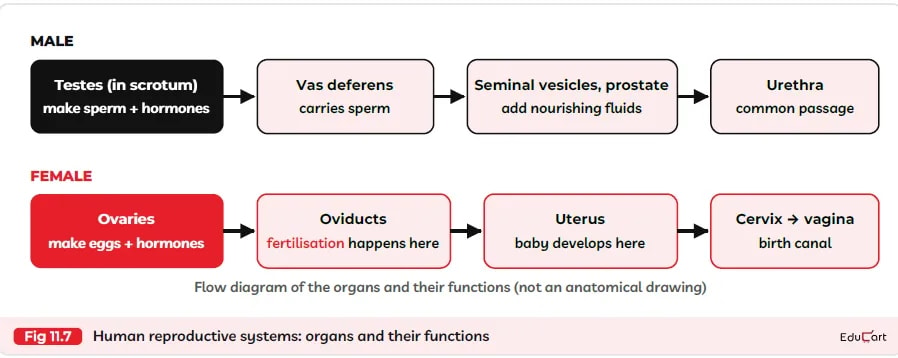
Human beings reproduce through sexual reproduction. The male reproductive system produces sperm, while the female reproductive system produces eggs.
At puberty, the reproductive organs mature and begin producing gametes and hormones. This stage is called reproductive maturity.
11.5.5 What happens when a sperm meets an egg?
When a sperm reaches and fuses with an egg, fertilisation takes place. In humans, this usually occurs in the oviduct.
The process involves the following stages:
- Ovulation: An ovary usually releases one mature egg during the menstrual cycle.
- Fertilisation: A sperm fuses with the egg in the oviduct to form a zygote.
- Cell Division: The zygote divides repeatedly through mitosis as it moves towards the uterus.
- Implantation: The developing embryo attaches to the thickened lining of the uterus.
- Pregnancy: The embryo continues to develop inside the uterus.
11.5.6 What happens when an egg is not fertilised?
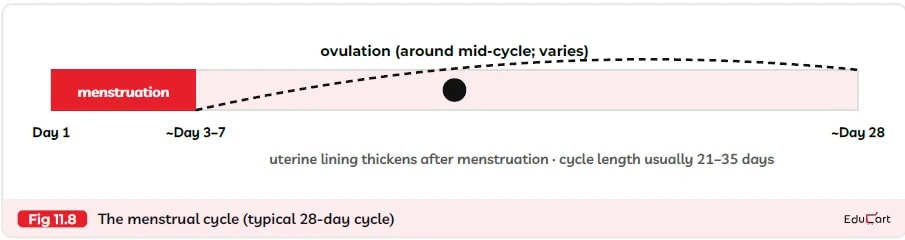
If the released egg is not fertilised, it breaks down. The thickened lining of the uterus is also shed along with blood and tissue through the vagina. This process is called menstruation.
The menstrual cycle involves regular changes in the ovaries and uterus.
Important Facts About Menstruation
- The menstrual cycle usually lasts 21–35 days, with around 28 days being a common average.
- Menstrual bleeding generally lasts 3–7 days.
- Menstruation begins during puberty and stops at menopause, usually around the age of 50.
- Menstruation stops during pregnancy because the uterine lining is needed to support the developing embryo.
- Ovulation does not always occur on the 14th day; its timing can vary between individuals and cycles.
11.5.7 Pregnancy and Childbirth
Pregnancy begins when the developing embryo successfully implants in the thickened lining of the uterus. The uterus provides nourishment and protection as the baby develops.
Pregnancy lasts approximately nine months and is divided into three trimesters.
During early development, the developing individual is called an embryo. From around the ninth week, it is called a foetus.
11.5.8 Mother's health during pregnancy
A mother's health plays an important role in the growth and development of the baby. Proper care during pregnancy supports both maternal and foetal health.
Important aspects of maternal care include:
- Eating a balanced diet with essential nutrients.
- Attending regular medical check-ups.
- Following suitable physical activity and getting enough rest.
- Receiving emotional support from family and healthcare professionals.
- Avoiding harmful habits and substances.
11.5.9 What does it mean to be sexually mature?
Sexual maturity refers to the stage when the reproductive organs become functional and the body becomes biologically capable of reproduction.
However, physical maturity does not automatically mean that a person is emotionally or socially ready for parenthood. Reproduction also involves responsibility and informed decisions.
What Determines the Sex of a Baby?
In humans, the egg always carries an X chromosome, while sperm may carry either an X or a Y chromosome.
- XX generally results in a female child.
- XY generally results in a male child.
Therefore, the chromosome carried by the fertilising sperm determines the baby's chromosomal sex.
11.5.10 How can unwanted pregnancies and infections be prevented?
Reproductive health involves understanding safe practices, preventing unintended pregnancies and reducing the spread of sexually transmitted infections (STIs).
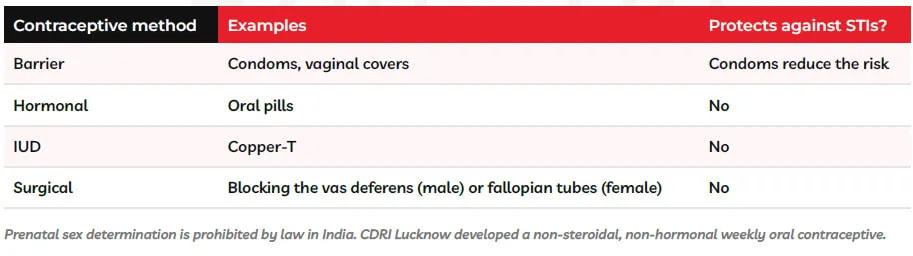
Methods of Contraception
Contraceptive methods help prevent pregnancy. Different methods work in different ways.
Sexually Transmitted Infections (STIs)
STIs are infections that can spread through sexual contact. Some common examples include:
- Gonorrhoea
- Syphilis
- Genital herpes
- Genital warts
- HIV infection
Using condoms correctly and consistently reduces the risk of many STIs. Timely medical testing and treatment are also important for reproductive health.
Important Terms and Their Meanings
Students should understand these important terms to follow the different processes discussed in Reproduction How Life Continues Class 9 Science Notes PDF.
Key Points to Remember from Class 9 Science Chapter 11
Here are some facts and concepts to revise before exams on Reproduction: How Life Continues Class 9 Science Notes.
- Types of Reproduction: Asexual reproduction involves one parent and usually produces genetically identical offspring. Sexual reproduction requires formation and fusion of gametes and introduces genetic variation.
- Vegetative Propagation: New plants can grow from roots, stems or leaves. A few commonly used methods are cutting, layering, grafting and tissue culture.
- Meiosis and Variation: During gamete formation, meiosis is the process of reducing chromosome number by half. In humans, there are 46 chromosomes in the body cells and 23 in sperm and egg cells.
- Flower Reproduction: The male reproductive part of the flower is called stamen and the female part of the flower is called the pistil. Pollination transfers pollen from the anther to the stigma.
- Fertilisation in Plants: The ovule after fertilisation becomes a seed, the ovary becomes a fruit, and the zygote develops into an embryo.
- Reproduction in Animals: Fertilisation can occur outside the female body (external fertilisation) or inside the female animal body (internal fertilisation).
- Human Reproduction: Fertilisation usually occurs in the oviduct, while implantation takes place in the uterus. The gestation period of humans is about 9 months.
- Reproductive Health: Menstrual hygiene, maternal care, awareness of STIs and knowledge of contraceptive methods are important aspects of reproductive health.
Important Numbers and Facts
- Human body cells contain 46 chromosomes (23 pairs).
- Critical numbers and facts.
- Human body cells have 23 pairs of chromosomes (46 total).
- Sperm and egg cells of a human being have 23 chromosomes in each cell.
- Human gametes can have 23 chromosomes, and the number of possible combinations in gametes is (223).
- The normal menstrual cycle is usually 28 days, but can range from 21 to 35 days.
- Menstrual bleeding usually lasts around 3–7 days.
- The gestation period of the human being is about 9 months.
Important Diagrams to Practise
- Budding in yeast and spore formation in Rhizopus.
- Artificial methods of vegetative propagation.
- Parts of a flower.
- Flowering plants: pollination and fertilisation.
- External and internal fertilisation.
- Male human reproductive system.
- Female reproductive system.
- Menstrual cycle and phases of pregnancy.
More Study Resources for Reproduction: How Life Continues Class 9 Notes
Alongside Chapter 11, Reproduction: How Life Continues notes, students should solve NCERT exercises and frequently asked questions to improve their understanding. Refer to the following resources for revision and practice:
Explore Recommended Books For CBSE Class 9 Science
Browse these recommended CBSE Class 9 Science books to strengthen conceptual understanding, practise important questions, and prepare effectively for school exams.
Frequently Asked Questions
Q1. What topics are covered in Reproduction: How Life Continues Class 9 Science Chapter 11 Notes?
CBSE Class 9 Science Ch 11 notes explain the following topics: asexual and sexual reproduction, vegetative propagation, reproduction in plants and animals, human reproduction, reproductive health, etc.
Q2. How many types of reproduction are in Class 9 Science?
In Class 9 Science, there are two types of reproduction: asexual and sexual reproduction. Asexual reproduction involves one parent while sexual reproduction involves the fusion of male and female gametes.
Q3. What are four methods of vegetative propagation in Class 9 Science Ch 11?
Vegetative propagation is a type of asexual propagation in which new plants grow from roots, stems or leaves of an existing parent plant.
Q4. Where does fertilisation take place in human beings?
In humans, fertilisation usually occurs in the oviduct, where the sperm and egg fuse to form a zygote during reproduction.
Q5. What are the important diagrams in Class 9 Science Chapter 11 for final exams?
Important diagrams include parts of a flower, pollination, vegetative propagation, budding in yeast, spore formation, and male and female reproductive systems.