Class 9 Science Chapter 3 Tissues in Action explains how cells are organised into different types of tissues in plants and animals, along with their structures and functions. These Tissues in Action Class 9 Notes cover the complete NCERT chapter, including plant tissues, animal tissues, the musculoskeletal system and joints.
Students can download the Class 9 Science Ch 3 notes PDF to understand the chapter, revise important concepts, learn key differences, and prepare for their school exams. This is one of the helpful resources Class 9 students should include in their study plan.
Download CBSE Notes for Class 9 Science Chapter 3 Tissues in Action
Download the Class 9 Science Ch 3 Notes in PDF format to revise important definitions, key differences, and essential diagrams. These chapter-wise notes can help students with quick revision, homework and self-study.

Class 9 Science Chapter 3 Notes at a Glance
Chapter 3, Tissues in Action, from the NCERT Class 9 Science textbook Exploration (pages 28-47) teaches students how plants and animals perform specific functions. It includes plant growth, permanent tissues, animal tissues, body movement, different types of joints, and the skeletal system.
Explore a comprehensive list of topics and subtopics covered in the chapter to get an overview of what you will study in Class 9 Science Ch 3 Notes PDF.
3.1 Why are Plant and Animal Tissues Different
Plant and animal tissues differ because plants and animals have different needs. Plants remain fixed in one place and prepare their own food, while animals move around and depend on other organisms for food.
3.2 Tissues for Growth in Plants
Plant growth takes place through specialised tissues called meristematic tissues. Their cells divide continuously to produce new cells, helping plants increase in length and thickness and regrow after being cut or damaged.
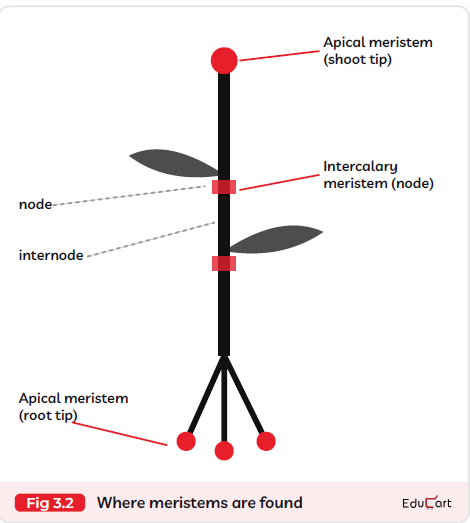
Plants have three main types of meristematic tissues based on their location and function.
3.2.1 Apical meristem - How do plants grow in length?
Apical meristem is found at the growing tips of roots and shoots. Its cells divide actively and produce new cells, which help the plant increase in length. This process is responsible for the growth of roots deeper into the soil and shoots towards sunlight.
3.2.2 Lateral meristem - How do plants grow in girth?
Lateral meristem is present along the sides of stems and roots, particularly in dicot plants. It helps increase the thickness or diameter of a plant as it grows.
One important function of lateral meristem is the formation of annual growth rings in tree trunks. Each year, a new layer of wood develops, forming a visible ring. These rings can help estimate the age of a tree.
3.2.3 Intercalary meristem - How do plants grow after being cut?
Intercalary meristem is found near the nodes or at the base of internodes in plants. It helps certain plants grow again after their upper portions are cut or removed.
For example, grass can continue growing even after being mowed because intercalary meristem remains present near the base of its internodes.
3.2.4 Permanent tissues
Permanent tissues develop when meristematic cells become specialised to perform specific functions. This process is called differentiation. Permanent tissues are of two types:
- Simple permanent tissues: Made up of one type of cell. Examples include parenchyma, collenchyma and sclerenchyma.
- Complex permanent tissues: Made up of different types of cells working together. Examples include xylem and phloem.
(i) Protective Tissue: Epidermis
Epidermis is the outermost layer of a plant that protects it from damage and water loss. It has closely packed cells and may be covered by a waxy layer called the cuticle.
- Cuticle: Reduces water loss.
- Stomata: Allow gas exchange and transpiration.
- Root Hairs: Increase the surface area for water absorption.
- Cork: Protects older stems and reduces water and gas loss.
(ii) Supporting Tissue: Simple Permanent Tissues
Simple permanent tissues include parenchyma, collenchyma and sclerenchyma.
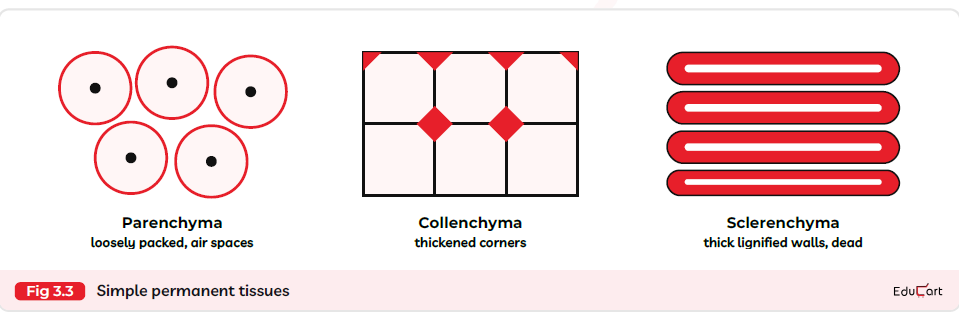
Parenchyma is commonly found in soft parts of plants, collenchyma in young stems and leaf stalks, and sclerenchyma in stems, leaf veins and coconut husks.
(iii) Conducting Tissue: Complex Permanent Tissues
Xylem and phloem transport essential substances throughout the plant.
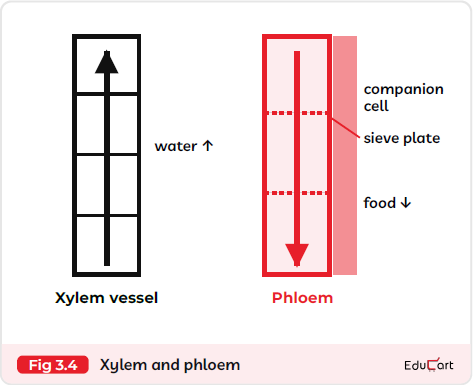
3.3 Animal Tissues
Animal tissues are specialised groups of cells that perform different functions. They are mainly classified into four types: epithelial, connective, muscular and nervous tissues.
3.3.1 Epithelial tissues - Structure and functions
Epithelial tissues cover the body and line internal organs. Their closely packed cells provide protection and help in absorption, secretion and exchange of substances.
3.3.2 Connective tissues
Connective tissues connect and support different body parts. Their cells are present in a surrounding material called the matrix.
3.3.3 Muscular tissues
Muscular tissues contract and relax to produce movement. They are classified into three types based on their structure, location and control.
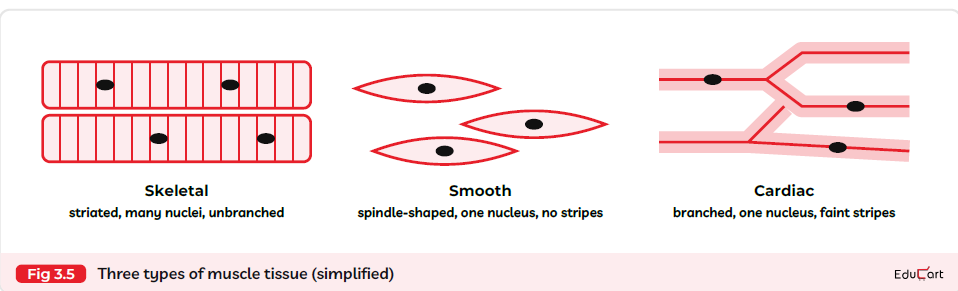
Skeletal muscles help in body movements, smooth muscles move substances through internal organs, and cardiac muscles maintain the rhythmic beating of the heart.
3.3.4 Nervous Tissue
Nervous tissue receives and transmits messages, helping the body respond to different situations. It is mainly found in the brain, spinal cord and nerves.
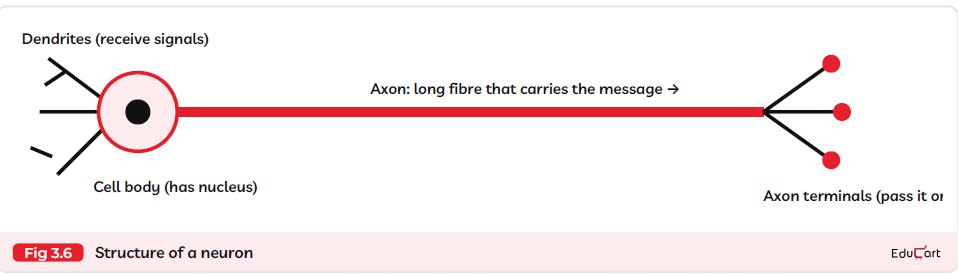
The basic unit of nervous tissue is called a neuron. It has the following parts and functions:
- Dendrites: Receive signals from other cells.
- Cell Body: Contains the nucleus and controls cell activities.
- Axon: Carries messages away from the cell body.
The brain acts as the body's control centre and helps coordinate activities, memory and responses.
3.4 The Musculoskeletal System
The musculoskeletal system consists of bones, muscles, joints, cartilage, tendons and ligaments. These parts work together to support the body, maintain posture and produce movement.
The musculoskeletal system moves through the combined action of muscles, bones and joints.
- When the nervous system sends signals to muscles, they contract and pull the bones through tendons. The bones then move around the joints, while ligaments help keep the joints stable.
- The skeleton accounts for approximately 12–15% of adult body weight. Muscles make up around 40–50% of body weight in adult males and 30–40% in adult females.
3.5 Types of Joints
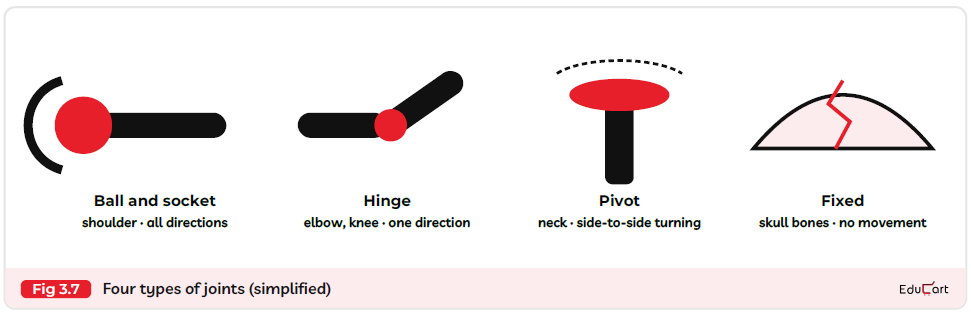
Joints are points where two or more bones meet. They connect bones and allow different types of body movements. Based on the movement they allow, joints are classified into four main types.
3.5.1 Ball and Socket joint
A ball and socket joint allows movement in different directions, including rotation. The rounded end of one bone fits into the socket of another bone.
Examples: Shoulder and hip joints.
3.5.2 Hinge joint
A hinge joint allows movement mainly in one direction, similar to a door hinge. It helps body parts bend and straighten.
Examples: Elbow and knee joints.
3.5.3 Pivot joint
A pivot joint allows one bone to rotate around another. It helps us turn our head from side to side.
Example: Joint between the skull and backbone in the neck.
3.5.4 Fixed joints
Fixed joints do not allow movement between the bones they connect. They provide stability and protection.
Example: Joints between the bones of the skull.
3.6 Skeletal System
The skeletal system forms the framework of the human body. It provides support, protects internal organs and works with muscles to produce movement.
The three important parts discussed in this chapter are:
1. Skull: The skull protects the brain. Its bones are joined by fixed joints, which keep them firmly connected.
2. Vertebral Column (Backbone): It consists of small bones called vertebrae. Cartilage discs between the vertebrae act as cushions and allow the backbone to bend and twist. It also protects the spinal cord.
3. Rib Cage: The rib cage consists of 12 pairs of ribs that protect the heart and lungs. Flexible cartilage allows it to expand and contract during breathing.
Role of Yoga in Physical Health
Yoga combines physical postures, breathing exercises and meditation. It helps improve flexibility and posture and supports overall physical well-being. Surya Namaskar consists of 12 poses that involve different muscles and joints.
Quick Overview of Important Terms and Their Meanings
While reading Class 9 Science Ch 3 notes, students should be familiar with the following scientific terms to understand the chapter and answer the questions based on definitions correctly.
Key Points to Remember in Class 9 Science Chapter 3 Notes
Below are some key concepts and facts from Chapter 3: Tissues in Action that students should revise before their exams.
- Levels of Organisation: Cells form tissues, tissues form organs, organs form organ systems, and organ systems function together to form an organism.
- Plant and Animal Tissues: Plant tissues support growth, protection and transportation, while animal tissues provide protection, connection, movement and coordination.
- Meristematic Tissues: Apical meristems increase the length of roots and shoots, lateral meristems increase plant thickness, and intercalary meristems help plants regrow.
- Permanent Tissues: Parenchyma, collenchyma and sclerenchyma are simple permanent tissues, while xylem and phloem are complex permanent tissues.
- Animal Tissues: The four main types of animal tissues are epithelium, connective tissue, muscle and nervous tissue. Each has a specific structure and function.
- Musculoskeletal System: Bones, muscles, joints, cartilage, tendons and ligaments work together to support the body, maintain posture and provide movement.
- Types of Joints: Ball and socket, hinge, pivot and fixed joints differ in the types of movements they allow.
- Bone and Muscle Health: Good posture, along with a balanced diet and regular exercise, promotes healthy bone and muscle development. Yoga and suitable exercises also support posture and physical agility.
Important Differences to Revise in Class 9 Science Chapter 3 Notes
Important Diagrams to Practise
- Types of meristematic tissues and their locations.
- Structure of a neuron.
- Types of epithelial tissues.
- Different types of muscular tissues.
- Human musculoskeletal system.
- Different types of joints.
- Main parts of the skeletal system.
Additional Study Resources for Class 9 Science Chapter 3
In addition to these Class 9 Science notes, students should solve different types of questions and use NCERT Solutions to enhance their understanding. Explore these extra resources for better exam preparation.
Explore Recommended Books For CBSE Class 9 Science
Use these extra study materials alongside Class 9 Science Chapter 3 Notes to understand important concepts, practise different question formats and prepare effectively for school examinations.
Frequently Asked Questions
Q1. What is the name of Chapter 3 in Class 9 Science?
Chapter 3 of the NCERT Class 9 Science book (Exploration) is titled Tissues in Action, which explains different types of tissues and how they function.
Q2. How many types of plant tissues are covered in Class 9 Science Ch 3 Notes?
Plant tissues are generally divided into two main types: meristematic tissues and permanent tissues, each having a specialised function.
Q3. What are the four principal types of animal tissues?
The four major tissue types are epithelial, connective, muscular, and nervous, and each has unique functions.
Q4. What are joints and their types in Chapter 3?
There are four major types: ball and socket, hinge, pivot and fixed joints, which allow different degrees of movement
Q5. What do you mean by totipotent in plants?
Totipotency is the ability of a single plant cell to develop into a complete plant under suitable conditions.