.svg)
When exams get closer, chapters like Mechanical Properties of Solids Class 11 can feel formula-heavy and confusing. Stress, strain, Young’s modulus - it all starts mixing up.
But don’t worry. This chapter is actually very logical once you understand the core idea, solids are not perfectly rigid. They stretch, compress and bend under force - even if the change is too small to see. Get complete chapter details in CBSE Syllabus Class 11 Physics.
From bridges and buildings to steel cables and springs, everything depends on elastic behaviour. In these Mechanical Properties of Solids Class 11 Notes, we’ll break down every concept in simple language so you can revise quickly and confidently before your exam.

Mechanical Properties of Solids Summarised
Solids are materials which have a definite shape and volume. Unlike liquids and gases, the molecules in solids are bound by strong intermolecular forces that keep them fixed at certain equilibrium positions.
Due to this, solids resist deformation when external forces are applied. However, under sufficient stress, solids can deform and even break. The study of how solids respond to external forces is called the mechanical properties of solids.
Elasticity
When a solid is deformed under the action of an external force, the configuration of its molecules changes. If the external force is removed, the body tries to regain its original shape and size.
This property of a body by virtue of which it resists deformation and returns to its original configuration is called elasticity.
If a body completely regains its original shape and size after the removal of deforming force, it is said to be perfectly elastic.
If it does not regain its original shape at all, it is called perfectly plastic. Most materials are neither perfectly elastic nor perfectly plastic but show behavior in between.
Stress and Strain
When a deforming force is applied on a body, internal restoring forces develop inside the body which resist the deformation. The internal restoring force per unit area is known as stress.
Stress = Restoring force (F) / Area (A)
The SI unit of stress is N/m² or Pascal (Pa). Although stress is defined as force per unit area, it depends on the direction of the applied force and the orientation of the surface. Therefore, stress is not a simple scalar quantity.
Depending on the manner of deformation, stress is classified into three types:
- Longitudinal stress → Produced when a force is applied parallel or normal to the cross-sectional area of the body, causing a change in length.
- Tangential or Shearing stress → Produced when a force is applied parallel to the surface, tending to deform the shape of the body.
- Hydraulic or Bulk stress → Produced when a body is subjected to equal force from all directions, leading to a change in volume.
Strain is defined as the ratio of change in dimension (length, volume, or shape) to the original dimension. It is a dimensionless quantity, as it is the ratio of two similar quantities.
- Longitudinal strain = Change in length / Original length.
- Shearing strain = Angle through which the body gets distorted (measured in radians).
- Volumetric strain = Change in volume / Original volume.
Hooke’s Law
Hooke’s law states that within the elastic limit, stress is directly proportional to strain.
Stress ∝ Strain
Stress = E × Strain
Here, E is the constant of proportionality known as the modulus of elasticity.
When the strain exceeds a certain limit, called the elastic limit, Hooke’s law is no longer valid and permanent deformation may occur.
Elastic Moduli
Elastic modulus is the ratio of stress to the corresponding strain. It measures the stiffness of a solid material. There are three types:
- Young’s Modulus (Y)
It is defined as the ratio of longitudinal stress to longitudinal strain.
Y = Longitudinal stress / Longitudinal strain
Y = (F / A) / (ΔL / L)
Here, F = force applied, A = area of cross-section, ΔL = change in length, and L = original length.
Young’s modulus describes the ability of a material to resist change in length under tensile or compressive forces.
- Shear Modulus (η or G)
It is the ratio of shearing stress to shearing strain.
G = Shearing stress / Shearing strain
G = (F/A) / θ}
where θ is the angular deformation in radians. It measures the material’s ability to resist shape change under tangential forces.
- Bulk Modulus (K)
It is the ratio of hydraulic stress to the corresponding volumetric strain.
K = Hydraulic stress / Volumetric strain
K = −ΔP / (ΔV/V)
Here, ΔP is the change in pressure, ΔV is the change in volume, and V is the original volume. The negative sign shows that with an increase in pressure, the volume decreases.
Compressibility
It is defined as the reciprocal of bulk modulus.
Compressibility=1 / K
Compressibility represents how easily a substance can be compressed under pressure.
Poisson’s Ratio
When a body is stretched, its length increases and its cross-sectional dimensions decrease. The ratio of lateral strain to longitudinal strain is called Poisson’s ratio (σ).
σ = Lateral strain / Longitudinal strain
For most materials, Poisson’s ratio lies between 0 and 0.5.
Elastic Potential Energy in a Wire
When a wire is stretched within the elastic limit, work is done against the restoring forces. This work is stored in the wire as elastic potential energy.
The elastic potential energy stored per unit volume is:
U = ½ × Stress × Strain
This is known as the energy density.
Stress-Strain Curve
The behavior of a material under increasing stress can be represented graphically. The curve obtained by plotting stress against strain is called the stress-strain curve.
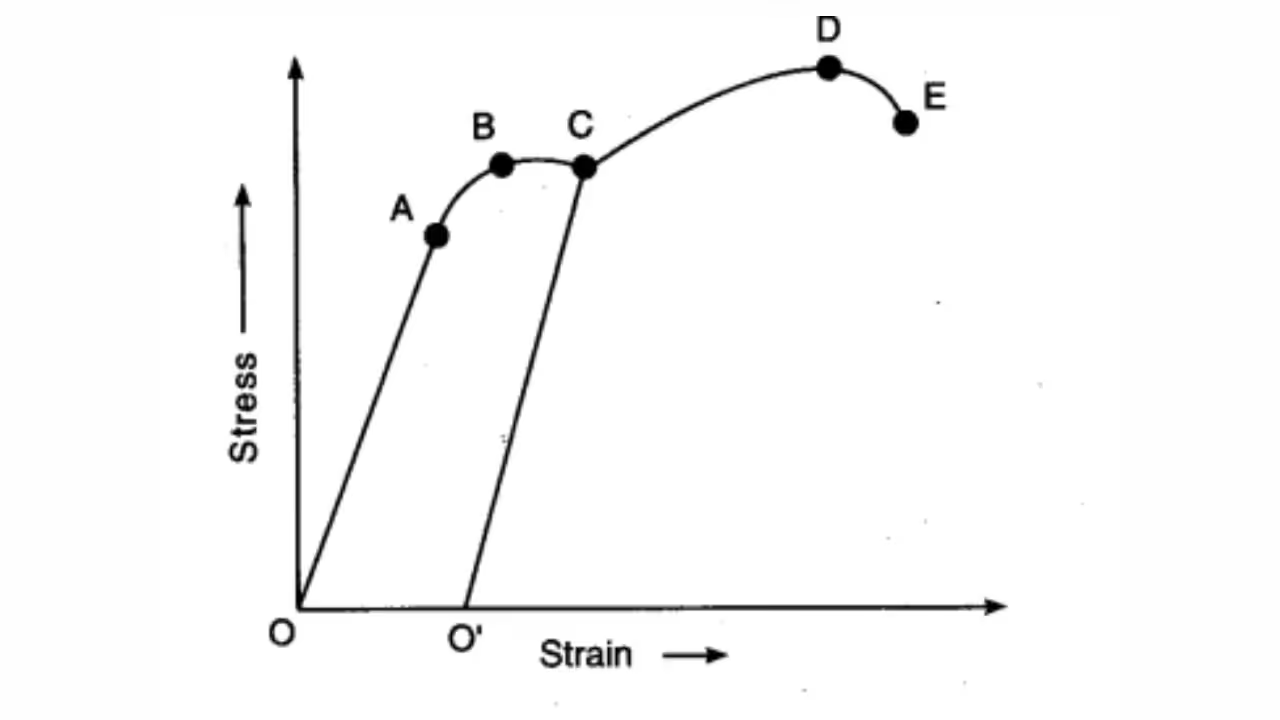
The main points on this curve are:
- O to A → Linear region. Hooke’s Law is obeyed
- A to B → Elastic region. The body still regains original shape after removing load
- Point B → Yield point. Beyond this, permanent deformation begins
- Between B and D → Plastic region. A small increase in stress causes large strain
- Point D → Ultimate tensile strength. Maximum stress material can bear
- Point E → Breaking point. Material fractures
- If D and E are close → material is brittle
- If far apart → material is ductile
Ductile materials (like steel) show a long yield region, while brittle materials (like glass) break soon after elastic limit.
Elastomers
Some materials like rubber and biological tissues do not strictly obey Hooke’s law. They can undergo large strains and still return to their original shape. Such materials are called elastomers. Their stress-strain curve is non-linear, and they do not have a clear plastic region.
Applications of Elastic Behavior of Materials
- Design of bridges and buildings requires knowledge of elastic moduli so that structures can withstand stress.
- Safety of machinery, aircraft, and vehicles depends on choosing materials with appropriate elastic properties.
- Springs, wires, and elastic materials in daily use are based on principles of elasticity.
Bending of Beams
When a beam is supported at both ends and loaded at the centre, it bends.The sagging (δ) is given by:
δ = Wl³ / (4bd³Y)
Where:
W = load
l = length
b = breadth
d = depth
Y = Young’s modulus
Increasing depth is more effective than increasing breadth to reduce bending.
Buckling
If a beam is too thin and long, it may bend sideways under load. This phenomenon is called buckling. To prevent this, I-shaped cross-sections are used in bridges and buildings.
Limitations of Hooke’s Law
- It is valid only within the elastic limit.
- Beyond the elastic limit, deformation is not proportional to stress.
- Real materials may show hysteresis, creep, and plastic behavior which are not explained by Hooke’s law.
Conclusion
That’s a wrap on Mechanical Properties of Solids Class 11. Now stress, strain and elastic moduli shouldn’t feel scary anymore. These concepts may look formula-heavy, but they are actually the backbone of real-world engineering. Revise the formulas once more, understand the stress-strain curve clearly, and you’re exam-ready. If this helps, save it for quick revision before your test.
FAQs
Q1. What is the difference between elastic and plastic behavior?
Ans. Elastic behavior means a body regains its original shape and size after removal of the deforming force, while plastic behavior means it undergoes permanent deformation.
Q2. What is Young’s modulus?
Ans. Young’s modulus is the ratio of longitudinal stress to longitudinal strain. It measures the stiffness of a material.
Q3. What are bulk modulus and shear modulus?
Ans. Bulk modulus is the ratio of volume stress to volume strain, while shear modulus is the ratio of shear stress to shear strain.
Q4. What is Poisson’s ratio?
Ans. Poisson’s ratio is the ratio of lateral strain to longitudinal strain when a material is stretched or compressed.
Q5. What is elastic potential energy in solids?
Ans. When a body is stretched or compressed within its elastic limit, it stores potential energy called elastic potential energy.












.svg)

