
.svg)

The chapter Carbon and Its Compounds is one of the most conceptually rich and scoring parts of Class 10 Chemistry. It explores the versatility of carbon, the backbone of all living and synthetic compounds, and helps students understand how millions of substances are formed from this single element.
Through this chapter, you learn about covalent bonding, hydrocarbons, functional groups, homologous series, and important chemical reactions such as oxidation, substitution, and addition. You also explore how carbon compounds form the basis of organic chemistry that you will study in higher classes.
These Class 10 Carbon and Its Compounds Important Questions are carefully selected to help you:
- Strengthen your understanding of carbon’s unique bonding ability.
- Practise different reaction types and naming conventions.
- Prepare thoroughly for both theory and application-based board exam questions.
PREMIUM EDUCART QUESTIONS
(Most Important Questions of this Chapter from our 📕)
In the table below, we have provided the links to Class 10 Science Chapter 4 Most Important Questions downloadable PDFs. Now you can download them without requiring a login.
Chapter 4 Carbon and Its Compounds Important Questions
Q1. Alkanes are saturated compounds of carbon and hydrogen that can be represented by the general formula CnH2n+2 where 'n' is the number of carbon atoms. An example of such a compound is ethane C2 H6"
Maya has a compound of carbon and hydrogen whose formula is C3H4"
(i) What is true about the type of flame this compound will give on combustion?
(ii) Draw all the possible straight chain structures of this compound.
Answer:
This compound does not follow the general formula of alkanes (CnH2n+2), meaning it is not saturated. C3H4 is an unsaturated hydrocarbon. Specifically, it could either be an alkyne (with one triple bond) or a diene (with two double bonds).
(i) What is true about the type of flame this compound will give on combustion?
Unsaturated hydrocarbons, such as C3H4, tend to produce a yellow sooty flame on combustion.
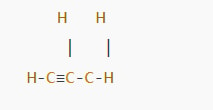
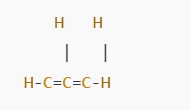
(ii) Draw all the possible straight chain structures of this compound.
Propyne (CH≡C−CH3CH)
and Propadiene (CH2=C=CH2)
Q2. Bromine water is a reddish solution of bromine (Br2) in water. When shaken with an unsaturated hydrocarbon, the red colour of the bromine water disappears because the bromine is used up in an addition reaction.
Kohli has three test tubes containing hexane, hexene and hexyne respectively. Which of the three compounds can he identify using the bromine water test? Give a reason for your answer.
Answer:
Kohli can identify hexene and hexyne using the bromine water test because they are unsaturated hydrocarbons that react with bromine water, decolorizing it. However, hexane cannot be identified because it does not react and does not affect the color of bromine water
Q3. Manasi wrote the names of four compounds as the first members of their respective homologous series.
- methanol- methanal- methanone- methanoic acid
(a) Which name has she written incorrectly? Justify your answer.
(b) What name should she have written instead?
Answer:
(a) Which name has she written incorrectly? Justify your answer.
Methanone is incorrect because a ketone requires at least three carbon atoms, and no compound with one carbon can be named "methanone."
(b) What name should she have written instead?
She should have written propanone (CH3COCH3), the first member of the homologous series of ketones.
Q4. Home-made vinegar is produced from wine. The wine is taken in a clean glass jar and shaken well to aerate it. Some water is added to the jar and then it is kept undisturbed in a dark place at room temperature to undergo fermentation. After 3-4 weeks, the vinegar would be ready to use.
(a) Name the functional groups of the MAIN organic compounds present in wine and vinegar.
(b) Based on the atoms getting added/removed when wine is converted to vinegar, name the type of reaction that happens.
(c) Name any chemical reagent that would be used for the same reaction if it is carried out in the laboratory.
Answer:
(a) Name the functional groups of the MAIN organic compounds present in wine and vinegar.
The main organic compound in wine is ethanol (CH3CH2OH), and the functional group is –OH (hydroxyl group).
The main organic compound in vinegar is acetic acid (CH3COOH), and the functional group is –COOH (carboxyl group)
(b) Based on the atoms getting added/removed when wine is converted to vinegar, name the type of reaction that happens.
This is an oxidation reaction, as oxygen is added, and the alcohol is converted to a carboxylic acid.
(c) Name any chemical reagent that would be used for the same reaction if it is carried out in the laboratory.
In the laboratory, the oxidation of ethanol to acetic acid can be carried out using potassium permanganate (KMnO4) or acidified potassium dichromate (K2Cr2O7) as the oxidizing agent. Both reagents supply oxygen for the oxidation process.
Q5. Study the following information given and answer the questions that follow.
Ethanol is a renewable biofuel because it is made from biomass. Ethanol is a clear, colourless alcohol made from a variety of biomass materials. Ethanol producers mostly use food grains and crops with high starch and sugar content such as corn, sorghum, barley, sugar cane, and sugar beets. The most common ethanol production processes today use yeast to ferment the starch and sugars in corn, sugar cane, and sugar beets.
(a) What is the chemical formula for ethanol?
(b) What other compound is obtained as a by-product when ethanol is obtained from a sugar?
(c) What would be the products formed when ethanol undergoes complete combustion? Support your answer with a balanced chemical equation.
Answer:
(a) What is the chemical formula for ethanol?
The chemical formula of ethanol is C2H5OH.
(b) What other compound is obtained as a by-product when ethanol is obtained from a sugar?
When ethanol is produced from sugars during fermentation, carbon dioxide (CO2) is obtained as a by-product.
(c) What would be the products formed when ethanol undergoes complete combustion? Support your answer with a balanced chemical equation.
When ethanol undergoes complete combustion, the products formed are carbon dioxide (CO2) and water (H2O).
The balanced chemical equation is:
C2H5OH+3O2→2CO2+3H2O
This reaction releases energy in the form of heat and is used as a source of renewable energy.
Q6. Polythene is a plastic made from ethene (CH2=CH2). When ethene is subjected to high pressure and moderately high temperatures, ethene molecules react with each other to form large molecules hundreds of times bigger, forming the plastic.
Which property of carbon atoms is instrumental in the formation of polythene?
Answer:
The property of carbon atoms that is instrumental in the formation of polythene is catenation. In the case of polythene production, the double bonds in ethene (CH2=CH2) break under high pressure and temperature, allowing the carbon atoms to link together in long chains.This process, called addition polymerization, results in the formation of polythene, a polymer with a repeating unit of −CH2−CH2−
Q7. Organic compounds belonging to different homologous series can be isomers. For example, propanal and propanone are isomers.
Can an alkane and an alcohol be isomers? Why or why not?
Answer:
No, an alkane and an alcohol cannot be isomers. They do not share the same molecular formula. The presence of the −OH group in alcohols alters the hydrogen count and makes them distinct from alkanes.
Q8. An alkane has 11 carbon atoms arranged within ring structures as shown below.
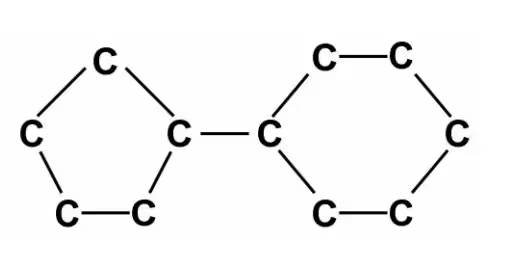
What is the molecular formula of the alkane?
Answer: The molecular formula of the alkane is C₁₁H₂₀, indicating it contains 11 carbon atoms and 20 hydrogen atoms. In this compound, each carbon atom is tetravalent, forming single covalent bonds with two adjacent carbon atoms and two hydrogen atoms. The hydrogen atoms are arranged around the carbon atoms in a tetrahedral geometry, which ensures the most stable configuration for carbon's four bonds.
Q9. Ethyl propanoate is a colourless compound with a pineapple-like smell. It is present naturally in some fruits such as kiwis and strawberries.
The structural formula of ethyl propanoate is given below.
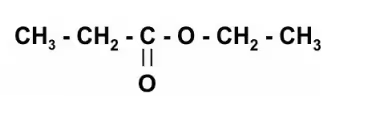
(a) Write the names of the carboxylic acid and the alcohol from which this compound is formed.
(b) Apart from mixing the carboxylic acid and the alcohol, what should be done to form this compound?
Answer:
(a) Write the names of the carboxylic acid and the alcohol from which this compound is formed.
Carboxylic Acid: Propanoic acid (CH₃-CH₂-COOH)
Alcohol: Ethanol (CH₃-CH₂-OH)
(b) Apart from mixing the carboxylic acid and the alcohol, what should be done to form this compound?
- Add a concentrated sulfuric acid catalyst, which acts as a dehydrating agent and promotes the esterification reaction.
- Heat the mixture under reflux to provide the necessary energy for the reaction while preventing the loss of volatile components.
The reaction proceeds as follows:
CH₃-CH₂-COOH (Propanoic acid) + CH₃-CH₂-OH (Ethanol) → CH₃-CH₂-COO-CH₂-CH₃ (Ethyl propanoate) + H₂O
This process produces ethyl propanoate and water as the byproduct.
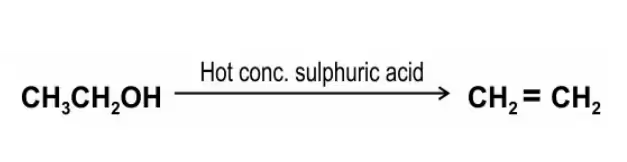
Q10. Heating an alcohol with concentrated sulphuric acid results in the dehydration of the alcohol to give the alkene as shown by the reaction of ethanol to give ethene.
Pramila heated 2-butanol (shown below) with concentrated sulphuric acid.
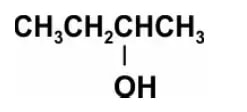
Write the structural formulae of all the possible products of the reaction.
Answer:
When 2-butanol reacts with concentrated sulfuric acid, it undergoes a dehydration reaction, producing two possible alkenes: 2-butene and 1-butene.
2-butene: CH3CH=CHCH3
1-butene: CH3CH2CH=CH2

in these reactions, concentrated sulfuric acid serves as a dehydrating agent, facilitating the removal of a water molecule from 2-butanol. This dehydration process leads to the formation of the corresponding alkenes, either 2-butene or 1-butene, depending on the elimination pathway.
Some More Important Question Answers of Class 10 Science Chapter 4
Q1. Why is carbon able to form a large number of compounds? Explain with reference to tetravalency and catenation.
Ans. Carbon has 4 valence electrons, so it can form 4 covalent bonds with other atoms (tetravalency). It can also bond with other carbon atoms repeatedly, forming long chains and rings. This property is called catenation. Due to tetravalency + catenation, carbon forms millions of stable compounds with hydrogen, oxygen, nitrogen, etc.
Q2. Draw the electron dot structure of ethane (C₂H₆). How many covalent bonds are present in this molecule?
Ans. In ethane, each carbon shares electrons with three hydrogens and one carbon.
- The dot structure shows single bonds (shared pairs).
- Ethane has 7 covalent bonds (6 C–H and 1 C–C).
Q3. Why do unsaturated hydrocarbons produce a sooty flame while burning?
Ans. Unsaturated hydrocarbons (alkenes/alkynes) have a higher percentage of carbon. During burning, the oxygen supply is not enough to oxidise all the carbon completely. This leads to incomplete combustion and deposition of unburnt carbon particles. That is why they burn with a yellow, sooty flame.
Q4. Differentiate between saturated and unsaturated hydrocarbons with one example and structural formula each.
Ans.
- Saturated hydrocarbons contain only single C–C bonds. Example: Ethane (C₂H₆) → H₃C–CH₃
- Unsaturated hydrocarbons contain double or triple bonds. Example: Ethene (C₂H₄) → H₂C=CH₂
Thus, saturation = single bonds, unsaturation = double/triple bonds.
Q5. Write the IUPAC name and structural formula of the first member of the ketone series.
Ans. The first member of the ketone series is propanone (CH₃–CO–CH₃).
- It has 3 carbon atoms, with a carbonyl (>C=O) group at the middle carbon.
- IUPAC name: Propanone (commonly called acetone).
Q6. Explain why graphite conducts electricity but diamond does not.
Ans. In graphite, each carbon atom bonds with 3 others, leaving one free electron. These free electrons are delocalised and allow current to flow. In diamond, each carbon is bonded to 4 others in a 3D network, so no free electrons remain. Hence, graphite conducts electricity but diamond does not.
Q7. What are alkanes? Write the general formula and draw the structure of propane.
Ans. Alkanes are saturated hydrocarbons with single bonds. Their general formula is CₙH₂ₙ₊₂.
For propane (C₃H₈):
Structure: CH₃–CH₂–CH₃
It is the third member of the alkane series.
Q8. Name the products formed when ethanoic acid reacts with sodium carbonate. Write the balanced chemical equation.
Ans. Ethanoic acid reacts with sodium carbonate to form sodium ethanoate, carbon dioxide and water.
Equation: 2CH₃COOH + Na₂CO₃ → 2CH₃COONa + CO₂↑ + H₂O
Effervescence of CO₂ gas confirms the reaction.
Q9. How will you test the presence of unsaturation in a hydrocarbon? Explain with chemical reactions.
Ans. Unsaturation can be tested with bromine water.
- If an unsaturated hydrocarbon is added to bromine water, the reddish-brown colour disappears due to an additional reaction.
- Example: CH₂=CH₂ + Br₂ → CH₂Br–CH₂Br, This confirms the hydrocarbon is unsaturated.
Q10. What happens when ethanoic acid reacts with ethanol in the presence of concentrated sulphuric acid? Name the process and product.
Ans. Ethanoic acid reacts with ethanol in the presence of conc. H₂SO₄ to form an ester (ethyl ethanoate) and water.
Reaction: CH₃COOH + C₂H₅OH → CH₃COOC₂H₅ + H₂O
This reaction is called esterification and the ester has a fruity smell.
Q11. Explain why soap does not form lather with hard water but detergents do.
Ans. Soap molecules react with the calcium and magnesium ions present in hard water to form insoluble salts. These salts appear as scum and reduce the cleansing power of soap, so very little lather is produced.
Detergents, on the other hand, are made from sulphonic acids or ammonium salts. They do not form insoluble salts with calcium or magnesium ions, which is why they can lather well in both soft and hard water. Thus, detergents are more effective in areas with hard water.
Q12. Name the products obtained when ethanol reacts with sodium metal. Write the balanced equation.
Ans. When sodium metal is added to ethanol, hydrogen gas is liberated with effervescence, and sodium ethoxide (C₂H₅ONa) is formed. The hydrogen gas can be tested by bringing a burning splinter near it, where it burns with a pop sound.
Equation: 2C₂H₅OH + 2Na → 2C₂H₅ONa + H₂↑, This reaction is used as a test for alcohols, since carboxylic acids also give hydrogen gas but with stronger effervescence.
Q13. What happens when ethanoic acid reacts with sodium hydroxide? Write the equation and explain.
Ans. Ethanoic acid reacts with sodium hydroxide to form sodium ethanoate (a salt) and water. This is a neutralisation reaction as the acid reacts with a base. The salt formed is soluble in water.
Equation: CH₃COOH + NaOH → CH₃COONa + H₂O
This reaction shows that carboxylic acids behave like normal mineral acids by neutralising alkalis, although they are weak acids.
Q14. Why does carbon not form C⁴⁺ cations or C⁴⁻ anions? How does it form bonds instead?
Ans. Carbon has four valence electrons. If it loses four electrons to form C⁴⁺, it will require a huge amount of energy to remove all four electrons. If it gains four electrons to form C⁴⁻, the six protons in the nucleus will not be able to hold ten electrons.
Hence, both possibilities are unstable. Instead, carbon attains stability by sharing its four electrons with other atoms, forming covalent bonds. This allows it to achieve noble gas configuration without complete electron loss or gain.
Q15. What are micelles? How do they help in cleaning clothes?
Ans. Soap molecules have two ends – a hydrophobic hydrocarbon tail and a hydrophilic ionic head (–COO⁻Na⁺). When soap is added to water containing grease or oil, the hydrophobic tails attach to the oil drop while the hydrophilic heads remain in water.
This arrangement forms spherical structures called micelles. In micelles, the oil is trapped inside and can be washed away with water. Thus, micelle formation helps in removing oily or greasy dirt from clothes effectively.
Q16. Why is methane called marsh gas? Write its combustion reaction.
Ans. Methane (CH₄) is produced naturally in marshy areas by the anaerobic decomposition of organic matter, hence it is called marsh gas.
It is a colourless, odourless gas and is the main component of biogas. On complete combustion in oxygen, it produces carbon dioxide and water, releasing energy.
Equation: CH₄ + 2O₂ → CO₂ + 2H₂O + heat, This property makes methane a useful fuel.
Q17. Define homologous series. Write two characteristics of it with an example.
Ans. A homologous series is a group of organic compounds having the same functional group and similar chemical properties, where each successive member differs by a –CH₂ unit.
Characteristics:
- Members have similar chemical properties because they have the same functional group.
- They show a gradual change in physical properties like boiling point or melting point.
Example: Alkanes: CH₄ (methane), C₂H₆ (ethane), C₃H₈ (propane). Each differs by –CH₂.
Q18. Write a chemical equation for hydrogenation of ethene. What change in physical property is observed?
Ans. Hydrogenation is the addition of hydrogen to an unsaturated hydrocarbon in the presence of a catalyst such as nickel.
Equation: CH₂=CH₂ + H₂ → CH₃–CH₃ (ethane)
The double bond breaks and hydrogen atoms add, converting ethene (unsaturated) into ethane (saturated). A physical change is observed when the liquid unsaturated oil becomes a solid fat with a higher melting point. This process is used in the manufacture of margarine from vegetable oils.
Q19. Distinguish between addition and substitution reactions with examples.
Ans.
- Addition reaction: Unsaturated hydrocarbons undergo addition of atoms like hydrogen or halogens at their double/triple bonds.
Example: CH₂=CH₂ + H₂ → CH₃–CH₃ (hydrogenation). - Substitution reaction: Saturated hydrocarbons undergo replacement of one atom with another in the presence of sunlight or catalyst.
Example: CH₄ + Cl₂ → CH₃Cl + HCl (chlorination of methane).
Thus, unsaturated hydrocarbons prefer addition, while saturated hydrocarbons prefer substitution.
Q20. Why is graphite used as an electrode, while diamond is not?
Ans. Graphite has a layered structure in which each carbon atom is bonded to three others, leaving one electron free. These delocalised electrons move freely and allow graphite to conduct electricity, making it suitable as an electrode in cells.
Diamond, however, has each carbon bonded to four others in a rigid structure, so no free electrons are present. Hence, diamond does not conduct electricity and cannot be used as an electrode.
Video Lecture: Must-watch for Quick Revision
Extra Questions for Practice for you to ace your exams!
Q1. Draw the electron dot structure of propane and butane.
Q2. Write the balanced chemical equation for the reaction of ethanol with concentrated sulphuric acid at 443 K.
Q3. An organic compound with molecular formula C₂H₆O is a constituent of wine. Identify the compound and mention one physical property.
Q4. Differentiate between soaps and detergents in terms of their composition and action in hard water.
Q5. Write chemical equations for the combustion of (i) ethane, and (ii) ethyne.
Q6. Describe a simple activity to show esterification?
Q7. Why do covalent compounds generally have low melting and boiling points? Give one example.
Q8. Which reaction is used to convert vegetable oil into ghee? State the conditions required.
Q9. Draw the structural formulas of the first three members of the homologous series of alcohols.
Q10. Why does ethyne burn with a sooty flame, while methane burns with a clean flame?
Introduction to Carbon and Its Compounds
Carbon, represented by the symbol 'C,' is an element in the periodic table due to its ability to form a large number of compounds. This is because carbon atoms can form four bonds with other atoms (called tetravalency) and connect to themselves in long chains (a property called catenation). These features make carbon central to many areas of science and everyday life.
In Class 10 Science Chapter 4 syllabus, you’ll learn about several aspects of carbon chemistry, including:
- Covalent Bonding: How carbon bonds with other elements, forming single, double, or triple bonds.
- Allotropes of Carbon: Different forms of carbon, like diamond and graphite, which have different properties despite being made of the same element.
- Carbon’s Versatility: Carbon forms a wide range of compounds like hydrocarbons, alcohols, and acids.
- Nomenclature: The system for naming organic compounds.
- Chemical Properties: Reactions of carbon compounds like combustion and substitution.
- Uses of Carbon Compounds: everyday substances like ethanol, ethanoic acid, soaps, and detergents.
How Important Questions Help in Mastering Carbon and Its Compounds?
Focusing on carbon and its compounds in class 10 important questions helps you learn the key ideas in Chapter 4. Here’s how they can benefit you:
- Learning Stronger Conceptual: Builds clarity about carbon’s bonding and compound formation.
- Better Recall: Regular practice improves retention of formulas, structures, and reactions.
- Improved Answer Writing: Helps you learn how to write neat and well-labeled chemical equations.
- Exam Readiness: Familiarizes you with the most common board question types including diagrams, reasoning, and reaction-based ones.
- Confidence Boost: Increases accuracy and speed during exams through organized revision.
FAQs
Q1. How many marks are usually allotted to this chapter in Class 10 Science exams?
Ans. This chapter usually carries 4 to 5 marks in board exams, with a mix of short answer and application-based questions.
Q2. What are the most important topics in this chapter?
Ans. Covalent bonding, functional groups, homologous series, oxidation reactions, and properties of ethanol and ethanoic acid are among the most important topics.
Q3. How can I remember the names and formulas of organic compounds easily?
Ans. Break them into patterns. Learn prefixes like meth-, eth-, prop-, and but-, and combine them with suffixes like –ane, –ene, and –yne for systematic naming.
Q4. Do I need to draw structural formulas for every compound?
Ans. Yes, drawing helps in understanding how atoms bond and is often required in 2 or 3-mark questions. Always label functional groups clearly.
Q5. How should I prepare for the soap and detergent concept?
Ans. learning the cleansing mechanism of soap with micelle formation. Learn the difference between soaps and detergents and their environmental effects.










.svg)

