Work Energy and Simple Machines is a foundational concept of physics. NCERT introduces students to topics like how work is done and how energy changes its forms in Class 9 Science Chapter 7.
These Work Energy and Simple Machines Class 9 notes cover the complete chapter. Students can download the notes PDF from this page. The notes help with important definitions, formulas, examples and numericals to strengthen your test and exam preparations.
Download Work Energy and Simple Machines Class 9 Notes PDF
Click the link below and download the PDF for Chapter 7 Class 9 Science notes. These notes help revise work, energy, power, kinetic and potential energy, etc. The notes have different learning patterns such as formulas, comparison tables, diagrams, etc., to make learning easier.
Download Class 9 Science Chapter 7 Notes

Class 9 Science Chapter 7 Notes at a Glance
NCERT Exploration Chapter 7: Work Energy and Simple Machines of Class 9 explains the work and energy concepts. Students learn how pulleys, inclined planes, and levers reduce the effort needed to perform tasks. The chapter spans pages 116 to 139 and covers theorems, examples, and practice questions.
7.1 Work Done by a Constant Force
Work is done when a force makes an object move in the direction of the force. It depends on the applied force and the displacement produced.
W = F x s
Here, W is work, F is force and s is displacement in the direction of the force. The SI unit of work is the joule (J).
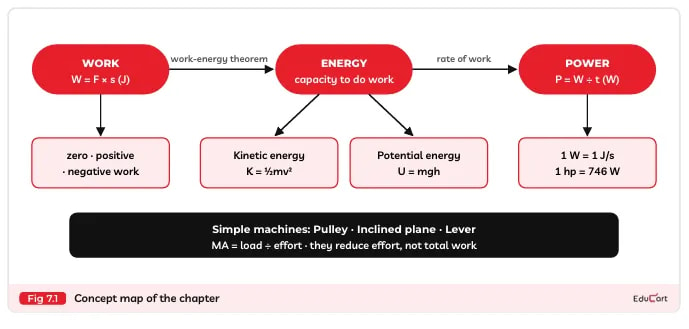
Remember: 1 joule is the work done when a force of 1 newton moves an object by 1 metre in the direction of the force.
7.1.1 When Is Work Done Equal to Zero?
Work is zero in these situations:
- No force acts: If no force is applied, no work is done.
- No displacement occurs: Pushing a rigid wall does not do work because the wall does not move.
- Force is perpendicular to displacement: Carrying a box horizontally while holding it at the same height involves no work against gravity.
Example: A porter carrying a load on a level road does no work against gravity because the upward force and horizontal displacement are perpendicular.
7.1.2 Positive and Negative Work Done
Work can be positive or negative depending on the direction of force and displacement.
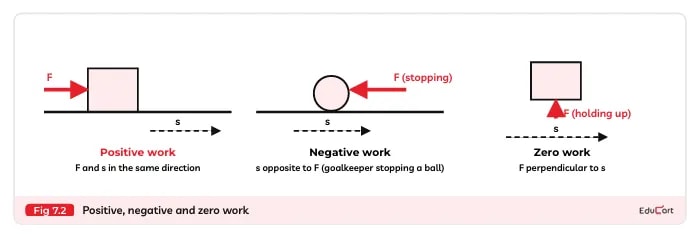
Solved example: A force of 50 N moves a box by 4 m in the direction of the force.
Work done = 50 × 4 = 200 J (positive).
7.2 The Work-Energy Theorem
The work-energy theorem connects the work done on an object with its change in kinetic energy. When work is done on an object, its energy changes.
- Positive work can increase an object's kinetic energy.
- Negative work can decrease its kinetic energy.
- Work and energy are both measured in joules (J).
Example: When a carrom striker hits a coin, it transfers energy to the coin. The coin gains energy, while the striker loses some energy and slows down.
For an object changing speed from u to v:
W = 1/2mv2-1/2mu2
Here, m is mass, u is initial speed, and v is final speed.
7.3 Forms of Energy
Energy exists in different forms and can change from one form to another.
Examples of energy conversion:
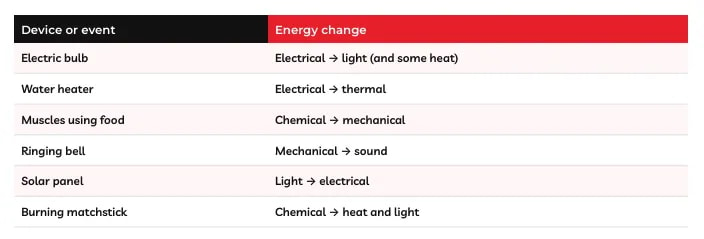
7.4 Mechanical Energy
Mechanical energy is the energy an object has because of its motion, position or shape. It is mainly of two types: kinetic energy and potential energy.
Mechanical Energy = KE + PE
7.4.1 Kinetic Energy
Kinetic energy is the energy possessed by an object due to its motion. A moving car, rolling ball and running person all have kinetic energy.

- m = mass in kilograms (kg)
- v = speed in metres per second (m/s)
- SI unit = joule (J)
- An object at rest has zero kinetic energy.
- Kinetic energy increases with the square of speed.
Solved Example:

7.4.2 Potential Energy
Potential energy is stored energy due to an object's position or shape. A book kept on a shelf, a stretched rubber band and a compressed spring have potential energy.
Gravitational potential energy near Earth's surface is calculated as:
PE = mgh
Here, m is mass, g is acceleration due to gravity, and h is height above a reference level.
- A heavier object at the same height has more potential energy.
- An object at a greater height has more gravitational potential energy.
- A stretched rubber band stores energy because of its shape.
Solved Example:

7.4.3 Conservation of Mechanical Energy
The law of conservation of mechanical energy states that the total mechanical energy remains constant when friction and air resistance are absent.
As an object falls:
- At the highest point, potential energy is maximum and kinetic energy is zero.
- During the fall, potential energy decreases and kinetic energy increases.
- Just before reaching the ground, kinetic energy is maximum and potential energy is minimum.
Solved Example:
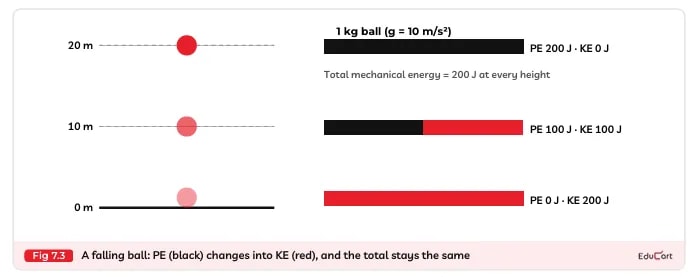
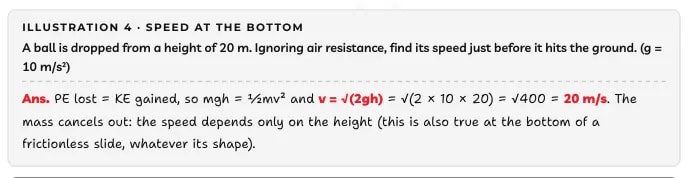
Remember: Energy changes from one form to another, but the total mechanical energy remains constant in the absence of friction and air resistance.
7.5 Power
Power is the rate at which work is done. It tells us how quickly a person or machine completes a task.
P = W/t
Here, P is power, W is work done, and t is time taken.
- SI unit: watt (W)
- 1 watt = 1 joule per second
- 1 horsepower (hp) = 746 watts
Solved example:

Remember: Two people may do the same amount of work, but the person who completes it in less time has greater power.
7.6 Simple Machines
A simple machine makes work easier by changing the size or direction of the force applied. It does not reduce the total work done in an ideal machine.
Important terms:
- Effort: The force applied to operate a machine.
- Load: The force that the machine has to overcome.
- Mechanical Advantage (MA): The ratio of load to effort.
MA = load/effort
If the mechanical advantage is greater than 1, a smaller effort can move a larger load.
7.6.1 Pulley
A pulley is a simple machine used to lift loads. It consists of a wheel with a groove through which a rope passes.
There are two main types:
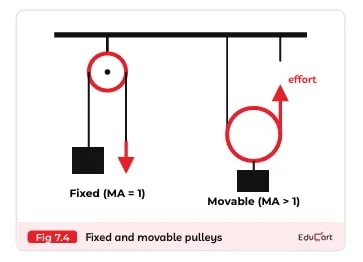
Uses of pulleys: Flagpoles, wells, lifts and cranes.
7.6.2 Inclined Plane
An inclined plane is a simple machine with a sloping surface. It helps move heavy objects to a higher or lower level using less effort.
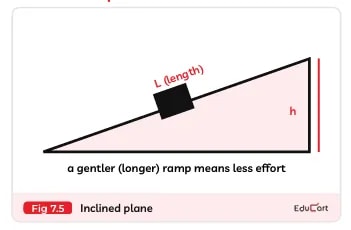
- A longer and less steep ramp requires less force to move an object.
- The object travels a longer distance on a gentle ramp.
- The work done remains the same in an ideal machine without friction.
Formula for Mechanical Advantage:
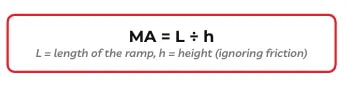
Solved example:

Examples: Ramps used to load goods into trucks and sloping roads on hills are examples of inclined planes.
7.6.3 Lever and Its Classes
A lever is a simple machine made of a rigid bar that turns around a fixed point called the fulcrum. It helps lift or move loads with less effort.
Important parts of a lever:
- Fulcrum: The fixed point around which the lever turns.
- Effort: The force applied to the lever.
- Load: The force or weight that needs to be moved.
- Effort arm: Distance between the fulcrum and the effort.
- Load arm: Distance between the fulcrum and the load.
Formula:

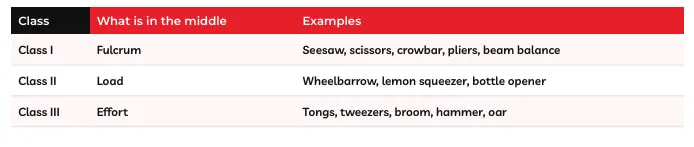
Three classes of levers:
Solved Examples:

Important Terms and Their Meanings
Students can check the table below for important terms and their meanings. The table lists a few of the most important terms from the Chapter 7 Class 9 Science notes.
Important Things to Remember from Class 9 Science Ch 7 Notes
Remember these important exam tips and tricks for your exam preparation. These will help you avoid common mistakes and strengthen your preparation effectively.
- Check the direction: Always check the direction of force before the calculation. Do not assume it is positive, because force can be negative or zero.
- Attention to distance & displacement: Use displacement in the applied force direction and not the total distance travelled.
- Speed's effect on kinetic energy: Remember the relation between speed and kinetic energy. If speed doubles, then kinetic energy becomes four times.
- Watch units in numericals: During numericals, convert mass into kg, distance into metres and time into seconds, then apply formulas.
- Energy vs Power: Energy is how much work can be done. Power tells us how quickly the work is done.
- Convert the energy in a falling object: A falling object’s potential energy decreases and kinetic energy increases. Total energy remains constant if air resistance is ignored.
- Lever memory trick: Remember F-L-E for the middle position: Fulcrum (Class I), Load (Class II) and Effort (Class III).
Important formulas and SI units:
More Study Resources for Class 9 Chapter 7 Science Notes
After finishing the Chapter 7 Class 9 Science notes, students are suggested to practise different question types from the chapter. To get familiar with question formats and presentation, students can check and use more study resources below:
Recommended Study Materials For CBSE Class 9 Science
Students are also advised to use the recommended study materials for CBSE Class 9 Science. The table below provides highly beneficial books brought by Educart to strengthen exam preparation.
Frequently Asked Questions
Q1. What do work energy and simple machines Class 9 notes cover?
Ans. They cover work, energy, power, kinetic energy, potential energy, conservation of energy and simple machines with formulas and examples.
Q2. What is the SI unit of work and energy?
Ans. The joule (J) is the SI unit of both work and energy.
Q3. What is the formula for kinetic energy?
Ans. Kinetic energy = ½mv², where m represents mass and v represents velocity.
Q4. What is mechanical advantage?
Ans. Mechanical advantage is the ratio of load to effort applied to a machine.
Q5. Where can students find useful revision material for Chapter 7 Class 9 Science notes?
Ans. Students can use chapter-wise notes to revise important concepts, formulas, solved examples and exam tips from Work, Energy, and Simple Machines.