The universe is built upon matter, and the basic unit of matter is called an atom. Every living and non-living object is made up of atoms. In Class 9 Science, Chapter 8: Journey Inside the Atom student study detail structure of atom, particles and atomic models.
Students can find Journey Inside the Atom notes from this page. Educart has arranged neat and student-friendly notes to support tests, revision and school examinations. These notes cover valuable concepts, important diagrams and practice questions to make self-study easier.
Download Journey Inside the Atom Class 9 Notes PDF
Download Journey Inside the Atom Class 9 Notes from the link below, and get a free PDF. The PDF contains the complete chapter in one place. It also explains Thomson's, Rutherford's and Bohr's models with other topics. Practising with these notes helps students understand difficult topics and prepare more effectively.
Download class 9 science chapter 8 notes

Class 9 Science Chapter 8 Notes at a Glance
NCERT Class 9 Chapter 8: Journey Inside the Atom, pages 140–157, explains the atom's structure and its components. Also, students learn about electrons, protons, neutrons, atomic models, isotopes, isobars and more. The detailed topics are listed below:
8.1 Rediscovering the Roots of Atomic Theory
The idea that matter is made of tiny, indivisible particles dates back to ancient philosophy before being proven by modern science.
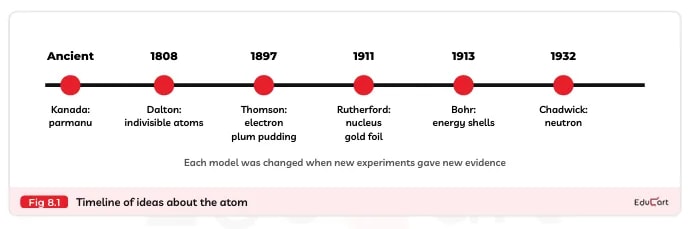
- Acharya Kanada (Ancient India): Suggested that matter is made of tiny, indivisible particles called parmanu, which combine to form larger particles.
- Leucippus and Democritus (Ancient Greece): Proposed that matter consists of indivisible particles called atomos, meaning “uncuttable”.
- John Dalton (1808): Presented the first experimental atomic theory, stating that all matter is made of indivisible atoms. His theory could not explain the internal structure of atoms.
8.2 A Short Historical Journey Through Atomic Models
Scientists performed experiments to discover the particles inside atoms and understand their arrangement.
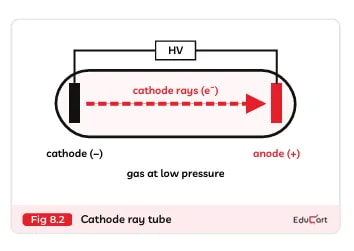
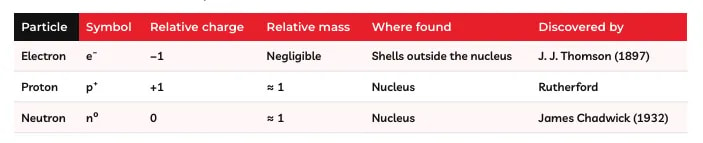
- Discovery of Electron (1897): J. J. Thomson discovered negatively charged particles called electrons (e-) using a cathode ray tube.
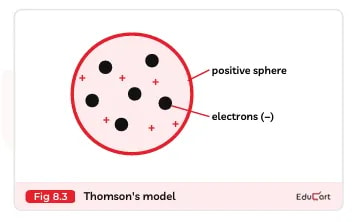
- Thomson’s Model: He described the atom as a positively charged sphere with negatively charged electrons embedded in it, like seeds in a watermelon.
- Rutherford’s Gold Foil Experiment (1911):
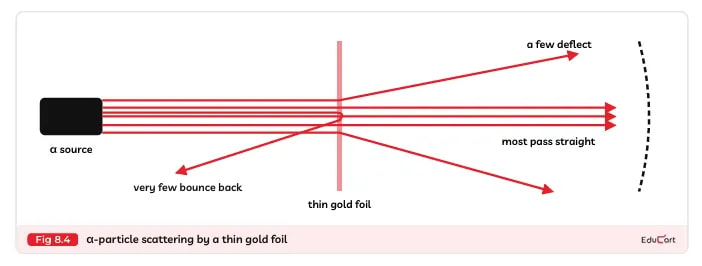
Rutherford, with Geiger and Marsden, fired alpha particles at thin gold foil.
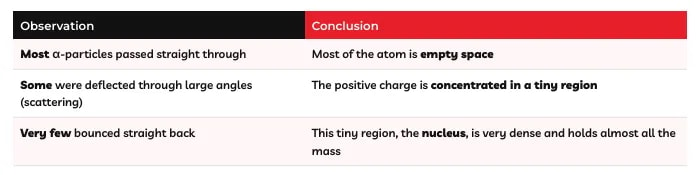
Rutherford’s Nuclear Model: An atom has a small, positively charged nucleus containing protons (p+, charge +1), with electrons revolving around it. However, this model could not explain why electrons do not lose energy and fall into the nucleus.

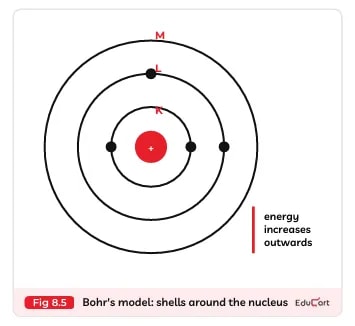
Bohr’s Model (1913): Niels Bohr proposed that:
- Electrons move in fixed energy levels called shells (K, L, M, N).
- Electrons do not lose energy while in these shells.
- Energy increases in shells farther from the nucleus.
- Electrons absorb or release energy when they move between shells.
8.3 What Components Contribute to the Mass of an Atom?
Almost all the mass of an atom comes from its nucleus because electrons have negligible mass.
Discovery of the Neutron (1932): James Chadwick discovered the neutron (n0), a neutral particle with a mass nearly equal to a proton. Neutrons are found in the nuclei of all atoms except ordinary hydrogen and help keep the nucleus stable.
8.4 Symbols of Elements
Berzelius introduced modern element symbols in 1813. Today, IUPAC approves symbols for the 118 known elements.
- Formatting Rules: Symbols use one or two letters. The first is always capitalised, while the second is lowercase (e.g., Al for Aluminium and Co for Cobalt).
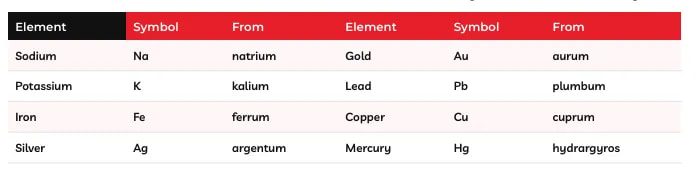
- Symbols from Older Names: Some symbols come from Latin or Greek names of elements.
8.5 Atomic Number
The atomic number (Z) is the total number of protons present in the nucleus of an atom.
- It uniquely identifies an element and determines its chemical behaviour.
- In an electrically neutral atom, the number of protons equals the number of electrons (Protons = Electrons = Z)
8.6 Mass Number
The mass number (A) is the total sum of protons and neutrons (collectively called nucleons) present in the nucleus of an atom.
Mass Numeber (A) = Number of Protons (p) + Number of Neutrons (n)
Number of neutrons(n) = A - Z
Solved Example:

8.7 How Are Electrons Distributed in Different Energy Levels?
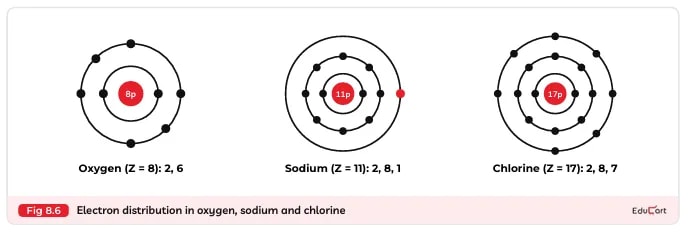
Electrons are arranged in different shells around the nucleus following the Bohr–Bury Rules:
- Maximum Shell Capacity (2n2): The maximum number of electrons a shell can hold is given by 2n2, where n is the shell number:
- Outermost Shell Limit: The outermost shell of an atom cannot hold more than 8 electrons (and the K shell cannot hold more than 2 electrons).
- Step-by-Step Filling: Shells are filled in order (K, L, M…); a new outer shell begins filling only after the inner shell is full.
Examples of Electron Distribution:
8.8 Combining Capacity of an Atom: Valency
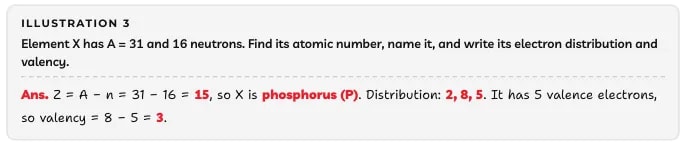
Valency is the combining capacity of an element—defined as the number of electrons an atom loses, gains, or shares to achieve a stable outermost shell.
How to Calculate Valency:
- 1, 2, or 3 valence electrons: The atom loses them easily.
Valency = number of valence electrons (e.g., Na = 1, Mg = 2, Al = 3). - 5, 6, or 7 valence electrons: The atom gains electrons to reach 8.
Valency = 8 - number of valence electrons (e.g. N = 8 - 5 = 3, O = 8 - 6 = 2, Cl = 8 - 7 = 1). - 4 valence electrons: The atom shares its 4 electrons.
Valency = 4 (e.g., C, Si). - 8 valence electrons (or 2 in K shell): Already stable
Valency = 0 (e.g., He, Ne, Ar).
Solved Example:
8.9 A Deeper Look into Atomic Structure
Atoms can have the same atomic number or mass number. This gives rise to isotopes and isobars.
Isotopes: Atoms of the same element with the same atomic number (Z) but different mass numbers (A) due to different numbers of neutrons.
- Properties: They have the same chemical properties but may differ in physical properties.
- Examples: Hydrogen isotopes are Protium (11H), Deuterium (21H) and Tritium (31H).
- Uses: Uranium-235 (nuclear fuel), Cobalt-60 (cancer treatment), Iodine-131 (thyroid treatment) and Carbon-14 (dating fossils).
- Average Atomic Mass: It is the weighted average of the masses of an element’s naturally occurring isotopes.
Isobars: Atoms of different elements with different atomic numbers but the same mass number.
- Properties: They have different chemical properties.
- Example: Argon-40, Potassium-40 and Calcium-40.
Solved Example: Average Atomic Mass

Important Terms and Their Meanings
The table listed below provides a list of important terms to keep handy while preparing for the Journey Inside the Atom Class 9 notes.
Important Things to Remember from Class 9 Science Chapter 8 Notes
Revise and remember key things while studying with Journey Inside the Atom Notes. These important things help you avoid common mistakes and make it easier to memorise.
- Atomic theory: Dalton first introduced his atomic theory in 1808, and Acharya Kanada proposed parmanu.
- Atomic models: Thomson made the plum pudding model, Rutherford discovered the nucleus, and Bohr explained energy shells.
- Subatomic particles: The electron carries a negative charge, the proton carries a positive charge, and the neutron carries no charge.
- Atomic number and mass number: Z = protons; A = protons + neutrons.
- Electron distribution: Bohr–Bury rules and the formula 2n² to help find shell capacity.
- Valency: Atoms gain, lose or share electrons to achieve a stable outer shell.
- Isotopes and isobars: Isotopes have the same atomic number, while isobars have the same mass number.
Important formulas and facts:
More Study Resources for Class 9 Science Chapter 8 Notes
Completing Class 9 Science Chapter 8 notes will help student build their basics of Atoms. Students should use extra study resources to practise questions from the chapter.
Recommended Study Materials For CBSE Class 9 Science
Apart from Journey Inside the Atom Class 9 notes, students can check out notes, question banks, sample papers and other study material for Class 9.
Frequently Asked Questions
Q1. What do Journey Inside the Atom Class 9 notes cover?
Ans. They cover atomic theory, subatomic particles, atomic models, electron distribution, valency, isotopes and isobars.
Q2. Who discovered the electron?
Ans. J. J. Thomson discovered the electron in 1897 through experiments involving cathode rays.
Q3. What is the main limitation of Rutherford's atomic model?
Ans. It could not explain atomic stability or why revolving electrons do not lose energy and collapse into the nucleus.
Q4. What are Journey Inside the Atom notes useful for?
Ans. They help students revise important definitions, diagrams, atomic models, numerical problems and examination concepts.
Q5. What is the difference between isotopes and isobars?
Ans. Isotopes have the same atomic number but different mass numbers; isobars have the same mass number but different atomic numbers.