Chapter 6: How Forces Affect Motion of Class 9 explains why objects start moving, stop, change direction or change shape. Students explore balanced and unbalanced forces, friction and Newton's three laws of motion. The chapter helps with understanding everyday activities like walking, running and cycling.
This page provides the complete Class 9 Science Ch 6 notes PDFs. It simplifies difficult definitions and important topics with relevant examples and diagrams. The notes also help students with numerical questions, formulas and calculations to support quick revision.
H2: Download How Forces Affect Motion Class 9 Notes PDF
Prepare for your school examination with short and effective How Forces Affect Motion notes. Download the PDF from the link below. It covers Newton's laws, friction, force calculations and practice questions. Students can use them for classroom learning, homework and last-minute revision.
Download Class 9 Science Ch 6 Notes PDF

Class 9 Science Ch 6 Notes at a Glance
The NCERT (Exploration) textbook covers How Forces Affect Motion in pages 94–115. It explains how forces influence motion in seven sections through friction, net force and Newton's laws. Students also study how forces act on a system of connected objects.
6.1 The Concept of Force
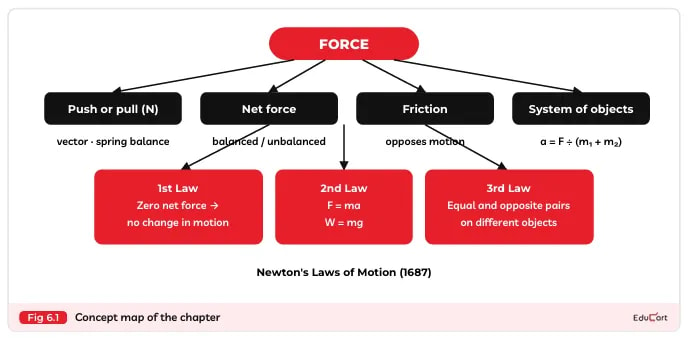
A force is a push or pull that can start or stop an object’s motion, change its speed or direction, or change its shape. It is a vector quantity because it has both magnitude and direction. Its SI unit is the newton, and a spring balance is used to measure it.
6.2 Balanced and Unbalanced Forces
When the net force on an object is zero, the force is called balanced. They do not change the object's state of motion.
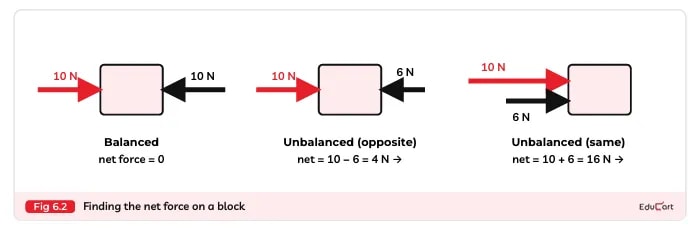
- Same direction: Add the forces.
- Opposite directions: Subtract the forces and follow the direction of the larger force.
6.3 The Force of Friction: Often Overlooked but Always Present
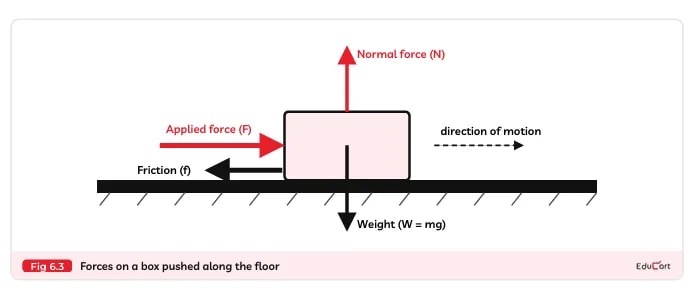
Friction is a force that opposes motion between two surfaces in contact. If the applied force is equal to friction, the net force is zero. If the applied force is greater, the object can accelerate. Tyre treads and grooves increase friction and provide better grip.
6.4 Newton's First Law of Motion
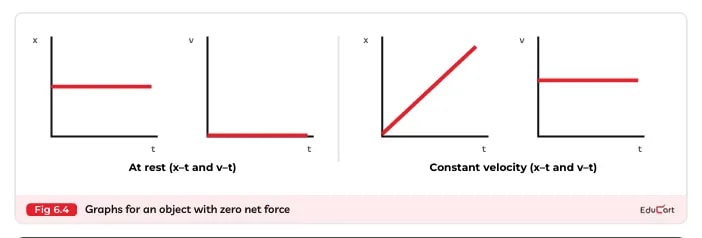
Newton's first law says that an object remains at rest or continues moving with constant velocity unless an external force acts on it. This law is related to the tendency of an object to resist a change in its state of motion.
For example, passengers fall forward when a moving bus stops suddenly.
6.5 Newton's Second Law of Motion
Newton's second law explains how force, mass and acceleration are related. Acceleration increases with net force and decreases with mass.

One is the force that produces an acceleration of 1 m/s2 in a mass of 1 kg. Weight is calculated using W = mg, where g = 9.8 m/s2
Example: A 2 kg object accelerates at 3 m/s². Find the force.
F = ma = 2 x 3 =6N
6.6 Newton's Third Law of Motion
Newton's third law states that every action has an equal and opposite reaction. These forces act on different objects, so they do not cancel each other.
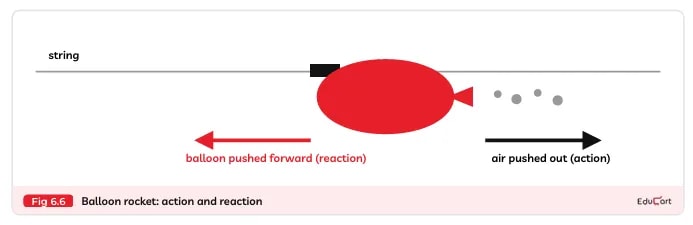
Examples include walking, balloon rockets and the recoil of a gun.
6.7 Forces Acting on a System of Objects
Two or more connected objects can be treated as a single object. Internal forces, such as tension in a connecting string, are ignored when calculating the acceleration of the whole system.

Example: Two boxes of masses 3 kg and 2 kg are pulled by a force of 20 N.
a=20 ÷ (3+2) = 4m/s2
Important Terms and Their Meanings
Make a list and keep it handy for quick revision of the important terms from Class 9 Science Ch 6 notes. Refresh your understanding of the chapter through the table below:
Important Things to Remember from Class 9 Science Ch 6 Notes
Before practising the questions from Class 9 Science Chapter 6 notes, remember these key concepts. These will help you in applying force and motion in numerical and reasoning-based questions.
- Finding net force: Add together same-direction forces and subtract opposite-direction forces. Do not forget to mention the force direction in the result.
- Balanced forces and friction: Remember zero net force is equal to zero acceleration. Always compare the applied force with friction before calculating force.
- Mass vs weight: Mass is measured in kilograms(kg), and Weight is measured in newtons (N).
- Newton's laws in daily life: Recall the bus examples for inertia and how pulling hands back while playing catch helps reduce impact force.
- Newton's second law: For the same mass, doubling the net force doubles acceleration. For the same force, doubling the mass halves acceleration.
- Action and reaction: These are equal and opposite forces on different objects, and they do not cancel each other.
- Connected objects: Two boxes joined with a string are calculated as one system for acceleration. Remember that tension is an internal force.
Important formulas and numerical reminders:
Important diagrams to practise:
- Free-body diagram of a box showing applied force, friction, normal force and weight.
- Balanced and unbalanced forces acting on a block.
- Balloon rocket showing action and reaction.
- Two boxes connected by a string, showing tension and external force.
- Two spring balances hooked together to demonstrate Newton's third law.
Memory trick: Use the I-F-R trick to remember Newton's laws: First law – Inertia, Second law – F=ma, Third law – Reaction.
Extra Study Resources for Class 9 Science Ch 6 Notes
Refer to more study resources along with Class 9 Science Chapter 6 notes PDFs.
Students can use the listed resources to revise NCERT concepts, practise numericals and prepare for examinations.
Recommended Study Materials for CBSE Class 9 Notes
Students are advised to explore Educart's question banks and sample papers for effective exam preparation. These books provide extra practise material aside from Class 9 Science Chapter 6 notes for better scores in results.
Frequently Asked Questions
Q1. What is the main topic of Class 9 Science Chapter 6?
Ans. It explains force, friction, Newton's laws and their role in changing the motion of everyday objects.
Q2. What is the SI unit of force?
Ans. The SI unit is the newton (N), defined using the mass of one kilogram and the acceleration of one metre per second squared.
Q3. What is Newton's first law called?
Ans. It is called the law of inertia because objects resist changes in their state of rest or motion.
Q4. Which formula is used in Newton's second law?
Ans. The formula is F = ma, where force equals mass multiplied by acceleration.
Q5. Why are action and reaction forces not balanced?
Ans. They act on different objects, unlike balanced forces, which act on the same object and produce zero net force.