CBSE introduces how mixtures are formed, classified and separated in Class 9 Science Chapter 5, Exploring Mixtures and Their Separation. The chapter explains homogeneous and heterogeneous mixtures, solutions, concentration and solubility. Students get to learn classroom concepts with everyday examples, like how to separate cream from milk, clean muddy water and understand why fish need cool water.
Students will find Class 9 Science Chapter 5 notes PDF on this page. These notes simplify important concepts, separation methods, and difficult definitions, with quick revision points to make learning easier.
Download Exploring Mixtures And Their Separation Class 9 Notes PDF
Download free Class 9 Science Ch 5 notes from the link below and start quick revision. The notes include definitions, examples, separation methods and comparison tables for easy explanations. These PDFs help students with exam preparation and class tests.
Download Class 9 Science Ch 5 Notes PDF

Class 9 Science Ch 5 Notes at a Glance
Exploring Mixtures and Their Separation is divided into five main NCERT sections. The chapter spans 72 - 93 pages and starts with the classification of mixtures and the basics of solutions. It further introduces the methods of separation, followed by the Tyndall effect.
5.1 How Can We Classify Mixtures?
A mixture contains two or more substances mixed without forming a new substance. Each component retains its properties, and the components can generally be separated by physical methods.
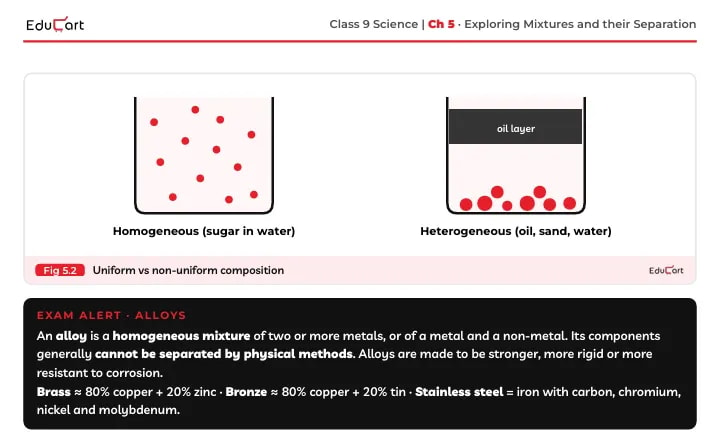
There are two main types of mixtures:
- Homogeneous mixture: It has a uniform composition throughout, and its components cannot be distinguished separately.
Examples: sugar solution, vinegar, air and alloys.
- Heterogeneous mixture: It has a non-uniform composition, and its components may be visible separately.
Examples: sand and water, oil and water, smoke and fog.
Important Example: An alloy is a homogeneous mixture of two or more metals, or a metal and a non-metal.
Brass contains approximately 80% copper and 20% zinc, while bronze contains approximately 80% copper and 20% tin. Alloys are generally made to improve strength, rigidity or resistance to corrosion.
5.2 Solutions
A solution is a homogeneous mixture of two or more substances. The substance that dissolves is called the solute, while the substance in which it dissolves is called the solvent.
For example, in a sugar solution, sugar is the solute and water is the solvent.
Mass of solution = Mass of solute + Mass of solvent
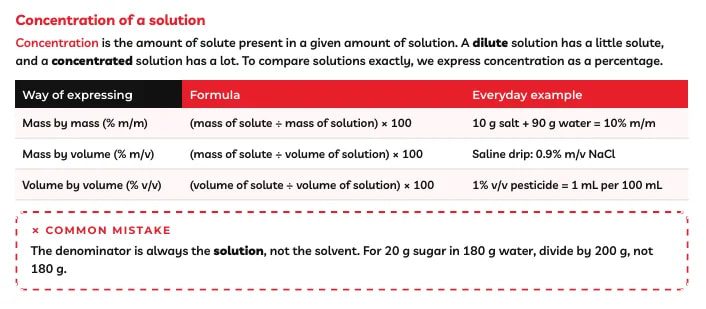
Concentration of a Solution: Concentration tells us the amount of solute present in a given amount of solution. A dilute solution contains less solute, while a concentrated solution contains more solute.
How Do We Express Concentration?
Concentration can be expressed in three ways:
- Mass by mass (% m/m): (Mass of solute ÷ Mass of solution) × 100
- Mass by volume (% m/v): (Mass of solute ÷ Volume of solution) × 100
- Volume by volume (% v/v): (Volume of solute ÷ Volume of solution) × 100
Solved Example: 20 g of sugar is dissolved in 180 g of water. Find the concentration by mass.
Given: Mass of solute = 20 g; Mass of solvent = 180 g
Mass of solution = 20 + 180 = 200 g
Using the formula:
% m/m = (20 ÷ 200) × 100 = 10%
Therefore, the concentration of the solution is 10% m/m.
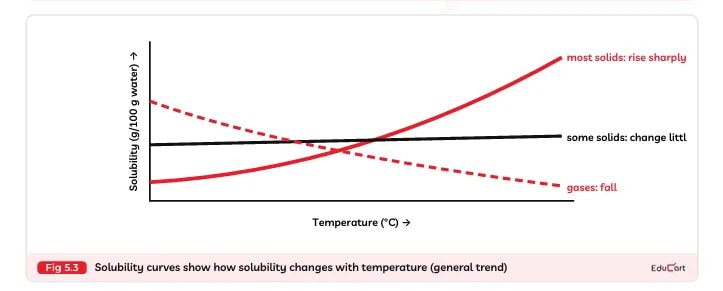
Solubility of Substances: Solubility is the maximum amount of solute that can dissolve in a fixed amount of solvent, usually 100 g of water, at a given temperature.
- Saturated solution: Cannot dissolve any more solute at a particular temperature.
- Unsaturated solution: Can dissolve more solute at that temperature.
The solubility of most solids increases with temperature, while the solubility of gases decreases. For example, more sugar dissolves in hot tea, whereas warm soft drinks lose dissolved gas faster.
5.3 Methods of Separation of Homogeneous Mixtures
Homogeneous mixtures can be separated using different physical methods based on the properties of their components.
1. Crystallisation
Crystallisation is used to obtain pure crystals of a solid from its solution. The impure solid is dissolved in a minimum amount of hot water, filtered and then cooled slowly. Pure crystals form as the solution cools, while soluble impurities remain in the leftover liquid.
Example: Purification of copper sulphate and obtaining salt from seawater.
2. Distillation
Simple distillation separates miscible liquids having a difference in boiling points of about 25°C or more. The liquid with the lower boiling point evaporates first. Its vapour is cooled in a condenser and collected as a liquid called the distillate.
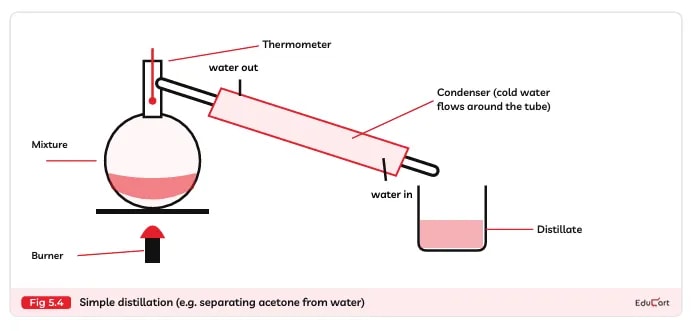
Example: Acetone and water can be separated by distillation because acetone has a lower boiling point.
When the boiling points of liquids differ by less than about 25°C, fractional distillation is used. A fractionating column helps separate the liquids more effectively.
Example: Crude oil is separated into petrol, kerosene, diesel and other fractions.
3. Paper Chromatography
Paper chromatography separates different coloured substances, such as dyes and pigments, from a mixture. A solvent moves up the paper, carrying the components at different speeds. As a result, they separate at different heights.
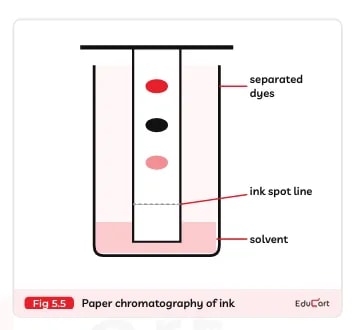
Example: Separating different dyes present in black ink or pigments present in leaves.
5.4 How Can We Separate the Components of Heterogeneous Mixtures?
Heterogeneous mixtures have a non-uniform composition and can be separated using different methods based on physical properties.
1. Separation of Two Immiscible Liquids
Immiscible liquids do not mix and form separate layers. A separating funnel is used to separate them based on their density.
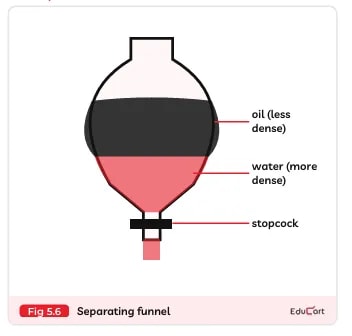
Example: A mixture of mustard oil and water can be separated using a separating funnel. Water forms the lower layer and is collected first.
2. Sublimation
Sublimation is the process in which a solid changes directly into vapour on heating without becoming liquid. The reverse process, in which vapour changes directly into solid, is called deposition.
Example: Camphor, naphthalene or ammonium chloride can be separated from sand using sublimation.
3. Suspensions
A suspension is a heterogeneous mixture in which undissolved particles remain spread in a liquid for some time. Its particles are larger than 1000 nm, settle on standing and can be separated by filtration.
Examples: Include muddy water, sand in water and sawdust in water.
Two useful methods of separating suspension particles are:
- Centrifugation: The mixture is rotated at high speed so that heavier particles settle at the bottom.
Examples: separating blood cells from plasma and cream from milk.
- Coagulation: A substance called a coagulant is added to make fine particles join together into larger lumps that settle down.
Example: Lemon juice or vinegar also causes milk proteins to coagulate while making paneer.
4. Colloids
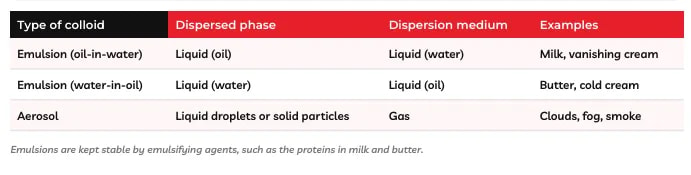
A colloid is a heterogeneous mixture with particle sizes between 1 nm and 1000 nm. Its particles do not settle on standing and cannot be separated by ordinary filtration. Colloids may look homogeneous but scatter light.
Examples: Milk, blood, ice cream, fog and clouds.
- Dispersed phase: The particles spread throughout the mixture.
- Dispersion medium: The substance in which these particles are spread.
Emulsions are colloids in which one liquid is dispersed in another liquid. Milk is an oil-in-water emulsion, while butter is a water-in-oil emulsion.
5.5 Tyndall Effect
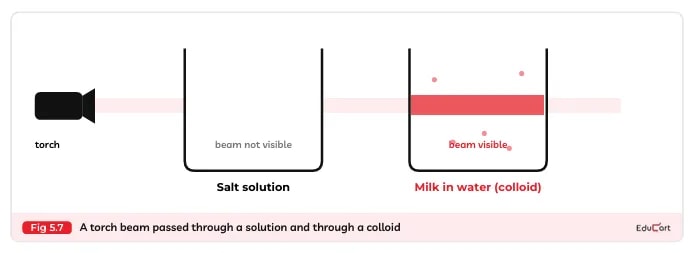
The Tyndall effect is the scattering of a beam of light by particles present in a colloid or suspension, making the path of light visible. True solutions do not show this effect because their particles are too small to scatter light.
Examples:
- Sunlight entering a dark, dusty room through a small opening.
- Headlight beams becoming visible on a foggy road.
- A torch beam passing through milk mixed with water.
Important Terms and Their Meanings
Students can use the table below to quickly revise important terms and short definitions for Class 9 Ch 5 Science notes.
Important Things to Remember from Class 9 Science Ch 5 Notes
Start with the important concepts from the Class 9 Science Ch 5 notes. Focus on these pointers below and practise regularly to avoid common mistakes. Learn the use and application of correct separation methods and their concentrations.
- Concentration numericals: Remember to calculate the total mass or volume of the solutions before using the formula. Avoid using the mass of the solvent as the denominator.
- Solubility questions: Remember that most solids dissolve more in hot water while gases are less soluble in warm water.
- Crystallisation vs Evaporation: Crystallisation is done when pure crystals are needed. Evaporation may leave soluble impurities.
- Distillation methods: Simple distillation and fractional distillation have an approximate 25°C boiling-point difference.
- Separating funnel: Water is denser than Oil. Thus, drain the lower layer of water first in water and oil mixtures.
- Centrifugation and Coagulation: Remember their practical application, like cleaning muddy water with alum by coagulation.
- Tyndall effect: Identify the examples like torch beam in fog, smoke or milk mixed with water.
Important formulas:
Important diagrams to practise:
- Simple distillation apparatus
- Separating funnel
- Paper chromatography
More Study Resources for Class 9 Science Ch 5 Notes
Along with Class 9 Science Chapter 5 notes PDF, students are required to explore more study resources. Go through the table below to find important questions and NCERT exercises to strengthen exam preparation.
Recommended Study Materials For CBSE Class 9 Science
Also, while preparing Class 9 Science Ch 5 notes, explore other recommended resources. These resources help students with other chapter-wise and subject-wise preparations for Class 9.
Frequently Asked Questions
Q1. What topics are covered in Exploring Mixtures and Their Separation Class 9 Science notes?
Ans. These notes explain types of mixtures, solutions, concentration, suspensions, colloids and separation techniques with simple explanations and examples for exam preparation.
Q2. What is the difference between a solute and a solvent?
Ans. A solute dissolves in a solvent to form a solution.
Q3. Which method is used to separate oil and water?
Ans. A separating funnel is used to separate oil and water.
Q4. What is the Tyndall effect?
Ans. It is the scattering of light by particles in a colloid or suspension.
Q5. Why is crystallisation better than evaporation for obtaining pure crystals?
Ans. Crystallisation gives purer crystals because many soluble impurities remain in the leftover liquid.