Class 9 Science Ch 4 notes: Describing Motion Around Us provides the concepts of how objects move and how to measure their motion. The chapter includes concepts like distance, displacement, speed, velocity and acceleration.
Students can learn and download a free PDF of Class 9 Science Ch 4 notes from this page. The notes cover and simplify the important topics to support your school exam preparations. This PDF helps students with quick revision and homework.
Download Describing Motion Around Us Class 9 Notes PDF
Download the complete PDF for Class 9 Science Chapter 4: Describing Motion Around Us Notes. It covers the complete chapter with definitions, formulas, solved numericals, graphs and practice questions. Students can easily download the free PDF from the link below.
Download Class 9 Science Ch 4 Notes PDF

Class 9 Science Ch 4 Notes at a Glance
NCERT Exploration for Class 9 Science Chapter 4 introduces students to the concept of motion. Pages 48 to 71 of the NCERT Class 9 Science Textbook explain how objects move along straight lines and circular paths. It also covers the measurement of motion using distance, displacement, speed and velocity with graphs, equations and numericals. Students can check the table below for the topics and sub-topics.
4.1 Motion in a Straight Line
Motion is the change in an object's position with time, measured with respect to a fixed point called a reference point. If its position does not change with time, the object is at rest.
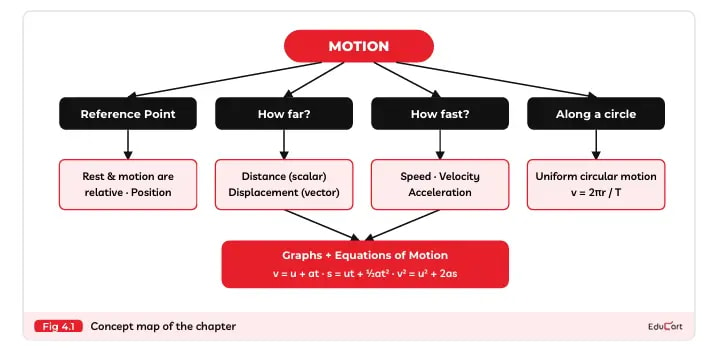
Rest and motion are relative. For example, a passenger sitting in a moving bus is at rest with respect to the bus but in motion with respect to a tree on the roadside.
4.1.1 Describing Position
The position of an object tells us where it is in relation to a reference point or origin.
- The origin is marked as zero (0).
- Positions to the right of the origin are taken as positive.
- Positions to the left of the origin are taken as negative.
Example: If a car is 20 m to the right of a tree, its position is +20 m. If it is 10 m to the left, its position is −10 m.
4.1.2 Distance Travelled and Displacement
Distance and displacement both describe how an object moves, but they are different.
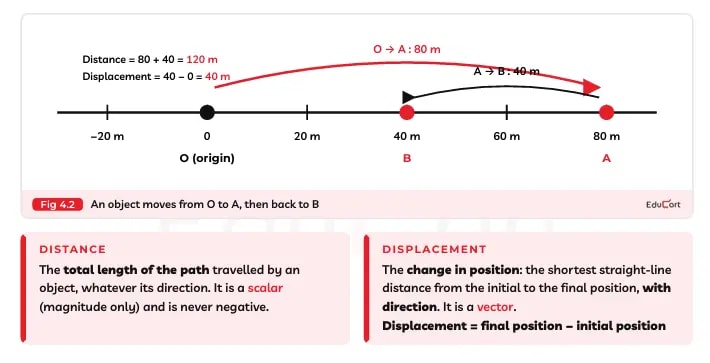
Distance: Distance is the total length of the actual path travelled by an object, regardless of its direction. It is a scalar quantity, meaning it has magnitude but no direction. It depends on the path followed and is always non-negative.
Displacement: Displacement is the shortest straight-line change in position from the starting point to the ending point, along with its direction. It is a vector quantity, meaning it has both magnitude and direction. It depends only on the initial and final positions and can be positive, negative or zero.
Formula:
Displacement = Final position − Initial position
Remember: Distance is always greater than or equal to the magnitude of displacement. If an object returns to its starting point, its displacement is zero, but its distance is not.
Solved Example: Ravi walks 300 m east and then 400 m north. Find the distance and magnitude of displacement.
- Distance = 300 + 400 = 700 m
- Displacement = √(300² + 400²) = 500 m towards the north-east
4.1.3 Average Speed and Average Velocity
Speed is the distance travelled per unit time, while velocity is the displacement per unit time in a particular direction.
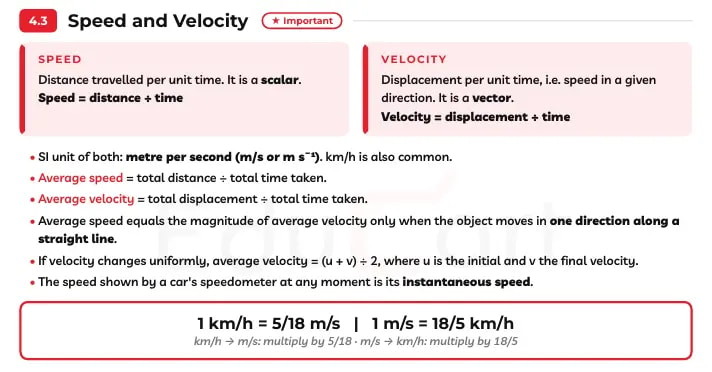
The speed shown by a vehicle's speedometer at a particular moment is called instantaneous speed.
Uniform and Non-uniform Motion
- Uniform motion: An object covers equal distances in equal intervals of time along a straight line. Its velocity remains constant.
- Non-uniform motion: An object covers unequal distances in equal intervals of time. Its velocity changes.
Unit Conversion:
- km/h to m/s: Multiply by 5/18.
- m/s to km/h: Multiply by 18/5.
Solved Example: A car travels 120 km in 2 hours and returns by the same road in 1 hour. Find its average speed and average velocity.
- Total distance = 120 + 120 = 240 km
- Total time = 2 + 1 = 3 h
- Average speed = 240 ÷ 3 = 80 km/h
- Total displacement = 0 km
- Average velocity = 0 ÷ 3 = 0 km/h
4.1.4 Average Acceleration
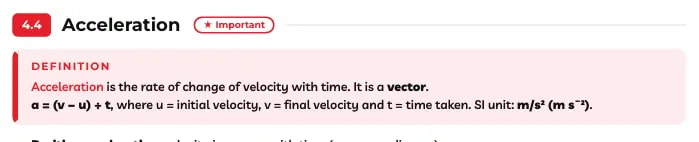
Acceleration is the rate of change of velocity with time. It is a vector quantity.
Formula:
Acceleration (a) = (Final velocity − Initial velocity) ÷ Time
a = (v − u)/t
Here, u = initial velocity, v = final velocity and t = time taken.
- Positive acceleration: Velocity increases with time.
- Negative acceleration or retardation: Velocity decreases with time.
- Uniform acceleration: Velocity changes by equal amounts in equal time intervals.
- Non-uniform acceleration: Velocity changes by unequal amounts in equal time intervals.
SI unit of acceleration: m/s²
Solved Example: A bus increases its velocity from 10 m/s to 25 m/s in 5 seconds. Find its acceleration.
a = (25 − 10)/5 = 15/5 = 3 m/s²
4.2 Graphical Representation of Motion
Graphs help us understand how an object's position or velocity changes with time. Time is generally shown on the horizontal (x) axis.
4.2.1 Plotting Graphs
To plot a graph:
- Draw two perpendicular axes.
- Mark time on the horizontal axis.
- Mark the quantity being measured on the vertical axis.
- Choose a suitable scale and plot the given values.
- Join the points to understand the pattern of motion.
4.2.2 Position-Time Graphs
A position-time graph shows how the position of an object changes with time.
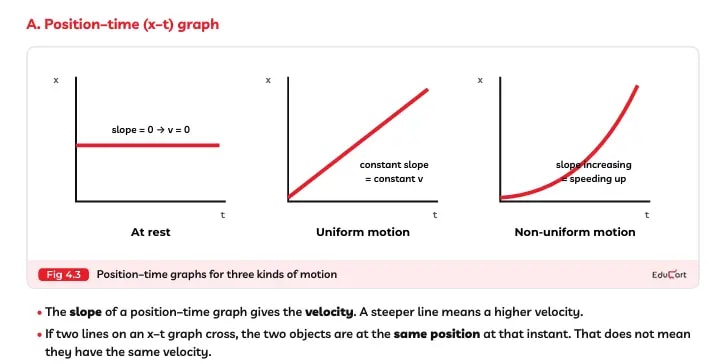
- A horizontal line indicates that the object is at rest.
- A straight sloping line indicates uniform motion.
- A curved line indicates changing velocity or non-uniform motion.
- The slope of the graph gives the object's velocity.
Remember: A steeper position-time graph represents a greater velocity.
4.2.3 Velocity-Time Graphs
A velocity-time graph shows how the velocity of an object changes with time.
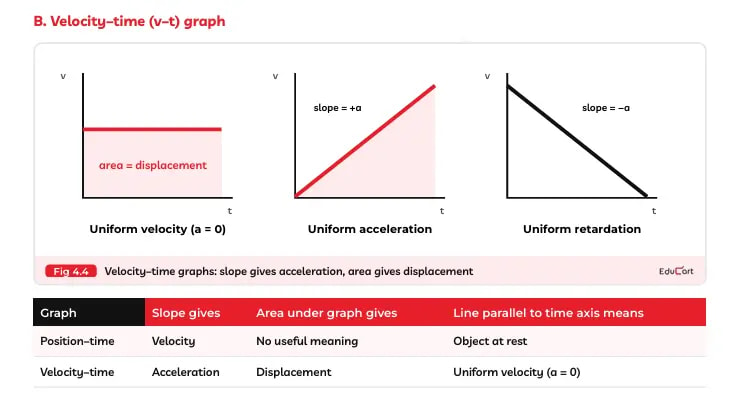
- A horizontal line indicates constant velocity and zero acceleration.
- An upward sloping straight line indicates uniform positive acceleration.
- A downward sloping straight line indicates uniform retardation.
- The slope gives acceleration.
- The area under the graph gives displacement.
Important Graph Relations
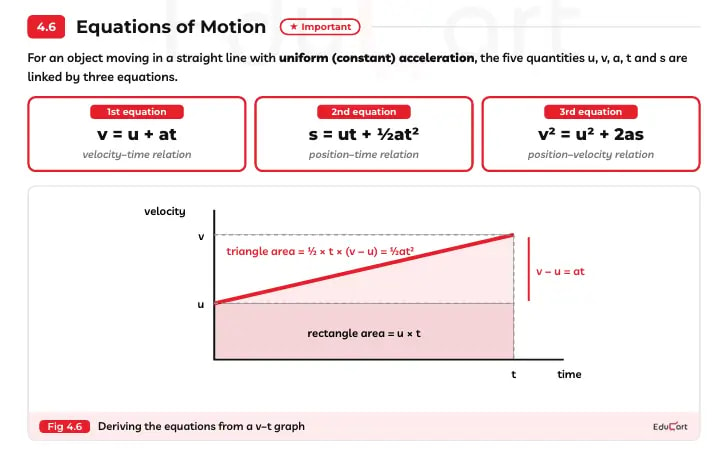
There are three important equations:
- First equation: v = u + at
- Second equation: s = ut + ½at²
- Third equation: v² = u² + 2as
Here:
- u = Initial velocity (m/s)
- v = Final velocity (m/s)
- a = Acceleration (m/s²)
- t = Time (s)
- s = Displacement (m)
Solved Example: A car starts from rest and accelerates uniformly at 2 m/s² for 5 seconds. Find its final velocity and displacement.
Given: u = 0, a = 2 m/s², t = 5 s
Using the first equation:
v = u + at = 0 + (2 × 5) = 10 m/s
Using the second equation:
s = ut + ½at²
s = 0 + ½ × 2 × 5² = 25 m
Therefore, final velocity = 10 m/s and displacement = 25 m.
4.4 Motion in a Plane
Motion in a plane takes place in two dimensions, such as along horizontal and vertical directions. Unlike straight-line motion, an object can change its direction while moving.
An important example of motion in a plane is uniform circular motion.
4.4.1 Uniform Circular Motion
When an object moves along a circular path at a constant speed, its motion is called uniform circular motion.
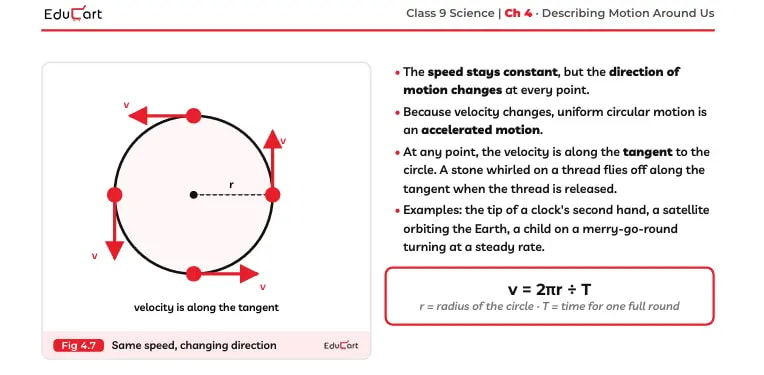
Key Points:
- The speed of the object remains constant.
- Its direction changes continuously.
- Since velocity changes with direction, the object is accelerating.
- The velocity at any point acts along the tangent to the circular path.
Examples: The tip of a clock's second hand, a satellite orbiting the Earth and a child moving on a merry-go-round.
Formula for Speed:
v = 2πr/T
Here, r = radius of the circular path and T = time taken to complete one full round.
Solved Example: An athlete runs around a circular track of radius 49 m and completes one round in 44 seconds. Find her speed. (Take π = 22/7.)
Circumference = 2πr
= 2 × 22/7 × 49 = 308 m
Speed = Distance ÷ Time
= 308 ÷ 44 = 7 m/s
Important Terms and Their Meanings
Use this list below, for quick revision and recall your understanding of the key terms from the chapter.
Important Things to Remember from Class 9 Science Ch 4 Notes
After completing the notes, students are suggested to revise key concepts from the chapter. Focus on the difference between related topics, graph interpretations and application of equations.
- Distance vs Displacement: Distance is the total path travelled, and displacement is the shortest directed distance between two positions.
- Speed vs Velocity: Speed is a scalar quantity, and velocity is a vector quantity.
- Uniform vs Non-uniform Motion: Uniform motion covers equal distances in equal time, and non-uniform motion covers unequal distances.
- Rest and Motion: Both depend on the reference point or observer.
- Position-Time vs Velocity-Time Graphs: The slope of a position-time graph gives velocity; the slope of a velocity-time graph gives acceleration.
- Uniform Circular Motion: In uniform circular motion, speed remains constant, but velocity changes due to changing direction.
- Equations of Motion: Apply these equations to straight-line motion with constant acceleration.
Important formulas:
Unit conversions: 1 km/h = 5/18 m/s; 1 m/s = 18/5 km/h.
Important diagrams:
- Position-time graphs
- Velocity-time graphs
- Uniform circular motion
More Study Resources for Class 9 Science Ch 4 Science
Students are advised to start practising after revising Ch 4 Science Class 9 Science notes. They can use textbook exercises, numerical questions and additional study resources for effective preparation. Check out the table below:
Recommended Study Materials For CBSE Class 9 Science
Class 9 Science is a foundational subject for students targeting higher studies in a science background. Students must explore highly recommended study material for a good score.
Frequently Asked Questions
Q1. What topics are covered in Exploring Mixtures and Their Separation Class 9 Science notes?
Ans. These notes explain types of mixtures, solutions, concentration, suspensions, colloids and separation techniques with simple explanations and examples for exam preparation.
Q2. What is the difference between a solute and a solvent?
Ans. A solute dissolves in a solvent to form a solution.
Q3. Which method is used to separate oil and water?
Ans. A separating funnel is used to separate oil and water.
Q4. What is the Tyndall effect?
Ans. It is the scattering of light by particles in a colloid or suspension.
Q5. Why is crystallisation better than evaporation for obtaining pure crystals?
Ans. Crystallisation gives purer crystals because many soluble impurities remain in the leftover liquid.