Class 9 is a foundation year that helps students build a strong base for future classes. CBSE Notes are an excellent resource for understanding concepts, completing assignments, building subject knowledge, and revising key points before exams. Class 9 Science Chapter 2 - Cell: The Building Block of Life Notes cover cell structure, cell membranes, organelles, cell division and cell theory.
Students can download the Class 9 Science Chapter 2 Notes PDF to build conceptual understanding and revise quickly. Click the download button below to save the PDF to your system and access it anytime, online or offline.
Download CBSE Notes for Class 9 Science Chapter 2 Cell: The Building Block of Life
Educart provides a quick way to download the Class 9 Science Ch2 Notes PDF to study cell structure and its functions. These PDFs include key concepts, definitions, and labelled diagrams to help students understand the chapter and revise effectively.

Class 9 Science Chapter 2 Notes at a Glance
Chapter 2 of Class 9 Science (Exploration), titled Cell: The Building Block of Life, pp. 8-27, covers the structures and functions of cells. It explains the functions and roles of different organelles, cell division and the principles of cell theory. The chapter also distinguishes between similar topics: diffusion and osmosis, prokaryotic and eukaryotic cells, and introduction of cancer.
2.1 How to Study Cells?
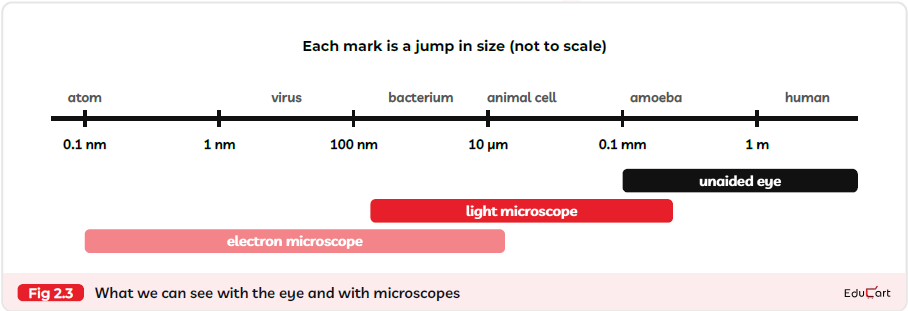
Cells are the basic units of structure and function in living things. Most cells are too small to be seen clearly with the naked eye, so we use microscopes to study them. A compound microscope has two lenses: the objective and the eyepiece.
- Total magnification = Eyepiece magnification × Objective magnification.
- In 1665, Robert Hooke observed tiny compartments in cork and named them cells.
- Light microscopes use visible light, while electron microscopes use electrons to show much smaller details.
2.2 Structure of a Cell
A cell has an outer boundary called the cell membrane or plasma membrane. Plant cells also have a cell wall outside this membrane. These coverings protect the cell and help it maintain its shape.
2.2.1 Cell Membrane: Structure and Functions
The cell membrane is a thin, flexible covering found in every cell. It is made of lipids and proteins and controls which substances enter and leave the cell.
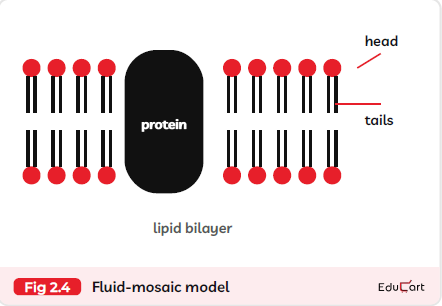
According to the fluid-mosaic model, the membrane has two layers of lipids with proteins embedded in them. These proteins help substances move across the membrane.
Two important processes are:
- Diffusion: Movement of particles from a region of higher concentration to lower concentration.
- Osmosis: Movement of water through a selectively permeable membrane from a dilute solution to a concentrated solution.
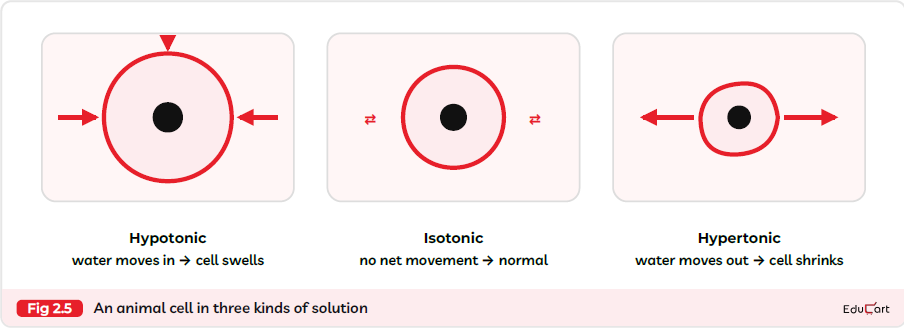
Depending on the surrounding solution, water may enter or leave a cell. A cell swells in a hypotonic solution, shrinks in a hypertonic solution and remains unchanged in an isotonic solution.
2.3 The Cell Interior: A Coordinated Working System
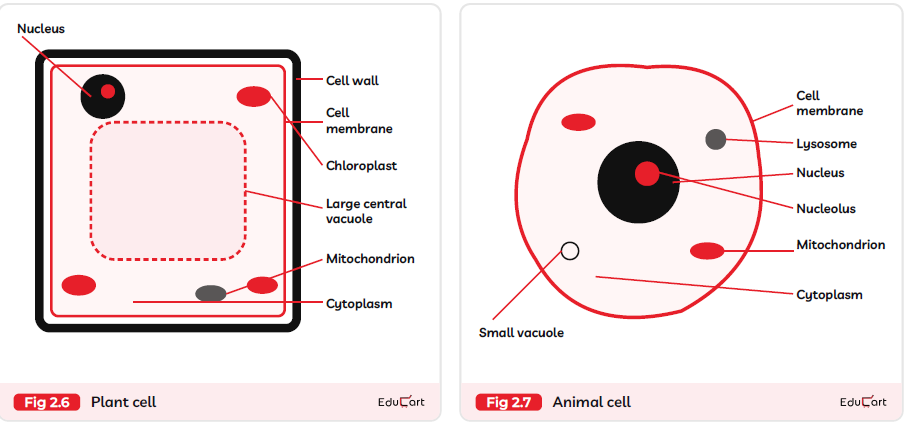
Inside a cell, the cytoplasm is a jelly-like substance that contains different cell structures called organelles. Each organelle performs a particular function.
Cells are broadly classified into two types:
- Prokaryotic cells: They do not have a membrane-bound nucleus or membrane-bound organelles. Bacteria are examples.
- Eukaryotic cells: They have a proper nucleus and membrane-bound organelles. Plants, animals and fungi have eukaryotic cells.
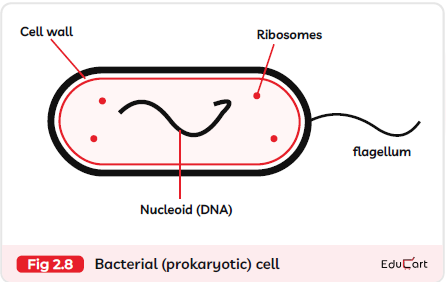
2.3.1 Cell Organelles and Their Functions
Different organelles work together to carry out the activities of a cell.
Mitochondria and plastids have their own DNA and ribosomes. Plant cells usually have a cell wall, plastids and one large central vacuole, while animal cells do not have a cell wall or plastids.
2.4 How Do Normal Cells Grow and Divide?
An organism mainly grows by producing more cells rather than by increasing the size of existing cells. Cell division also helps repair damaged tissues and replace old cells.
Both prokaryotic and eukaryotic cells divide. Eukaryotic cells follow an organised process called the cell cycle.
2.4.1 Cell Division: Mitosis and Meiosis
Cell division is the process by which new cells are formed from existing cells. It is important for growth, repair and reproduction.
There are two main types:
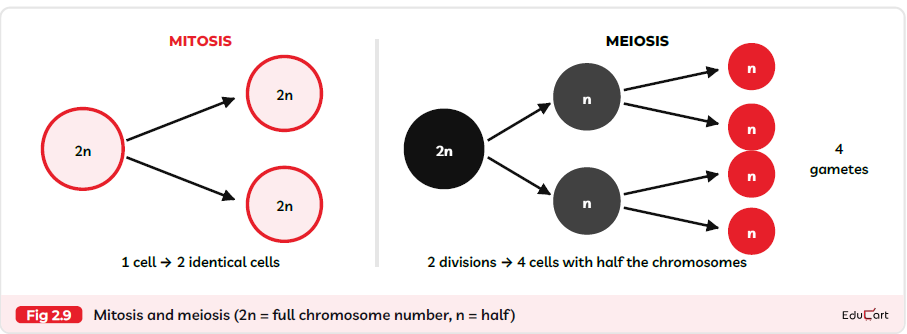
Mitosis
- Takes place in body cells.
- Involves one division.
- Produces two genetically identical daughter cells.
- Maintains the same chromosome number.
- Helps in growth and repair.
Meiosis
- Takes place in reproductive organs.
- Involves two successive divisions.
- Produces four cells, each with half the parent cell's chromosome number.
- Helps form gametes for sexual reproduction.
Cells can also be grown outside the body in a process called cell culture. It is used in research and in producing medicines, vaccines and food products.
2.5 Cell Theory: The Unifying Principle of Biology
Cell theory explains the basic role of cells in all living organisms. It was developed through the work of three scientists:
The three main points of cell theory are:
- All living organisms are made of one or more cells.
- The cell is the basic unit of structure and function in living organisms.
- All cells arise from pre-existing cells.
2.5.1 Do Cells Grow and Reproduce Forever?
No. Cells have a definite lifespan. They grow, divide when needed and eventually die.
- Contact inhibition: Many animal cells stop dividing when they come in contact with neighbouring cells.
- Cancer: Cancer cells lose this control and divide uncontrollably, which can lead to tumour formation.
- Programmed cell death: The body removes certain cells in a controlled way. This is important for development and immunity.
- Totipotency: The ability of a mature plant cell to develop into a whole plant under suitable conditions. This idea was proposed by Gottlieb Haberlandt and forms the basis of plant tissue culture.
Important Terms and Their Meanings
Important Things to Remember from Cell: The Building Block of Life Class 9
Here are some key points from Class 9 Science Ch2, Cell: The Building Block of Life Notes. Revising these key details right before the exam will help you quickly recall important concepts and prepare better.
- Robert Hooke first observed and named cells in 1665 after analysing a thin slice of cork.
- The human eye's resolution limit is about 0.1 mm, so microscopes are necessary to study most cells.
- The cell membrane is selectively permeable, and the plant cell wall gives rigidity and support.
- Diffusion moves particles from higher to lower concentration, while osmosis moves water molecules across a selectively permeable membrane.
- Prokaryotic cells lack a membrane-bound nucleus, while eukaryotic cells contain a true nucleus and membrane-bound organelles.
- Mitochondria release energy as ATP, ribosomes synthesise proteins, and chloroplasts carry out photosynthesis.
- Mitosis produces two identical daughter cells, whereas meiosis produces four cells with half the chromosome number.
- Classical cell theory states that all living organisms consist of cells and new cells arise from pre-existing cells.
Important formulas and calculations:
- Total magnification = Eyepiece magnification × Objective magnification
- Cell size = Field diameter ÷ Number of cells across the field diameter
- 1 mm = 1000 µm
- 1 nm = one-billionth of a metre
More Study Resources for Class 9 Science Chapter 2: Cell
Use these additional Class 9 Science study materials to solidify concepts, practise important questions, and the marking scheme before exams. Pair the following resources alongside your chapter notes for effective study.
Explore Recommended Books For CBSE Class 9 Science
If you’re preparing for the Class 9 Science school exam, use these recommended books to strengthen your preparation. These resources are curated to help students find relevant study resources in one place.
FAQs
Q1. Why do we need microscopes to study cells?
Microscopes are used to study most cells because humans can’t see them with the naked eye, as the resolution of human eyes is approximately 0.1 mm.
Q2. How does the cell membrane differ from the cell wall?
The cell wall provides rigidity, shape, and protection in plants, while the cell membrane regulates substance movement.
Q3. What’s the difference between mitosis and meiosis?
In meiosis, four genetically different cells are produced with half the number of chromosomes, while in mitosis, two genetically identical cells are produced for growth and repair.
Q4. What are the three principles of classical cell theory?
According to the classical theory of cells, organisms are composed of cells, cells are the basic units of life, and new cells are generated from pre-existing cells.
Q5. What is contact inhibition in cells?
Contact inhibition stops many animal cells from dividing after contact; cancer cells lose this control and may form tumours that spread.