

To Download PDF
Please verify your Whatsapp number first,
so you can download this pdf immediately


 Send OTP
.svg)




The chapter Magnetic Effects of Electric Current is one of the most conceptually rich and practical topics in Class 10 Physics. It explains how electricity and magnetism are related and how electric current can produce magnetic fields.
This chapter not only helps you understand magnetic field patterns and the working of electromagnetic devices but also connects real-life applications like household appliances and transportation systems to scientific laws.
The Magnetic Effects of Electric Current Important Questions for Class 10 Physics are designed to help you:
PREMIUM EDUCART QUESTIONS
(Most Important Questions of this Chapter from our 📕)
In the table below, we have provided the links to downloadable Magnetic Effect Of Electric Current Most Important Questions PDFs. Now you can download them without requiring a login.
Q1. Arun built a DC electric motor using whatever scrap material he had. Since he did not have a split ring, he used a full ring in contact with the brushes.

State what will be the effect of using a full ring on the movement of the axle in Arun's motor. Give a reason for your answer.
Answer: If Arun uses a full ring instead of a split ring in his DC motor, the axle of the motor will not rotate continuously. Here's why:
The split ring (commutator) is crucial for reversing the direction of current in the coil every half-turn. This reversal ensures that the torque acting on the coil remains in the same direction, allowing the motor to rotate continuously.
However, with a full ring:
In summary, the use of a full ring prevents continuous rotation because it does not reverse the current in the coil as required for proper motor operation.
Q2. An induction cooktop works on the principle of electromagnetic induction. Inside the cooktop there is a tightly wound metal coil. An alternating current flows through the coil and produces an invisible, high-frequency, alternating magnetic field all around it.
When a vessel made of magnetic material is placed on the cooktop, the magnetic field produced by the coil penetrates the iron of the vessel and induces whirling electrical (eddy) currents inside the pan and makes it hot.There is no open flame used. Heat from the pan flows directly into the food or water inside it (by conduction) without heating up the area surrounding the cooktop. Unless there is a pan on the cooktop, no heat is produced.

List any two advantages, with reasons, of cooking using an induction cooktop instead of a gas stove.
Answer: Here are two advantages of cooking using an induction cooktop instead of a gas stove:
Energy Efficiency: In an induction cooktop, heat is directly generated in the vessel through electromagnetic induction. This minimizes heat loss to the surroundings, making the process more energy-efficient compared to a gas stove, where significant heat is lost to the air around the flame.
Safety: Induction cooktops do not use an open flame, reducing the risk of burns or accidental fires. Additionally, they only generate heat when a suitable vessel is placed on the cooktop, adding an extra layer of safety, especially in households with children.
These features make induction cooktops a more efficient and safer cooking option.
Q3. The figure shows two magnets X and Y kept near each other. Their poles are not marked, but the magnetic field lines are shown in the figure.

If magnet X is moved towards magnet Y as indicated by the arrow, will the two magnets attract or repel each other? Justify your answer by describing how you interpret the field lines.
Answer: From the diagram of the magnetic field lines:
Since opposite poles attract each other, the two magnets will attract each other when magnet X is moved closer to magnet Y. The interpretation of the magnetic field lines shows that the poles facing each other are opposite in polarity (north pole of X and south pole of Y). This alignment causes an attractive force between the two magnets.
Q4. In a DC motor with a commutator, how many times does
(i) the current in the armature coil change its direction during one rotation of the coil,
(ii) the current stop flowing in the armature coil during one rotation of the coil?
Answer: (i) The current in the armature coil changes direction twice during one complete rotation.
This happens because the commutator switches the direction of the current at the point where the coil passes through the neutral position (when the coil is aligned with the magnetic field of the stator). The commutator reverses the current flow in the coil every half turn to maintain continuous rotation of the armature.
(ii) The current never completely stops flowing during one rotation in a properly functioning DC motor with a commutator.
The commutator ensures that there is always a path for the current to flow, even when the coil is at the neutral position where the current direction is reversed. The commutator continuously switches the current direction as needed, maintaining a constant flow of current.
Q5. You are given three identical 10 ohm resistors and a 12 V cell.
Draw the circuit diagram to show how the resistors can be connected with the 12 V cell so that the total heat produced in the circuit is the MINIMUM.
Answer: To minimize the total heat produced in the circuit, you should connect the resistors in series.

Q6. A current clamp is an electrical device used to measure current in a conductor without making any physical contact with the conducting part of the conductor. The current clamp has jaws that clamp around the conductor as shown below.

Some current clamps work on the principle of electromagnetic induction and hence can measure only alternating current. Give a reason why direct current cannot be measured by these current clamps.
Answer: Direct current (DC) cannot be measured by current clamps that work on the principle of electromagnetic induction because electromagnetic induction only occurs with a changing magnetic field.
Therefore, current clamps that rely on electromagnetic induction can only detect alternating current (AC), not direct current (DC), because DC does not produce the fluctuating magnetic field required for induction.
Q1. What happens when current flows through a conductor?
Answer: When an electric current passes through a conductor, a magnetic field is produced around it. This was discovered by Hans Christian Ørsted in 1820. He noticed that a compass needle placed near a current-carrying wire got deflected. This proved that electricity and magnetism are related.
Q2. What are magnetic field lines? State their properties.
Answer: Magnetic field lines are imaginary lines used to represent a magnetic field. Here are the Properties:
Q3. Explain the right-hand thumb rule.
Answer: Hold a current-carrying conductor in your right hand with the thumb pointing in the direction of current. The direction in which your curled fingers point gives the direction of the magnetic field around the conductor.
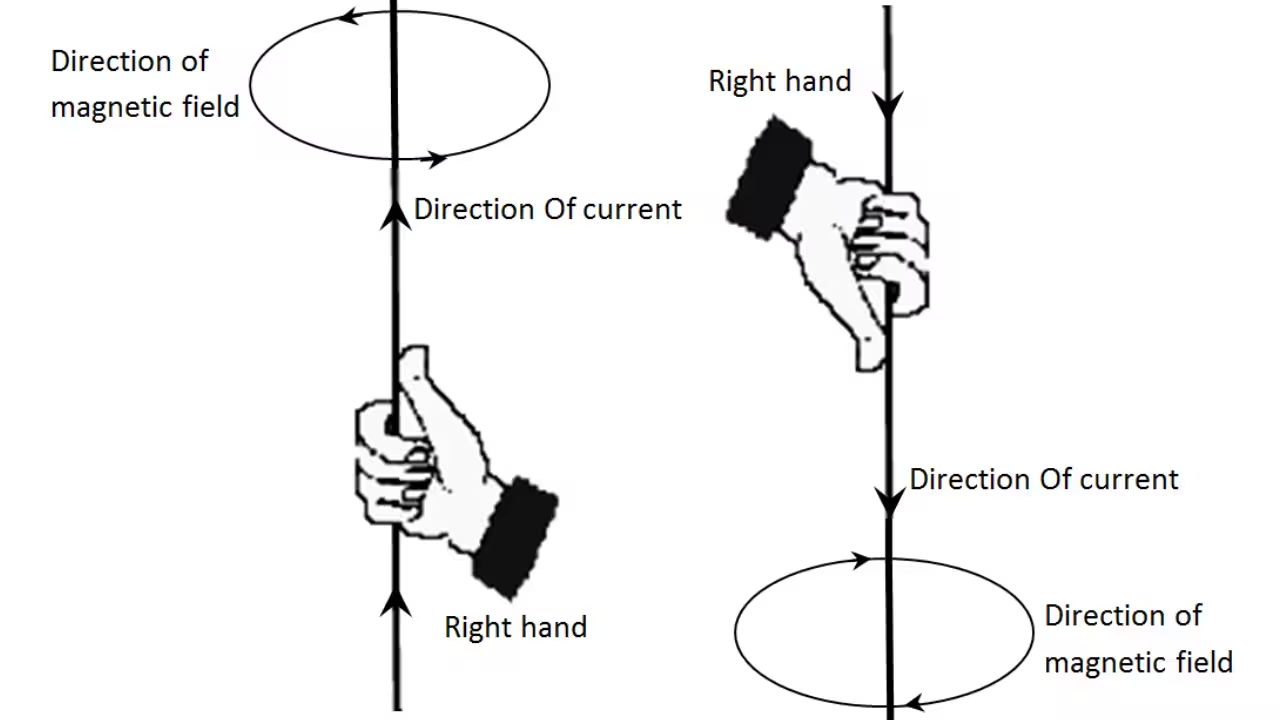
Q4. Describe the magnetic field produced by a straight current-carrying conductor.
Answer: The magnetic field forms concentric circles around the wire, with the wire as the center. The strength of the field increases with current and decreases with distance from the wire.
.avif)
Q5. How can the direction of the magnetic field be determined around a straight wire?
Answer: By using the right-hand thumb rule:
Q6. What is the magnetic field at the centre of a circular coil carrying current?
Answer: Field lines around a circular coil are circular near the wire, but at the centre they combine to give a strong magnetic field along the axis of the coil. Direction is found by the right-hand rule: curl fingers in current direction, thumb shows field direction.
Q7. What is a solenoid? Describe its magnetic field.
Answer: A solenoid is a long coil of wire wound in the form of a cylinder. When current flows, it produces a uniform magnetic field inside, similar to a bar magnet: one end acts as north, the other as south. The strength increases with:
Q8. How can you show that a current-carrying conductor in a magnetic field experiences a force?
Answer: Experiment: Place a wire between the poles of a magnet. When current flows, the wire is deflected. Reversing current or field reverses the direction of force.
Q9. State Fleming’s Left-Hand Rule.
Answer: Stretch the thumb, forefinger, and middle finger of your left hand mutually perpendicular:
This is used to find direction of motion in electric motors.
Q10. Derive the formula for force on a current-carrying conductor in a magnetic field.
Answer: Force depends on:
Maximum force when conductor is perpendicular to the field (θ = 90°).
Q11. State the principle of an electric motor.
Answer: A current-carrying conductor in a magnetic field experiences a force. In a motor, a rectangular coil rotates continuously because forces on opposite sides form a couple.
Q12. Explain the working of an electric motor.
Answer:
Applications: used in fans, mixers, pumps.
Q13. What is electromagnetic induction?
Answer: The process of producing current in a coil due to a changing magnetic field is called electromagnetic induction. It was discovered by Faraday.
Q14. How can current be induced in a coil?
Answer: By:
Q15. State Fleming’s Right-Hand Rule.
Answer: Stretch the thumb, forefinger, and middle finger of right hand perpendicular:
This is used for direction of induced current in generators.
Q16. Explain the principle and working of an electric generator.
Answer:
Principle: Electromagnetic induction - current is induced in a coil rotating in a magnetic field.
Working:
Q17. Differentiate between AC and DC.
Answer:
Q18. What is the role of a fuse in a household circuit?
Answer: Fuse is a safety device made of wire with low melting point. If current exceeds safe limit, fuse melts and breaks circuit, protecting appliances from damage.
Q19. Why are appliances in homes connected in parallel?
Answer:
Q20. What are the main safety measures in household wiring?
Answer:
Q1. Who discovered the magnetic effect of current? Explain the experiment.
Q2. Draw magnetic field lines around a bar magnet.
Q3. Explain with a diagram how a solenoid acts as a bar magnet.
Q4. Write two factors affecting the strength of magnetic field in a solenoid.
Q5. Why does a compass needle deflect near a current-carrying wire?
Q6. Explain why current reverses direction every half turn in a motor.
Q7. Define electromagnetic induction with an activity.
Q8. Draw a labelled diagram of an AC generator.
Q9. Differentiate between fuse and MCB.
Q10. Why is earthing important in electrical appliances?
This chapter is best learned through a mix of theory, diagrams, and applications. Follow these steps to prepare effectively:
Begin by learning what a magnetic field is and how its direction is represented using field lines. Study the properties of magnetic field lines - they never intersect, and their closeness indicates field strength.
This rule helps determine the direction of the magnetic field around a current-carrying conductor. Hold your right hand with the thumb pointing in the direction of current, and the curl of your fingers shows the magnetic field’s direction.
Know how magnetic field patterns change with conductor shape. Practise drawing neat field diagrams for both cases, showing the direction of field lines.
Learn how a solenoid behaves like a bar magnet, with distinct north and south poles. Study its use in creating strong magnetic fields in devices such as electromagnets.
Study the construction and working of an electric motor, including its main parts: coil, commutator, brushes, and magnets. Practise drawing its labeled diagram neatly.
Understand how current is induced when a conductor moves in a magnetic field. Study the construction and working of a simple electric generator and its difference from a motor.
Learn the basic layout of the domestic circuit, including live, neutral, and earth wires. Study safety devices such as fuses and circuit breakers (MCBs).
Chapter 12, Magnetic Effects of Electric Current, involves key principles of electromagnetism and their applications. To study this chapter better than ever, follow these preparation tips:
Master Key Rules and Laws
Practice Diagrams
Understand Practical Applications
Solve Numerical Problems
Revise Regularly
We hope that you practise the above Magnetic Effect Of Electric Current Extra Questions and achieve your dream marks.
Q1. How many marks are generally allotted to this chapter in Class 10 board exams?
Ans. This chapter usually carries 8 to 10 marks, including one or two reasoning-based and diagram questions.
Q2. Which topics are most important for board exams?
Ans. Magnetic field lines, Right-Hand and Left-Hand Rules, the working of an electric motor and generator, and electromagnetic induction are the most important topics.
Q3. Are diagrams compulsory in this chapter?
Ans. Yes, diagrams are very important. Labeled diagrams of the motor, generator, solenoid, and field lines are frequently asked and carry full marks when drawn neatly.
Q4. How can I easily remember the difference between Fleming’s rules?
Ans. Remember that Left-Hand Rule is for motors (current produces motion) and Right-Hand Rule is for generators (motion produces current).
Q5. How can I prepare this chapter effectively before exams?
Ans. Revise all key rules, draw each diagram twice, and practise short notes summarizing each topic. Focus on conceptual clarity instead of memorizing definitions.



.svg)

