.svg)

Reflection and Refraction is one of the most scoring and conceptually important topics in Class 10 Physics. It introduces you to the behavior of light when it interacts with different surfaces and mediums.
This chapter builds the foundation for advanced topics like optics and ray diagrams in higher classes. Knowing the principles of reflection and refraction helps you analyze the functioning of mirrors, lenses, and common optical instruments such as the human eye, microscopes, and cameras.
The Light: Reflection and Refraction Important Questions for Class 10 Physics help you:
- Strengthen conceptual clarity of ray diagrams and formulas.
- Practice numericals and reasoning-based questions.
- Prepare efficiently for both board exams and school assessments.
PREMIUM EDUCART QUESTIONS
(Most Important Questions of this Chapter from our 📕)
In the table below, we have provided the links to downloadable Light: Reflection And Refraction Class 10 Important Questions With Answers PDFs. Now you can download them without requiring a login.

Chapter 9 Light Reflection And Reflection Important Questions Answers
Q1. Two convex lenses P and Q have focal length 0.50 m and 0.40 m respectively. Which of the following is TRUE about the combined power of the two lenses?
a. P is equal to 4.5 D.
b. P is less than 4.5 D.
c. P is more than 4.5 D.
d. P cannot be determined from the information given.
Answer: (a) P is equal to 4.5 D
Explanation:
P=P1+P2
P= 1/f
For lens P= 2D
For lens Q= 2.5D
P=P1+P2
=2+2.5
=4.5D
Q2. When an incident ray of light enters a medium from air, it bends towards the normal.
Which of the following is TRUE about the refractive index of the medium (nm) as compared to the refractive index of air (na)?
a. nm is equal to na.
b. nm is less than na
c. nm is more than na
d. (The refractive indices cannot be compared based on the given information.)
Answer: (c) nm is more than na
Explanation:
When a ray of light enters a medium from air and bends towards the normal, it indicates that the speed of light is reduced in the medium. This happens because the refractive index of the medium (nm) is greater than the refractive index of air (na).
nasini=nmsinr
Q3. The image below shows a student demonstrating that sunrays concentrated to a point using a spherical mirror can burn a paper as a science project.
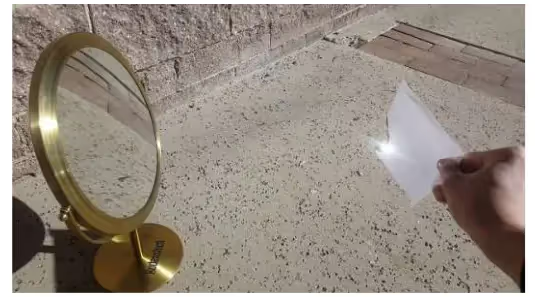
Answer the following questions.
3.1 What is the term used for the distance between the mirror and the paper?
a. radius of curvature
b. principal focus
c. principal axis
d. focal length
Answer: (d) focal length
Explanation: The paper is placed at the point where the sunrays converge after reflection from the mirror. This point is called the principal focus (F) of the mirror, and the distance between the mirror and this point is the focal length.
3.2 What kind of image would be formed on the paper?
a. real and diminished
b. real and enlarged
c. virtual and diminished
d. virtual and enlarged
Answer: (a) real and diminished
Explanation: The image formed on the paper is real because the sunrays physically converge to form the image. Real images can be projected onto a surface like paper.
The image of the Sun formed by the spherical mirror is diminished because the Sun is at a very large distance (essentially at infinity), and the image at the focal point is a small bright dot representing the concentrated rays.
Q4. If the student wishes to point the mirror to another object so as to obtain a virtual enlarged image, where should be the position of the object with respect to the mirror?
a. at principal focus
b. at centre of curvature
c. between pole and principal focus
d. between centre of curvature and principal focus
Answer: (c) between pole and principal focus
Explanation: When the object is between the pole and the principal focus, the reflected rays appear to diverge. If extended backward, they seem to originate from a point behind the mirror.
This creates a virtual, upright, and enlarged image, which can only be observed in this object position for a concave mirror.
Q5. Which of the following is NOT a common use for the type of spherical mirror used by the student for the experiment above?
a. car headlights
b. solar cooker
c. rear-view mirror
d. shaving mirrors
Answer: (c) rear-view mirror
Explanation: The experiment mentioned likely involves a convex mirror or a concave mirror, depending on the context. Let’s analyze each option based on the typical uses of these spherical mirrors:
- Car headlights: Use concave mirrors to focus light into a beam, making them efficient for projecting light over long distances.
- Solar cooker: Uses concave mirrors to concentrate sunlight at a focal point to generate heat.
- Rear-view mirror: Uses convex mirrors to provide a wider field of view for the driver.
- Shaving mirrors: Use concave mirrors to produce a magnified image when the face is close to the mirror.
The mirror used in the experiment cannot be used as a rear-view mirror, as it would typically require a convex mirror, which is not used for focusing experiments like solar cookers or headlights.
Thus, "rear-view mirror" is NOT a common use for the type of spherical mirror likely used in this experiment.
Q6. The eyeball of a person has become slightly larger. Which kind of lens should the person wear to correct the defect in the vision caused by this change in the size of the eyeball?
Answer: If the eyeball of a person has become slightly larger, the increased size causes the retina to move farther from the eye's lens. As a result, the light rays converge in front of the retina rather than directly on it. This condition is known as myopia or nearsightedness.
To correct myopia, the person should wear a lens that diverges the light rays slightly before they enter the eye, ensuring they focus properly on the retina.
Correct Lens:
- The person should wear a concave lens (a diverging lens) with negative power.
This lens spreads the incoming light rays so that the eye's lens focuses them farther back, directly onto the retina, restoring clear vision.
Q7. In a human eye, the distance between the lens and the retina is 17 mm. The light entering the eye gets refracted at the cornea and then at the lens. Ciliary muscles in the eye can control the focal length of the lens by changing its shape.
(a) Diana is looking at the Moon. What is the focal length of the combination of cornea and the lens in Diana's eyes at this time?
(b) Diana is reading a book kept at a distance of 20 cm from her eyes. What is the focal length of the combination of the cornea and the lens in Diana's eyes at this time?
(c) When Diana brings the book closer to her eyes, the letters appear blurry to her and she cannot read the book. Explain why the letters appear blurry to her.
Answer: (a) When Diana is looking at the Moon, the Moon is essentially at infinity. For an object at infinity, the light rays entering the eye are parallel, and they converge at the retina.
The focal length (f) of the eye's optical system must match the distance between the lens and the retina to form a sharp image:
f=17mm
=0.017m
(b) When Diana is reading a book at a distance of u=20 cm=0.2 m, the image is formed at the retina, so the image distance (v) is 17 mm (0.017 m).
1/f= 1/v-1/u
1/f= 1/0.017 - 1/-0.2
1/f= 58.82+5
=63.82
f= 1/63.82
≈0.0157m=15.7mm
(c) When Diana brings the book closer, the distance between the book and her eyes (uuu) becomes smaller. For the eye to focus on such a close object, the focal length of the eye's lens system must decrease further. However, the eye's ciliary muscles have a limit to how much they can adjust the lens shape. If the required adjustment exceeds this limit:
- The image no longer forms on the retina.
- The letters appear blurry because the image forms either in front of or behind the retina.
This inability to adjust sufficiently is why the letters become blurry.
Q8. Smriti is looking at herself in a convex mirror in a science museum, standing 2 m away from the mirror. Her image appears to be around half her actual height. Estimate the focal length of the mirror.
Answer: M= Height of image/Height of object
M= v/u
v= ½ . (-2)
v= −1m
The negative sign indicates that the image is virtual and behind the mirror.
1/f= 1/v - 1/u
1/f= -1 + ½
1/f= -½
f= -2m
Q9. A person needs a lens of power -5.0 D for correction of his vision.
(a) What is the possible vision defect of the person?
(b) What is the focal length of the corrective lens?
Answer: a. The power of the corrective lens is negative (−5.0 D), indicating it is a diverging lens. Diverging lenses are used to correct myopia (nearsightedness).
In myopia, the person can see nearby objects clearly but struggles to see distant objects. This occurs because the eye's lens focuses the image in front of the retina instead of on it. The diverging lens shifts the focal point back onto the retina, correcting the defect.
b. The relationship between the power PPP (in diopters) and the focal length fff (in meters) is:
P= 1/f
Substitute P=−5.0 D:
f= 1/(-5.0)
= −0.2m(or -20 cm)
Q10. The images formed by an ordinary convex lens suffer from a defect, called chromatic defect, which leads to false coloured edges in the images. This happens because light rays of different colours bend differently as they enter and leave the lens.
If a parallel white light beam passes through a convex lens, the light of which colour (among violet to red in the spectrum) will converge at a point closest to the lens? Justify your answer.
Answer: When a parallel beam of white light passes through a convex lens, the phenomenon of chromatic aberration causes light of different colors (wavelengths) to refract by different amounts. This occurs because the refractive index of the lens material varies with the wavelength of light—a phenomenon known as dispersion.
Shorter wavelengths (violet): Light with shorter wavelengths, such as violet, experiences a higher refractive index. This means violet light bends more sharply and converges closer to the lens.
Longer wavelengths (red): Light with longer wavelengths, such as red, has a lower refractive index. This means red light bends less sharply and converges farther from the lens.
The light of violet color will converge at a point closest to the lens because it has the shortest wavelength in the visible spectrum and is refracted the most by the lens. This behavior is consistent with the dispersive nature of the lens material, leading to chromatic aberration.
Some More Important Question Answers of Class 10
Q1. What is reflection of light? State the laws of reflection.
Ans. Reflection is the bouncing back of light when it strikes a smooth surface (like a mirror).
Laws of reflection:
- The angle of incidence - angle of reflection.
- Incident ray, reflected ray, and normal all lie in the same plane.
Q2. Define focal length and principal axis of a concave mirror.
Ans.
- Principal axis: Straight line passing through pole (P) and center of curvature (C).
- Focal length (f): Distance between pole (P) and focus (F).
Q3. explain ray diagrams for image formation by concave mirror for (i) object at infinity, (ii) object at focus.
Ans.
(i) Object at infinity: Rays parallel → meet at F.
- Image at focus, point-sized, real, inverted.
.avif)
(ii) Object at focus: Rays parallel after reflection.
- Image at infinity, highly enlarged, real, inverted.
.avif)
Q4. A concave mirror has a focal length 15 cm. Where will the image form if an object is placed 30 cm away?
Ans. Formula: 1/f = 1/v + 1/u
f = –15 cm, u = –30 cm
1/v = 1/f – 1/u
= (–1/15) – (–1/30)
= –2/30 + 1/30 = –1/30
So v = –30 cm → image at center of curvature, real, inverted, same size.
Q5. Differentiate between concave and convex mirrors.
Ans. Here is the difference between concave and convex mirrors.
Q6. What is refraction of light? State its laws.
Ans. Refraction is the bending of light when it passes from one medium to another due to change in speed.
Laws:
- Incident ray, refracted ray, and normal all lie in the same plane.
- Snell’s Law: sin i / sin r = constant = refractive index.
Q7. Why does a pencil in water appear bent?
Ans. Light from the submerged part bends at the water-air boundary. The eyes trace rays back in straight lines, so the pencil looks broken/bent.
Q8. Define refractive index. If speed of light in glass = 2×10^8 m/s, in air = 3×10^8 m/s, find n.
Ans. n = c/v = 3×10^8 ÷ 2×10^8 = 1.5.
So refractive index of glass = 1.5.
Q9. Why does a coin in water appear raised?
Ans. Due to refraction, rays from the coin bend away from normal. The coin appears at a shallower depth than it actually is (apparent depth phenomenon).
Q10. explain ray diagrams for convex lenses for (i) object at infinity, (ii) object at focus.
Ans. (i) At infinity: Rays parallel → converge at F. Image at F, real, inverted, very small.
(ii) At focus: Rays become parallel. Image at infinity.
Q11. A convex lens has a focal length 20 cm. Object placed at 30 cm. Find image position.
Ans. Formula: 1/f = 1/v – 1/u
f = 20 cm, u = –30 cm
1/v = 1/20 + 1/–30 = (3–2)/60 = 1/60
v = 60 cm.
So image: real, inverted, enlarged, beyond 2F.
Q12. Difference between real and virtual images.
Ans.
Q13. Why does a convex lens act as a magnifying glass?
Ans. When the object is between focus and optical center, the lens gives a virtual, erect, enlarged image. Hence used as magnifying glass.
Q14. Define power of the lens. Find the power of the lens with f = 25 cm.
Ans. Power P = 100/f(cm) = 100/25 = +4 D.
So the lens has power +4 dioptre (convex).
Q15. What is total internal reflection? Example.
Ans. When light travels from denser to rarer medium at angle > critical angle, it reflects back fully.
Example: Optical fibers, diamond sparkle.
Q16. Why is a convex mirror used as a rear-view mirror?
Ans. Convex mirrors give a wide field of view, always erect, diminished images. Useful for drivers to see more area behind.
Q17. explain ray diagram for concave mirror with object between pole and focus.
Ans.
- Rays diverge, appear to meet behind the mirror.
- Image: virtual, erect, enlarged.
Q18. An object is at 60 cm from a convex lens of f = 20 cm. Find magnification.
Ans. 1/f = 1/v – 1/u
1/20 = 1/v – 1/–60
1/v = 1/20 + 1/60 = (3+1)/60 = 4/60 = 1/15
v = 15 cm
Magnification M = v/u = 15/–60 = –0.25. So image real, inverted, ¼ size.
Q19. Define critical angle. If the refractive index of glass = 1.5, find C.
Ans. sin C = 1/n = 1/1.5 = 0.667
C = sin⁻¹(0.667) ≈ 42°.
Q20. List applications of concave and convex mirrors.
Ans.
- Concave mirrors: shaving mirror, solar furnace, headlights.
- Convex mirrors: rear-view mirrors, ATM security, hallway corners.
Video Lecture: Must-watch for Quick Revision
Extra Questions for Practice!
Q1. Derive mirror formula using ray diagram.
Q2. Explain sign conventions for spherical mirrors.
Q3. Why does a fish in water appear closer than actual?
Q4. A concave mirror of f = 20 cm forms an image at 40 cm. Find object distance.
Q5. Draw ray diagram for convex lens when object at 2F.
Q6. Differentiate between refraction through prism and lens.
Q7. Explain working of optical fibers.
Q8. Why does a diamond sparkle so much?
Q9. Write similarities and differences between reflection and refraction.
Q10. A lens has power –2 D. Find focal length and type of lens.
How to Prepare for Light – Reflection and Refraction
To perform well in this chapter, you need a balance of conceptual understanding and numerical practice. here are some of the ways:
Master the Laws and Definitions
- Memorize the laws of reflection and refraction along with their real-life examples.
- Understand critical terms like focal length, principal axis, refractive index, and critical angle.
Practice Ray Diagrams
- Practice drawing and labeling ray diagrams for mirrors and lenses.
- Ensure clarity in accurately marking the focal point, center of curvature, and image formation.
- Focus on learning the rules for constructing ray diagrams for concave and convex mirrors and lenses.
Focus on Applications
- Study the practical applications of concepts like total internal reflection (e.g., optical fibers, diamond brilliance).
- Understand the uses of concave and convex mirrors in everyday life.
Revise and Practice Regularly
- Solve NCERT exercises, exemplar problems, and additional sample papers to reinforce your understanding.
- Time yourself while solving numerical problems to improve speed and accuracy.
Clarify Doubts
- Seek help from teachers or peers for challenging topics like ray diagrams, refraction at curved surfaces, or TIR.
- Use online tutorials and animations to visualize complex phenomena.
Stay consistent in your preparation and keep practicing to shine bright, just like the light!
FAQs
Q1. How many marks are generally allotted to this chapter in Class 10 board exams?
Ans. This chapter carries around 7 to 9 marks, usually including both a numerical and a diagram-based question.
Q2. Which topics are most important for board exams?
Ans. Ray diagrams for mirrors and lenses, numericals based on the mirror and lens formula, sign conventions, and uses of concave and convex mirrors are the most important topics.
Q3. How should I remember the mirror and lens formula?
Ans. Write them down daily while revising and practise solving at least one numerical of each type. Understanding rather than memorizing helps you recall them easily.
Q4. Are ray diagrams compulsory for full marks?
Ans. Yes, whenever a question involves image formation, drawing the correct ray diagram with labels is essential for full marks.
Q5. How can I improve my speed and accuracy in numerical questions?
Ans. Practise regularly, keep units consistent, and double-check the sign conventions for each problem. Writing all steps clearly helps avoid calculation errors.












.svg)

