
.svg)

The chapter The Human Eye and the Colourful World is one of the most engaging and conceptually clear topics in Class 10 Physics. It connects the study of light with real-life phenomena, helping students understand how the human eye works and how natural occurrences like rainbows and sunsets happen.
It also explains the structure and working of the human eye, the function of the lens system, and various optical effects such as dispersion, scattering, and atmospheric refraction. These concepts build upon your understanding of reflection and refraction and form the base for higher-level studies in optics.
The Human Eye and the Colourful World Important Questions are designed to help you:
- Understand the anatomy and functioning of the human eye.
- Practise reasoning and concept-based questions related to natural optical phenomena.
The Human Eye: Structure and Function
The human eye is a spherical organ that enables us to perceive light, colour, and depth. This spherical organ serves as the primary sense organ for vision, allowing us to perceive light, colour, depth, and a vast array of visual details. It acts as a natural optical device, interpreting light and converting it into meaningful images the brain can understand.
PREMIUM EDUCART QUESTIONS
(Most Important Questions of this Chapter from our 📕)
In the table below, we have provided the links to downloadable Human Eye and Colorful World Class 10 Important Questions PDFs. Now you can download them without requiring a login.

Chapter 10 Human Eye and Colourful World: Important Questions
1. Mars's atmosphere is composed mainly of carbon dioxide, nitrogen and argon and negligible amounts of oxygen, water vapour and methane.
Using the information given in the sentence above and knowledge about how rainbows are formed on Earth, explain why rainbow formation is impossible on Mars.
Answer: Rainbows on Earth are formed when sunlight is refracted, reflected, and dispersed in water droplets, resulting in a spectrum of colors. For a rainbow to form, there must be water vapor in the atmosphere to act as the medium through which the sunlight is refracted and dispersed.
On Mars, the atmosphere contains only trace amounts of water vapor, which is insufficient for the formation of rainbows. Without significant amounts of water droplets or vapor, there is no medium to refract and reflect light in the same way it occurs on Earth. Additionally, since Mars’s atmosphere is primarily composed of carbon dioxide, nitrogen, and argon, these gases do not have the same optical properties as water, and thus, they cannot create the dispersion of light required for a rainbow.
Therefore, rainbow formation is impossible on Mars due to the lack of water vapor in its atmosphere.
2. Space is mostly vacuum, devoid of any medium.
(a) What colour does the Sun appear to the astronauts on International Space Station?
(b) Give reason for your answer to (a).
Answer: a) The Sun appears white to astronauts on the International Space Station (ISS).
(b) The reason the Sun appears white in space is that there is no atmosphere to scatter sunlight. On Earth, the atmosphere scatters shorter wavelengths of light (blue and violet), which is why the sky appears blue and the Sun appears yellowish or reddish when it is near the horizon. However, in space, without the scattering effect of the atmosphere, all wavelengths of light from the Sun reach the astronauts' eyes without distortion. As a result, the Sun appears white, which is the combination of all the colors of the visible spectrum.
3. A person's near point is at 45 cm and far point is at 2 m.
What kind of corrective lens is BEST suited for his vision defect?
a. Convex
b. Concave
c. Bifocal
d. Plano-convex
Answer: (b) concave
Explanation The person's near point is at 45 cm, and their far point is at 2 m. This indicates that they have myopia (nearsightedness), as they can see objects up close but have difficulty seeing distant objects clearly. The corrective lens needed for myopia is a concave lens.
A concave lens helps diverge light rays entering the eye, shifting the image of distant objects closer to the retina, making it easier for the person to see clearly at a distance.
4. In a medium like glass, the velocity of light increases as the wavelength increases. Which of the following light would be the fastest in glass?
a. blue
b. violet
c. green
d. Red
Answer: (d) red
Explanation In a medium like glass, the velocity of light increases as the wavelength increases. This is because the refractive index of a medium is inversely related to the wavelength of light, and shorter wavelengths (like violet and blue) are refracted more strongly, slowing down more than longer wavelengths (like red).
Given this, red light has the longest wavelength among the options, so it will travel the fastest in glass.
5. Which of the following correctly gives the sequence of events that take place when human eye changes its focus from a distant object to an object closer to the eye?
a. ciliary muscles relax --> curvature of eye lens increases --> focal length of eye lens increases
b. ciliary muscles contract --> curvature of eye lens decreases --> focal length of eye lens increases
c. ciliary muscles relax --> curvature of eye lens decreases --> focal length of eye lens decreases
d. ciliary muscles contract --> curvature of eye lens increases --> focal length of eye lens decreases
Answer: (d)ciliary muscles contract --> curvature of eye lens increases --> focal length of eye lens decreases
Explanation To focus on a near object, the ciliary muscles contract.
This causes the curvature of the eye lens to increase, making the lens more curved.
A more curved lens has a shorter focal length, allowing the eye to focus on nearby objects.
6. Which of these is a reason why a far-sighted person needs a convex lens to correct his vision?
a. The image forms in front of his retina
b. The image forms behind the retina.
c. The image forms below the retina.
d. The image forms on the retina.
Answer: (b) The image forms behind the retina.
Explanation In far-sightedness, the eye's focal point is too far behind the retina, causing difficulty in focusing on nearby objects. A convex lens converges light rays before they enter the eye, allowing the image to form on the retina instead of behind it.
7. Under which of these can myopia and hypermetropia be classified?
a. breakdown of tissues
b. incorrect bending of light in the eye
c. incorrect reflection of light by surfaces around us
d. incorrect coordination with brain for colour
Answer: (b)incorrect bending of light in the eye
Explanation Both myopia and hypermetropia are refractive errors, which occur due to the incorrect bending (or focusing) of light entering the eye. In myopia, the light is focused in front of the retina, while in hypermetropia, the light is focused behind the retina. Both conditions arise from the eye's inability to bend light correctly, often due to the shape of the eyeball or the lens.
Some More Important Question Answers of class 10 Human eye
Q1. Draw the labelled diagram of the human eye and explain the function of each part.
Answer:
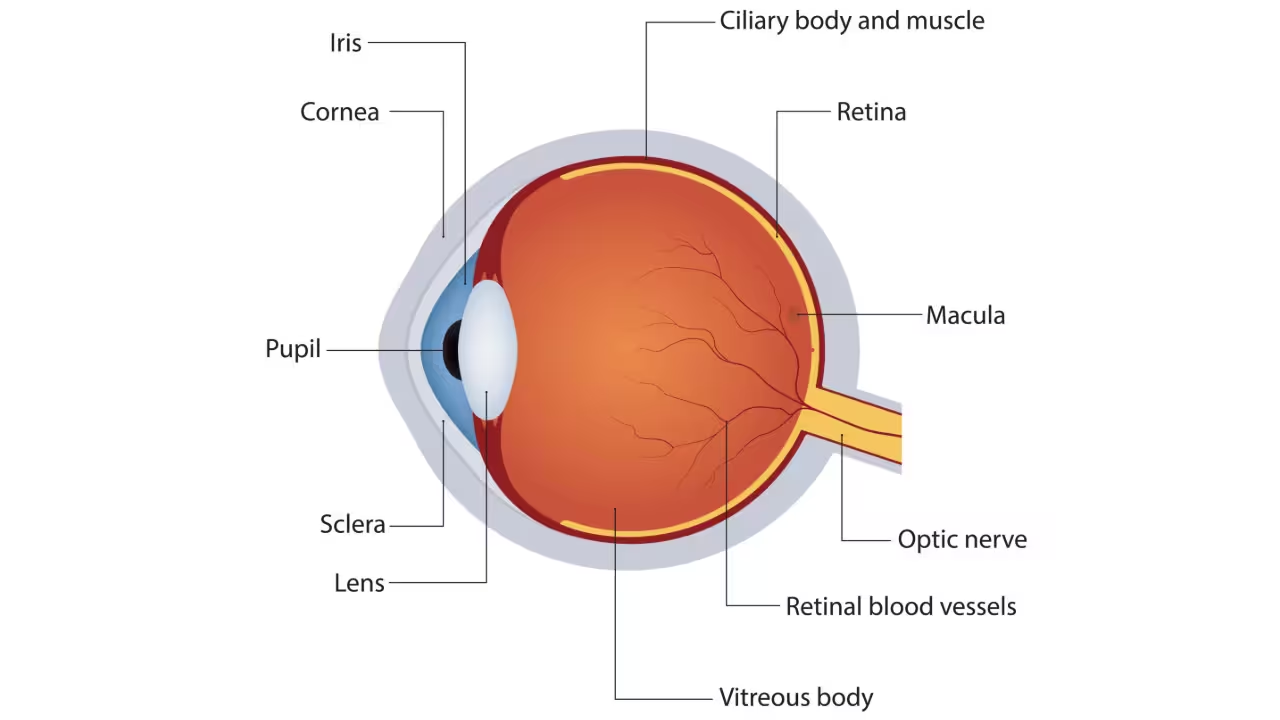
Parts & functions (step-by-step):
- Cornea: Transparent front surface. It does most of the eye’s focusing (refracts light) because of the air–cornea refractive index change.
- Aqueous humor: Thin fluid between cornea and lens; helps maintain intraocular pressure and supplies nutrients.
- Iris: Coloured diaphragm that controls pupil size (amount of light entering).
- Pupil: Central aperture (hole). Appears black; its diameter changes in bright/dim light (constriction/dilation).
- Lens (crystalline lens): Flexible, biconvex structure that fine-tunes focus (adjusts focal length) for near and far vision via accommodation.
- Ciliary muscles & suspensory ligaments: Ciliary muscles change lens shape; suspensory ligaments transmit that change to the lens.
- Vitreous humor: Transparent gel filling the eyeball behind the lens; helps maintain shape and transmits light to retina.
- Retina: Light-sensitive layer with photoreceptor cells (rods and cones). It receives the focused image and converts it into nerve signals.
- Rods: More numerous, very sensitive to low light ,produce black/white vision and detect movement.
- Cones: Work in bright light and detect colours (three types: red, green, blue sensitive).
- Fovea (central pit in retina): Small area with concentrated cones , sharpest vision.
- Optic nerve: Carries electrical signals from retina to the brain.
- Blind spot (optic disc): Point where optic nerve leaves retina; no photoreceptors → no image detection there.
Q2. How is a clear image formed on the retina?
Answer: How the eye forms an image (step-by-step):
- Light from an object enters the eye; the first refracting surface is the cornea. Because air - cornea curvature difference is large, the cornea does most of the bending (refraction) of incoming rays.
- The lens then fine-adjusts focus: by changing its shape (becoming thicker for near objects and thinner for distant objects) it changes its focal length so the final image is formed on the retina.
- The retina receives an inverted real image (upside down). The brain processes and interprets the signals, flipping them so we perceive the world right-side up.
Key points:
- For distant objects, the lens is flatter (less convex) - minimal accommodation.
- For near objects, ciliary muscles contract → suspensory ligaments loosen → lens becomes thicker → focal length shortens → rays converge on retina.
Q3. What is accommodation? Explain the mechanism of accommodation when the eye looks at (a) a far object and (b) a near object.
Answer: Accommodation is the eye’s ability to change its focal length to keep objects at different distances focused on the retina.
Mechanism (detailed):
- At rest (looking at distant object, >6 m):
- Ciliary muscles are relaxed.
- Suspensory ligaments are under tension (pull lens flat).
- Lens becomes flatter (less curved), so its focal length increases.
- Parallel rays from a distant object are focused on the retina without much bending from the lens.
- Looking at near object (e.g., 25 cm):
- Ciliary muscles contract.
- Suspensory ligaments relax (less tension).
- Lens becomes thicker/more rounded (increased curvature).
- Lens power increases (focal length decreases), allowing convergence of diverging rays from a near object onto the retina.
Physiology sequence for near vision: ciliary contraction → ligament slackening → lens thickening → increased refractive power → image on retina.
Q4. Define near point and far point of the eye. How do they change with age?
Answer:
- Near point (least distance of distinct vision): Closest distance at which the eye can see a clearly focused object when the eye is fully accommodated. For a normal young adult, it is about 25 cm.
- Far point: Furthest distance at which the eye can see objects clearly without accommodation. For a normal (emmetropic) eye, the far point is at infinity.
Change with age (presbyopia):
- With age, lens becomes less elastic and ciliary muscle efficiency decreases → eye cannot accommodate well.
- The near point recedes (moves farther away). For older people the near point may be 50 cm, 100 cm, etc.
- Far point normally remains at infinity unless there is a refractive defect.
Q5. Explain myopia (short-sightedness): cause, symptoms, diagram and correction with lens (include numerical example).
Answer: Cause: Eye is too long (axial myopia) or cornea/lens too strongly curved → image of distant objects focuses in front of the retina when the eye is relaxed.
Symptoms: Difficulty seeing distant objects clearly (e.g., blackboard looks blurry), but near objects are clear.
Ray diagram (myopia):
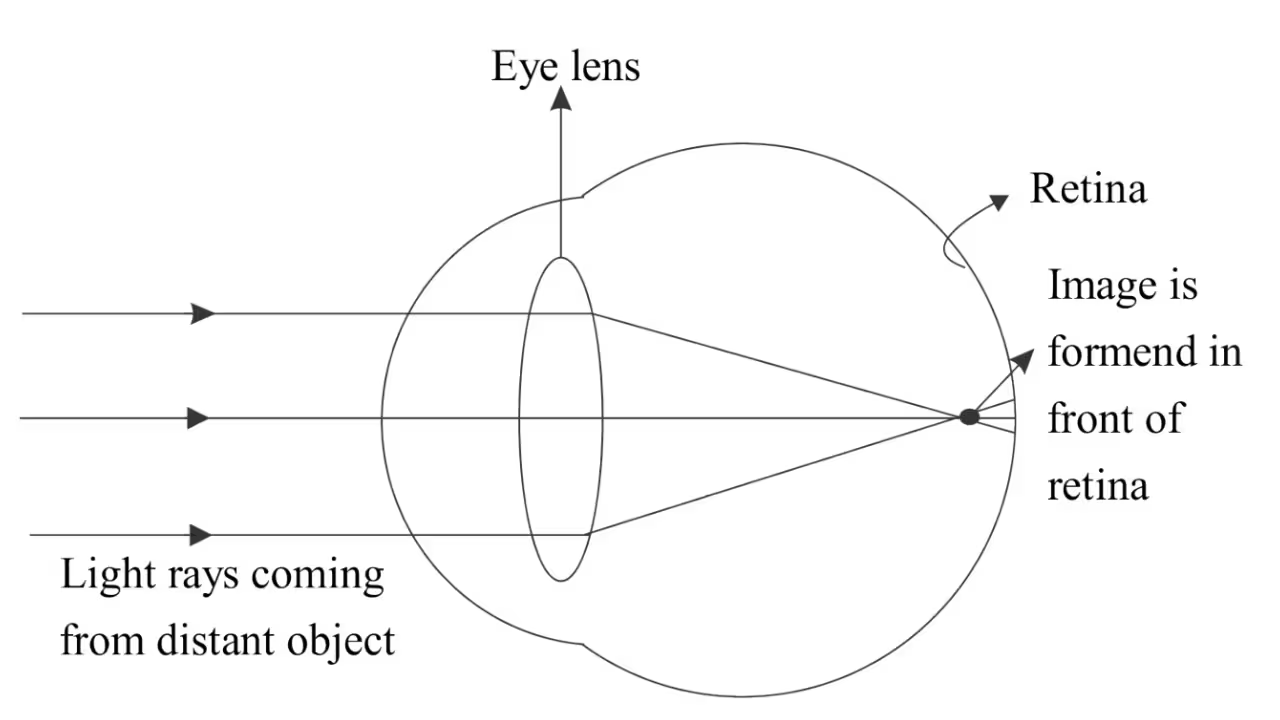
Correction: Use a concave (diverging) lens. It diverges incoming rays so that, after passing through the eye’s own lens, the rays focus on the retina. Spectacle lenses form a virtual image at the patient's far point so the eye can see distant objects.
Numerical example (step-by-step):
A student’s far point = 80 cm (i.e., beyond 80 cm he can’t see clearly). What power of the spectacle lens is required so he sees distant objects clearly (i.e., with his glasses, objects at infinity should be focused at his far point 80 cm)?
- For an object at infinity, u = −∞ (object distance negative infinity in sign convention).
- For a spectacle lens to form a virtual image at the far point (v = −80 cm). (Negative v because the virtual image is on the same side as the object/eye.)
- Use lens formula (in CM): 1f=1v−1u\dfrac{1}{f} = \dfrac{1}{v} - \dfrac{1}{u}f1=v1−u1.
Step-by-step:
- Convert v to meters: v = −80 cm = −0.80 m.
- u=−∞u = -\inftyu=−∞ so 1/u=01/u = 01/u=0.
- Thus 1/f=1/v−0=1/(−0.80)1/f = 1/v - 0 = 1/(-0.80)1/f=1/v−0=1/(−0.80)
1/f=−1.251/f = -1.251/f=−1.25 (in dioptres because f in meters). - So f=−0.8 mf = -0.8 \text{ m}f=−0.8 m.
Power P=1/f=−1.25P = 1/f = -1.25P=1/f=−1.25 dioptre (D). So a concave lens of power −1.25 D is required.
Q6. Explain hypermetropia (far-sightedness): cause, symptoms, diagram and correction with lens (include numerical example).
Answer: Cause: Eye is too short (axial hypermetropia) or lens/cornea not sufficiently curved → image of near objects focuses behind the retina when the eye is fully accommodated.
Symptoms: Difficulty seeing nearby objects clearly (reading small text), may see distant objects better if accommodation compensates.
Ray diagram (hypermetropia):
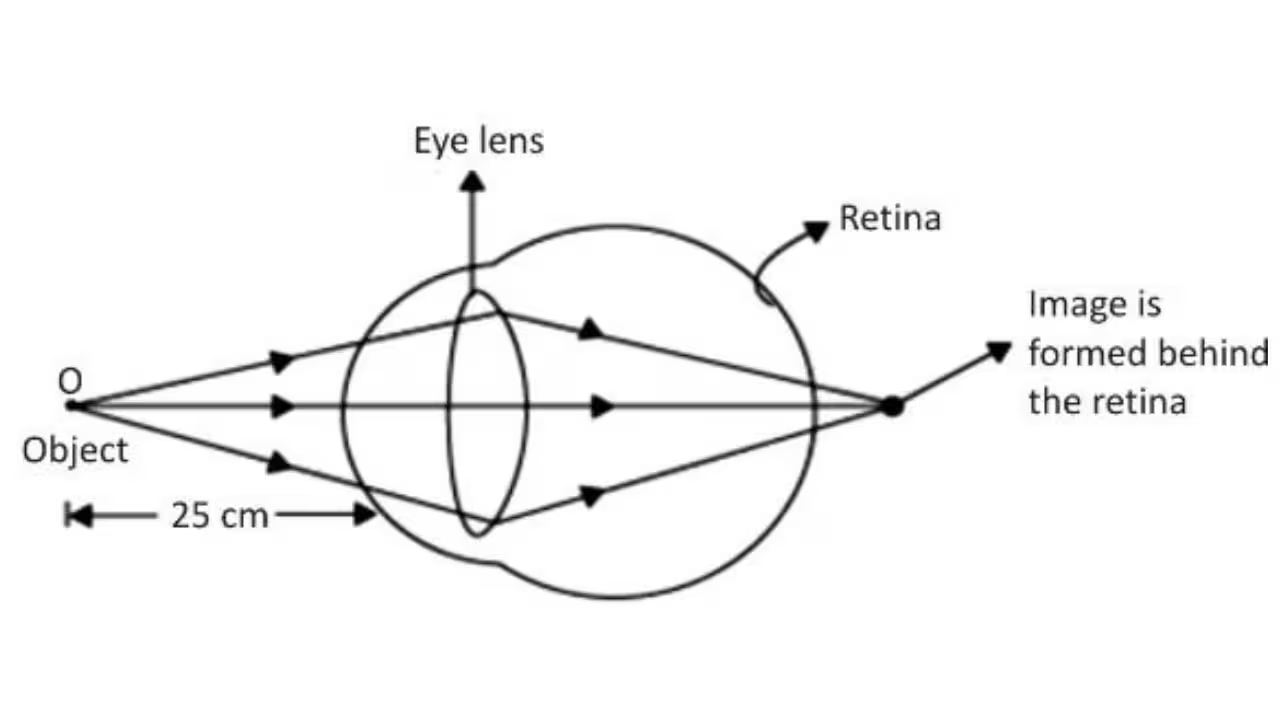
Correction: Use a convex (converging) lens. It helps by converging rays before they enter the eye so that the eye’s lens can focus them on the retina. The spectacle lens forms a virtual image of the near object at the patient’s near point (i.e., at a distance where the eye can focus).
Numerical example (step-by-step):
A person’s near point is 100 cm (1.0 m) instead of the normal 25 cm. We want to buy spectacles so that this person can read at 25 cm comfortably. Find the power of the lens required.
Goal: For an object at u = −25 cm (−0.25 m), the spectacle lens should produce a virtual image at the person’s near point v = −100 cm (−1.0 m).
Use lens formula (meters): 1f=1v−1u\dfrac{1}{f} = \dfrac{1}{v} - \dfrac{1}{u}f1=v1−u1
Step-by-step:
- Convert to meters: u = −0.25 m, v = −1.00 m.
- Compute 1/v=1/(−1.00)=−1.001/v = 1/(-1.00) = -1.001/v=1/(−1.00)=−1.00 (m⁻¹).
- Compute 1/u=1/(−0.25)=−4.001/u = 1/(-0.25) = -4.001/u=1/(−0.25)=−4.00 (m⁻¹).
- So 1/f=(−1.00)−(−4.00)=−1.00+4.00=3.001/f = (-1.00) - (-4.00) = -1.00 + 4.00 = 3.001/f=(−1.00)−(−4.00)=−1.00+4.00=3.00 (m⁻¹).
- Therefore f=1/3.00=0.333… m=+33.33 cmf = 1/3.00 = 0.333\ldots \text{ m} = +33.33\ \text{cm}f=1/3.00=0.333… m=+33.33 cm.
Power P=1/f=3.00P = 1/f = 3.00P=1/f=3.00 dioptre (D). So a convex lens of +3.0 D is required.
Q7. What is presbyopia? How is it corrected?
Answer: Presbyopia is an age-related defect where the eye gradually loses ability to accommodate (lens becomes less elastic). Near point recedes; reading close objects becomes difficult, typically starting around 40 years.
Correction: Bifocal spectacles are commonly used - lower part is for near vision (convex lens segment), upper part for distance. Alternatively, reading glasses (convex) for near tasks and normal glasses for distance.
Q8. Define astigmatism. Cause and correction.
Answer:
- Astigmatism is a defect in which the eye does not focus light evenly on the retina, causing blurred or distorted vision for both near and far objects.
- Cause: Irregular curvature of the cornea (not perfectly spherical - often slightly cylindrical) or lens irregularity leads to different focal lengths in different meridians (directions), so vertical and horizontal lines focus differently.
- Correction: Use cylindrical lenses (toric lenses) in spectacles which compensate for differing curvatures; contact lenses or refractive surgery (e.g., LASIK) are other treatments.
Q9. What is the blind spot? How can you locate your blind spot?
Answer:
- Blind spot (optic disc): Area on retina where optic nerve fibers exit; contains no photoreceptors, so light falling here is not detected → corresponding part of the visual field is blind.
- Locate blind spot (simple test):
- Close your left eye.
- Hold a paper with a small dot (●) on the left and a cross (✚) on the right, about 30 cm away.
- Fix your gaze on the cross (✚). Slowly move the paper closer/farther while keeping your gaze fixed.
- At a certain distance the dot (●) will disappear - that’s when its image falls on your blind spot.
Q10. What are rods and cones? How do they differ in structure and function?
Answer:
Roles: rods give night (scotopic) and motion vision; cones give daytime (photopic) and colour vision and high acuity.
Q11. What is diffraction, interference, dispersion and scattering — give short definitions and one example each.
Answer:
- Diffraction: Bending of light around edges or through small openings; e.g., pattern of light/dark fringes when monochromatic light passes through a small slit.
- Interference: Superposition of two coherent light waves producing bright/dark fringes; e.g., Young’s double-slit experiment.
- Dispersion: Splitting of white light into constituent colours because refractive index depends on wavelength; e.g., prism forming a spectrum.
- Scattering: Redirection of light by small particles in a medium; intensity depends on particle size and wavelength (Rayleigh/Mie scattering); e.g., blue sky due to Rayleigh scattering.
Q12. Explain dispersion of white light by a glass prism. Why do different colours deviate by different amounts?
Answer:
- Dispersion occurs because the refractive index nnn of glass depends on wavelength λ (shorter λ → larger nnn). When white light enters a prism, each wavelength refracts by a different angle (Snell’s law: nsini=n′sinrn \sin i = n' \sin rnsini=n′sinr).
- Sequence of steps (detailed):
- White light enters the prism - shorter wavelengths (violet, blue) slow down more and bend more toward the normal than longer wavelengths (red).
- Inside the prism, different colours travel in slightly different directions.
- On emerging, again each colour refracts differently; overall result is a spread of colours - the spectrum (VIBGYOR: Violet (inner), Indigo, Blue, Green, Yellow, Orange, Red (outer)).
- Why different deviations? Because refractive index n(λ) is larger for shorter wavelengths; deviation angle ∝ (n−1) → shorter λ deviate more.
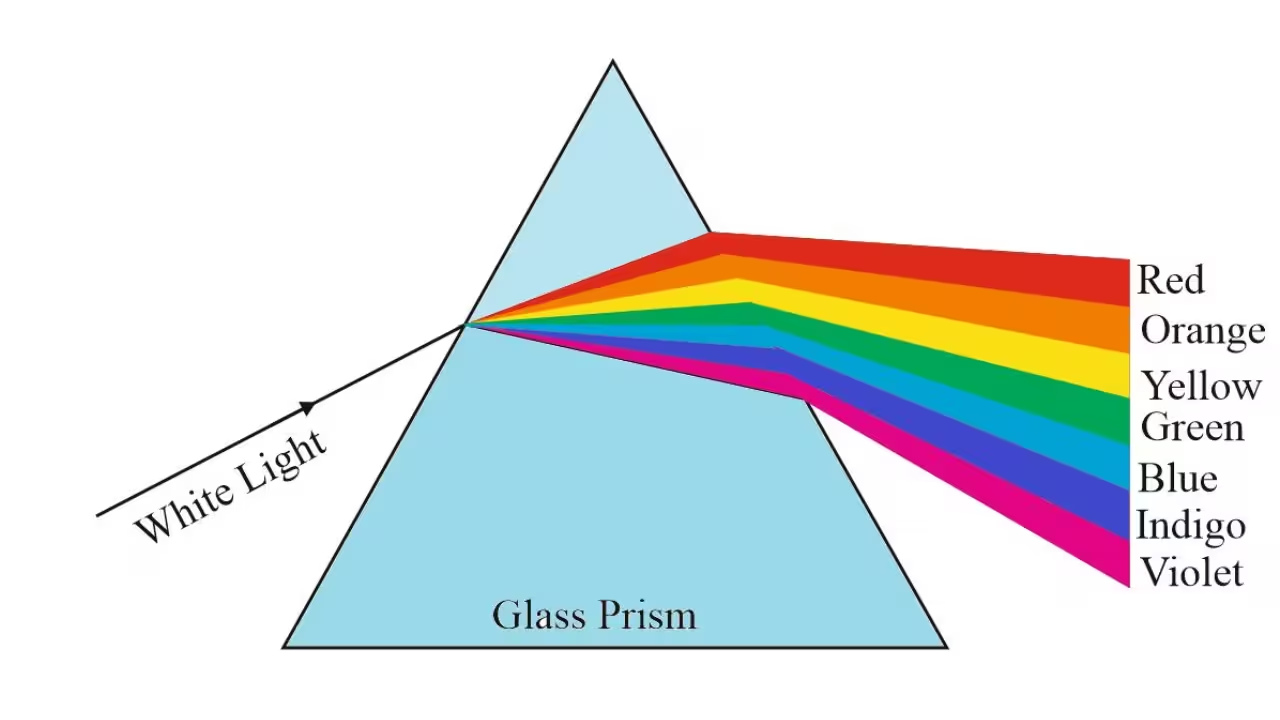
Q13. What is the visible spectrum and what are the colours in order?
Answer:
- Visible spectrum: Portion of electromagnetic spectrum human eyes can detect (wavelength ~380 nm to 750 nm).
- Order (from longer λ to shorter λ): Red → Orange → Yellow → Green → Blue → Indigo → Violet (ROYG BIV).
Q14. Explain why the sky appears blue during the day and why sunrise/sunset appears red.
Answer: This is explained by Rayleigh scattering (scattering by particles much smaller than wavelength - molecules of air):
- Intensity of scattered light ∝ 1/λ⁴. Shorter wavelengths (blue, violet) scatter much more than longer wavelengths (red).
- Why sky is blue: Sunlight reaches us after scattering by air molecules. Blue light (λ ≈ 450 nm) is scattered strongly in all directions, so the sky looks blue from every direction. Although violet scatters even more, our eyes are less sensitive to violet, and some violet is absorbed by the upper atmosphere, so the sky appears blue.
- Why sunrise/sunset is red: When the sun is near the horizon, sunlight passes a much longer path through the atmosphere. Shorter wavelengths (blue/green) get scattered away before reaching the observer; the remaining direct sunlight that reaches the eye is rich in longer wavelengths (red, orange) → sun and sky near the horizon appear red/orange.
Q15. What is a rainbow? Explain its formation (primary rainbow) with diagram and order of colours.
Answer: A rainbow is a circular arc of colours produced by dispersion, refraction and internal reflection of sunlight by spherical water droplets.
Step-by-step (primary rainbow - detailed):
- Refraction at entry: A ray of sunlight enters a spherical raindrop; it bends (refracts) and disperses into component colours because each colour has a slightly different refractive index.
- Internal reflection: Inside the drop, the refracted rays reflect off the inner back surface (one internal reflection for primary rainbow).
- Refraction on exit: The reflected rays refract again when they exit the drop into air. Each colour emerges at a slightly different angle.
- Observation geometry: For an observer, the directions of maximum intensity for the colours form a cone with the observer’s eye at the apex and centre at the antisolar point (opposite the Sun). For red, the angle between incoming sunlight direction and red rays that reach the eye is about 42°; for violet about 40°. Thus, red appears on the outer edge and violet on the inner edge.
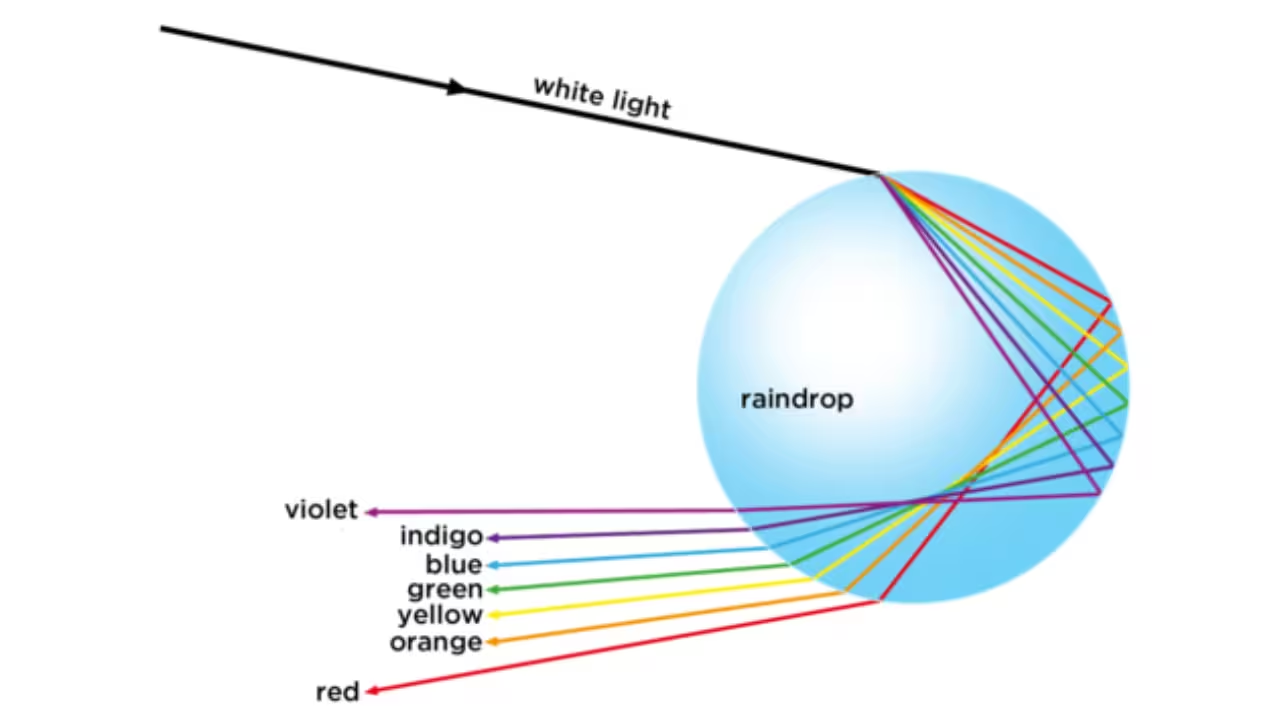
Order of colours (outer → inner): Red, Orange, Yellow, Green, Blue, Indigo, Violet.
Q16. Why is the secondary rainbow fainter and why are its colours reversed?
Answer:
- Secondary rainbow forms when sunlight undergoes two internal reflections inside raindrops (instead of one).
- Reversed order: Each internal reflection reverses the order of colours; two reflections reverse order compared to primary, so violet is outer and red inner for secondary rainbow (i.e., colours reversed relative to primary).
- Fainter: With each internal reflection some light is lost (partial transmission at each surface) - two internal reflections reduce intensity more than one, hence the secondary rainbow is dimmer.
- The secondary rainbow appears at a larger angle (~50–53° from the antisolar point).
Q17. Explain Tyndall effect and how it differs from Rayleigh scattering and dispersion. Give examples.
Answer:
- Tyndall effect: Scattering of light by colloidal particles (sizes comparable to wavelength). It makes a beam of light visible in a colloidal medium (e.g., dust in air, milk in water). Example: light beam visible in fog or dusty room.
- Differences:
- Rayleigh scattering: scattering by molecules (particles much smaller than wavelength) - intensity ∝ 1/λ⁴; explains blue sky.
- Tyndall/Mie scattering: particles comparable to wavelength → scattering is less wavelength-dependent (bigger particles scatter all wavelengths more equally) → explains why clouds appear white (water droplets are large, scatter all colours).
- Dispersion: separation of colours due to refractive index dependence on wavelength in transparent medium (prism, not scattering).
Q18. What causes the twinkling of stars and why don’t planets twinkle as much?
Answer:
- Twinkling (scintillation) is caused by rapid changes in the refractive index of air (atmospheric turbulence). As starlight passes through different moving air pockets with varying temperature/density, its path bends slightly causing brightness and position to vary quickly - twinkling.
- Why stars more than planets? Stars are effectively point sources (very tiny apparent angular size). Small deviations cause large apparent fluctuations. Planets have a finite angular size (disc) - the varying deviations average out across the disc, so planets twinkle much less.
Q19. How can white light be recombined after dispersion? Give an example (use two prisms).
Ans. After a prism separates white light into spectrum, another prism (inverted relative to the first) can recombine the colours back into white light because dispersion is reversible (if the second prism has the same material and angle arranged to reverse the angular separation).
Example (two-prism experiment): Pass white light through prism A → get spectrum. Place an identical prism B with its apex inverted so the deviated colours enter B in the correct order → emerging beam recombines to white.
Q20. List practical applications/phenomena that use dispersion or scattering (6 examples with brief explanations).
Answer:
- Spectroscope / spectrometer: Uses dispersion by prism/grating to obtain spectral lines for identifying elements.
- Rainbow observation: Natural dispersion & reflection in raindrops produces rainbow.
- Optical fibres (low scattering requirement): Fibres require materials with minimal scattering for long-distance signal transmission.
- Atmospheric optics (sunset colours): Rayleigh scattering explains sunsets and sky colours.
- Filters & colour displays: Use selective absorption (not dispersion exactly) informed by knowledge of wavelengths of colours.
- Tyndall effect in colloids: Used in quality checks of colloidal suspensions (e.g., milk, fog machines).
Video Lecture: Must-watch for Quick Revision
Extra Questions for Practice!
Q1. Draw and label a neat diagram showing accommodation for near and distant objects.
Q2. A short-sighted person has a far point of 1.2 m. Find the power of the lens required to correct the defect for distant vision.
Q3. Explain why resolution of the human eye is maximum at fovea and why rods are absent there.
Q4. Describe the formation of image in camera and compare it with formation of image in the eye.
Q5. Why do clouds appear white but the sky is blue? Explain using particle size and scattering.
Q6. Using Snell’s law, explain why violet light bends more than red light on entering glass.
Q7. Show with a diagram how a prism can split and then recombine a beam of light.
Q8. Explain with a diagram how spectacles for presbyopia (bifocal lenses) are designed.
Q9. What is chromatic aberration in lenses? How is it minimized in optical instruments?
Q10. Explain why the sun appears flattened (slightly) at sunrise/sunset (use atmospheric refraction).
How to Ace These Class 10 Human Eye and the Colourful World Important Questions
To master this chapter, focus on conceptual understanding and visual learning through diagrams. Here is a step-by-step approach to prepare effectively:
Step 1: Learn the Structure of the Human Eye
Understand the parts of the human eye, including the cornea, iris, pupil, lens, retina, and optic nerve. Learn their functions and how they work together to form images.
Step 2: Understand the Functioning of the Eye
Study how light enters the eye, how the image is formed on the retina, and how the brain interprets it. Learn the concept of power of accommodation, which allows the eye to adjust its focal length for near and distant vision.
Step 3: Revise Defects of Vision
Learn the three main eye defects – myopia (short-sightedness), hypermetropia (long-sightedness), and presbyopia. Understand their causes, corrective lenses used, and how these lenses adjust the focal length to fix vision. Draw neat diagrams showing each defect and its correction.
Step 4: Study Dispersion of Light
Understand what happens when white light passes through a prism and splits into seven colours (VIBGYOR). Revise the terms dispersion, refractive index, and deviation.
Step 5: Learn Atmospheric Refraction and Its Effects
Study how light bends through the atmosphere, leading to phenomena like the apparent position of stars, early sunrise, and delayed sunset. These reasoning-based questions are frequently asked in board exams.
Step 6: Understand Scattering of Light
Learn how scattering of light explains natural events such as the blue colour of the sky and reddish appearance of the sun during sunrise and sunset.
Step 7: Practise Diagrams and Labeling
Draw the diagram of the human eye, ray diagrams showing defects and corrections, and the dispersion of light through a prism. Diagrams are key to scoring full marks.
How to Ace These Class 10 Human Eye and the Colourful World Important Questions
To master this chapter, focus on conceptual understanding and visual learning through diagrams. Here is a step-by-step approach to prepare effectively:
Step 1: Learn the Structure of the Human Eye
Understand the parts of the human eye, including the cornea, iris, pupil, lens, retina, and optic nerve. Learn their functions and how they work together to form images.
Step 2: Understand the Functioning of the Eye
Study how light enters the eye, how the image is formed on the retina, and how the brain interprets it. Learn the concept of power of accommodation, which allows the eye to adjust its focal length for near and distant vision.
Step 3: Revise Defects of Vision
Learn the three main eye defects – myopia (short-sightedness), hypermetropia (long-sightedness), and presbyopia. Understand their causes, corrective lenses used, and how these lenses adjust the focal length to fix vision. Draw neat diagrams showing each defect and its correction.
Step 4: Study Dispersion of Light
Understand what happens when white light passes through a prism and splits into seven colours (VIBGYOR). Revise the terms dispersion, refractive index, and deviation.
Step 5: Learn Atmospheric Refraction and Its Effects
Study how light bends through the atmosphere, leading to phenomena like the apparent position of stars, early sunrise, and delayed sunset. These reasoning-based questions are frequently asked in board exams.
Step 6: Understand Scattering of Light
Learn how scattering of light explains natural events such as the blue colour of the sky and reddish appearance of the sun during sunrise and sunset.
Step 7: Practise Diagrams and Labeling
Draw the diagram of the human eye, ray diagrams showing defects and corrections, and the dispersion of light through a prism. Diagrams are key to scoring full marks.
Tips to Use These Human Eye and Colourful World Chapter
By focusing on these strategies, you can master both the theoretical and practical aspects of Chapter 10 of CBSE Class 10 effectively:
1. Master the Eye’s Structure: Practice labelling diagrams of the eye and understand the function of each part, like the cornea, lens, retina, and optic nerve.
2. Focus on Vision Defects: Learn the causes, symptoms, and corrections for myopia, hypermetropia, presbyopia, and astigmatism.
3. Understand Atmospheric Phenomena: Study concepts like the twinkling of stars, the Tyndall effect, and the dispersion of light. Connect these to examples like rainbows and red sunsets.
4. Practice Ray Diagrams: Draw and label ray diagrams for refraction through lenses, light dispersion in prisms, and rainbow formation.
5. Solve Application-Based Questions: Work on numerical problems involving lens formulas, power of lenses, and critical angles. Solve CBSE sample and past papers for better preparation.
6. Regular Revision: Revise key topics and formulas regularly to strengthen your understanding.
FAQs
Q1. How many marks are generally allotted to this chapter in Class 10 board exams?
Ans. This chapter usually carries 5 to 7 marks, often including one diagram-based and one reasoning-based question.
Q2. Which topics are most important for exams?
Ans. Structure of the human eye, defects of vision and their corrections, dispersion of light, and atmospheric refraction are the most important topics.
Q3. How can I remember which lenses correct which eye defects?
Ans. Remember that concave lenses correct myopia (short-sightedness) and convex lenses correct hypermetropia (long-sightedness). Presbyopia is corrected by bifocal lenses.
Q4. Are diagrams compulsory in this chapter?
Ans. Diagrams are not compulsory in every question, but they are strongly recommended for full marks wherever relevant.
Q5. How can I prepare for reasoning-type questions in this chapter?
Ans. Understand the scientific principle behind each phenomenon instead of memorising answers. Link it with examples from daily life for better recall.












.svg)

