
.svg)

Polynomials are an important chapter of class 10 mathematics syllabus; they form a fundamental basis of the curriculum. Understanding polynomials is important as they provide a base for more advanced concepts that students may face in their future studies. In Class 10, chapter 2 of the math is named Polynomials.
To help students excel in their exams, here we will explore the most important questions, class 10 Maths ch 2 with extra questions, to ensure that our students are always equipped with the right study materials and have a good understanding of the chapter.
Constants: 1, 5, 8, etc
Variables: x, y, p, r, etc
Exponents: 6 in x5, etc.
IMPORTANT QUESTIONS CH2 MATHS
(Most Important Questions of this Chapter from our 📕)
In the table given below, we have provided the downloadable links to Polynomials Class 10 Important Questions With Answers Pdf. Now you can download them without requiring a login.
Class 10 Ch2 Polynomials Important Questions 2026
Q1. (x2-3√2x+4)/(x2-√2) ; x =√2
At how many points does the graph of the above expression intersect the x-axis? Show your work.
Ans. The points where the graph of the above expression intersects the x-axis represent the zero of a polynomial.
The zero of a polynomial is obtained by equating fx to zero.
fx=0
⇒x2-32x+4x-2=0
Now factorising the numerator, we get
⇒x2-2√2x-2x+4/(x-√2)=0
⇒xx-2√2-√2x-2√2/(x-√2)=0
⇒x-√2x-2√2x-√2=0
So, we get x-2√2=0
Hence, there is only one point where the graph of the expression intersects the x-axis is x=2√2
Q2. p and q are zeroes of the polynomial 2x2+5x-4.
Without finding the actual values of p and q, evaluate (1 - p)(1 − q ). Show your steps.
Ans. Given that, p and q are the zeroes of a polynomial 2x2+5x-4.
We need to find the value of (1-p)(1-q).
(1-p)(1-q)=1-q-p+pq
(1-p)(1-q)=1-p+q+pq ...(i)
Using the relation between the zeroes and the coefficients of the quadratic polynomial, we get
Sum of the zeroes =-b/a
Product of the zeroes =c/a
where, the standard form of a quadratic polynomial is fx=ax2+bx+c
Here in the given polynomial, we get a=2, b=5, c=-4
So, the sum of the zeroes =-5/2
The product of the zeroes =-4/2=-2
So, p+q=-5/2 and pq=-2
Substituting the value of p+q and pq in equation(i), we get
(1-p1-q)=1-(-5/2)+(-2)
=-1+5/2=3/2
Hence, the value of (1-p)(1-q) is 3/2
Q3. The sum of two zeroes of q ( x ) is zero.Using the relationship between the zeroes and coefficients of a polynomial, find the:i) zeroes of q ( x ).ii) value of k.Show your steps.
A polynomial is given by q ( x ) = x3- 2x2-9x+k, where k is a constant.
Ans. q ( x ) = x3- 2x2-9x+k
α+β=0
This implies:
β=−α
From α+β+γ=2
= 2α+β+γ=2 and α+β=0
γ=2
Substitute β=−α and γ=2 into αβ+βγ+γα=−9:
α(−α)+(−α)(2)+(2)(α)=−9
Simplify:
−α2−2α+2α=−9
−α2=−9
α2=9
Thus:
α=3 orα=−3
If α=3 then β=−3 then If α=-3 then β=3
From αβγ=−k, substitute α=3, β=−3, and γ=2:
(3)(−3)(2)=−k
-18 = -k
k=18
Verify the Zeroes
The zeroes are α=3, β=−3, and γ=2. Verify:
- Sum of the zeroes: 3+(−3)+2=2 (correct).
- Product of zeroes taken two at a time:3(−3)+(−3)(2)+(2)(3)=−9 (correct).
- Product of zeroes: 3(−3)(2)=−18 so k=18 (correct).
Final Answer:
i) The zeroes of q(x) are 3, −3, and 2.
ii) The value of k is 18.
Q4. p ( x ) = ax2 - 8 x + 3, where a is a non-zero real number. One zero of p ( x ) is 3 times the other zero.
i) Find the value of a. Show your work.
ii) What is the shape of the graph of p (x)?
Give a reason for your answer.
Ans. Let the two zeroes of p(x) be α and β. It is given that:
β=3α
From the relationships between zeroes and coefficients of the polynomial ax2 - 8 x + 3:
Sum of the zeroes: α+β
=-(-8/a)
=8/a
Product of the zeroes: αβ
=3/a
Substitute β=3α into the sum of the zeroes:
α+3α=8/a
4α=8/a
α=2/a
Substitute α=2\α and β=3α=6/a into the product of the zeroes:
αβ= (2/a) x (6/a)
= 12/a2
Equating to the product relationship:
12/a2 = 3/a
(since a≠0):
12=3a
a=4
Q5. p(x) = 2x2-6x-3. The two zeroes are of the form:
(3 ±√k)/2; Where k is a real numberUse the relationship between the zeroes and coefficients of a polynomial to find the value of k. Show your steps.
Ans. p(x)=2x2−6x−3
The roots of p(x) are given in the form:
x1,x2= (3±√k)/2
Here, k is an unknown value that we need to determine.
Sum of the zeroes: x1+ x2
=- (-6/2)
= 3
Product of the zeroes: x1. x2
=- (3/2)
= -3/2
From the roots x1. x2= (3±√k)/2, compute the sum of the zeroes:
Sum of the zeroes: x1+ x2
= (3+√k)/2 +(3-√k)/2
= (3+√k +(3-√k)/2
= 6/2
= 3
Product of the zeroes: x1. x2
=(3+√k)/2 . (3-√k)/2
= (32-√k2)/22
= (9-k)/4
Equating this to the given product of the zeroes
(9-k)/4 = -3/2
9−k=−6
k=9+6=15
k=15
Q6. Find the distance between the zeroes of the polynomial f ( x ) = 2 x2-x-6. Show your steps.
Ans. For f ( x ) = 2 x2-x-6 the coefficients are:
a=2,
b=−1,
c=−6.
The quadratic formula gives the zeroes of the quadratic equation:x= (−b±(√b2-4ac))/2a
x= (−(-1)±(√(-1)2-4(2)(-6)))/2(2)
x= (1±7)/4
Thus, the two zeroes are:
x1= (1+7)/4
x1= (8)/4
x1= 2
x2= (1-7)/4
x2= (-6)/4
x2= (-3/2)
Distance=∣x1−x2∣
Substitute the values of x1= 2 and x2= (-3/2)
Distance=7/2
Distance= 3.5
Q7. Shown below are the graphs of two cubic polynomials, f ( x ) and g (x). Both polynomials have the zeroes (-1), 0 and 1.
Anya said, "Both the graphs represent the same polynomial, f ( x ) = g(x) = (x + 1)( x-0)(x-1)
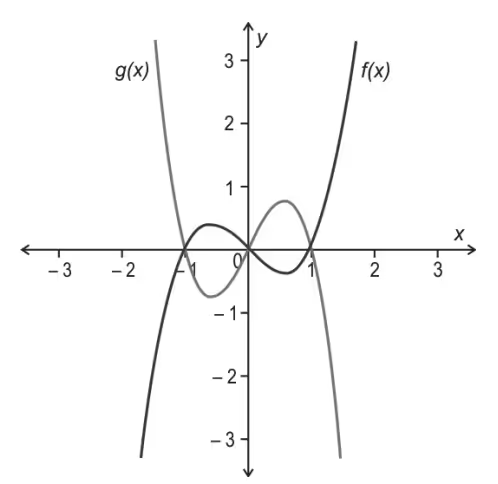
as they have the exact zeroes." Pranit said, "Both the graphs represent two different polynomials, f ( x ) = (x + 1)(x- 0)(x-1) and g(x) = (x + 1)(x - 0)(x-1) and only two such polynomials exist that can have the zeroes (-1), 0 and 1."
Aadar said, "Both the graphs represent two different polynomials, and infinitely many such polynomials exist that have the zeroes (-1), 0 and 1." Who is right? Justify your answer.
Ans. To determine who is correct among Anya, Pranit, and Aadar, let us analyze the situation:
Given:
- Both graphs have the same zeroes, i.e., x=−1, x=0, and x=1.
- The polynomial expressed as (x+1)(x−0)(x−1) has these zeroes.
Analysis:
Anya's Claim: Anya said, "Both the graphs represent the same polynomial f(x)=g(x)=(x+1)(x)(x−1) because they have the exact same zeroes."
Reason Anya is incorrect:
- The zeroes only indicate the locations where the graphs intersect the x-axis, but the shape of the graphs depends on the leading coefficient of the polynomial.
- Two polynomials can share the same zeroes but differ in their leading coefficients or scaling factors. For example:
f(x)=(x+1)(x)(x−1)
g(x)=c(x+1)(x)(x−1), where c is a constant other than 1.
- In this case, the graphs of f(x) and g(x) differ in their height (vertical scaling).
Pranit's Claim: Pranit said, "Both the graphs represent two different polynomials, f(x)=(x+1)(x)(x−1) and g(x)=(x+1)(x)(x−1) and only two such polynomials exist that can have the zeroes −1, 0, and 1."
Reason Pranit is incorrect:
- His statement is contradictory. If both graphs represent different polynomials, there can be infinitely many such polynomials with the same zeroes because the general form of a polynomial with zeroes −1, 0, and 1 is:
P(x)=c(x+1)(x)(x−1)
Here, ccc can be any real number (not just 1 or some fixed constant).
Aadar's Claim: Aadar said, "Both the graphs represent two different polynomials, and infinitely many such polynomials exist that have the zeroes −1, 0, and 1."
Reason Aadar is correct:
- A polynomial with roots −1, 0, and 1 has the general form
P(x)=c(x+1)(x)(x−1)
- The constant c determines the vertical scaling of the polynomial. For example
If c=1, the polynomial is f(x)=(x+1)(x)(x−1)
If c=2, the polynomial is g(x)=2(x+1)(x)(x−1)
This means there are infinitely many possible polynomials (corresponding to different values of c) with the same zeroes.
Aadar is correct.
The two graphs represent different polynomials with the same zeroes, and there are infinitely many such polynomials because any polynomial of the form P(x)=c(x+1)(x)(x−1) where c is any non-zero constant, will have the zeroes −1, 0, and 1.
Q8. p(x) = (x+3)2 - 2(x- c ); where c is a constant.
If p (x) is divisible by x, find the value of c. Show your steps.
Ans. Given a polynomial px=x+32-2x-c, where c is a constant.
Using algebraic identity, we can expand the expression,
px=x2+6x+9-2x+2c
px=x2+4x+9+2c
We need to find the value of c when px is divisible by x
According to the remainder theorem, when a polynomial p(x) (whose degree is greater than or equal to 1 is divided by a linear polynomial qx) whose zero is x=a, the remainder is given by r=pa
Substituting x=0, we get
Remainder =p0=9+2c
Since px is divisible by x, we get the remainder as zero.
⇒9+2c=0
2c=-9
c=-9/2
Hence, the value of c is -9/2
Q9. Students of a class were shown the graph below.
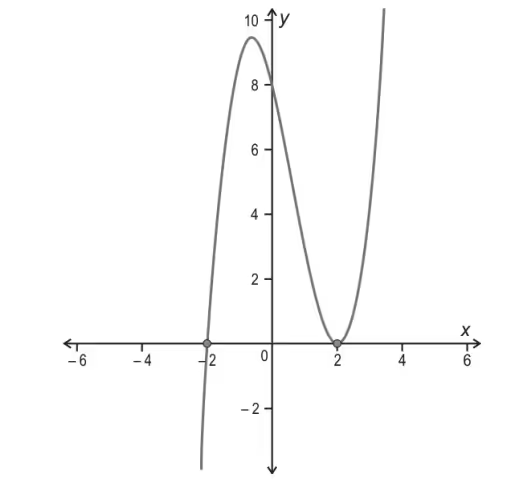
Based on their answers, they were divided into two groups. Group 1 said the graph represented a quadratic polynomial, whereas group 2 said the graph represented a cubic polynomial.
i) Which group was correct?
ii) Write the polynomial represented by the graph.
Ans. (i) The graph clearly shows three x-intercepts (roots), indicating that the polynomial has degree 3. Therefore, the graph represents a cubic polynomial. Thus, Group 2 is correct.
(ii) From the graph, the x-intercepts are at x=−2, x=0, and x=2.
If the roots are −2, 0, and 2, the polynomial can be expressed as:
p(x)=k(x+2)(x)(x−2)
Here, k is a constant to be determined.
Using the difference of squares:
p(x)=k(x2−4)x
p(x)=k(x3−4)
From the graph, the maximum value of p(x) appears to be approximately 10 at x=−1.
Substitute x=−1 and p(x)=10 into the polynomial:
10=k((−1)3−4(−1))
10=k(−1+4)
10=k(3)
k= 10/3
Substituting k= 10/3 into the equation
p(x)= 10/3(x3−4x)
Thus, the polynomial represented by the graph is:
p(x)= (10/3)x3−(10/3)x
Some More Important Question Answers of Class 10 Maths Ch2
Q1. Find the zeroes of the quadratic polynomial 4x² - 4x - 15. Verify the relationship between zeroes and coefficients.
Ans.
- The polynomial is f(x) = 4x² - 4x - 15.
- Here, a = 4, b = -4, c = -15.
- Use quadratic formula: x = [-b ± √(b² - 4ac)] / 2a.
- Discriminant D = (-4)² - 4(4)(-15) = 16 + 240 = 256.
- √D = 16.
- Roots: x = (4 ± 16)/8.
→ x₁ = (20/8) = 5/2
→ x₂ = (-12/8) = -3/2 - Sum of zeroes = 5/2 + (-3/2) = 1. From coefficients, -b/a = -(-4)/4 = 1. Verified.
- Product of zeroes = (5/2)(-3/2) = -15/4. From coefficients, c/a = -15/4. Verified.
Answer: Zeroes are 5/2 and -3/2. Relations verified.
Q2. Find the value of k such that x - 2 is a factor of x³ + kx² - 5x + 6.
Ans.
- By factor theorem, if x - 2 is a factor, then f(2) = 0.
- Substitute x = 2: f(2) = (2)³ + k(2²) - 5(2) + 6 = 8 + 4k - 10 + 6.
- Simplify: 8 - 10 + 6 = 4, so 4 + 4k = 0.
- Solve: 4k = -4 → k = -1.
Answer: k = -1.
Q3. Find the remainder when 2x³ + 3x² + x + 5 is divided by x + 2.
Ans.
- By remainder theorem, remainder = f(-2).
- Substitute: f(-2) = 2(-2)³ + 3(-2)² + (-2) + 5.
- = 2(-8) + 3(4) - 2 + 5 = -16 + 12 - 2 + 5.
- = -1.
Answer: Remainder = -1.
Q4. Divide 2x³ + 3x² - 2x - 6 by x + 1.
Ans.
- Use long division:
- First term: 2x³ ÷ x = 2x². Multiply divisor: 2x²(x+1) = 2x³ + 2x². Subtract: (2x³ + 3x²) - (2x³ + 2x²) = x².
- Bring down -2x → expression = x² - 2x.
- Next term: x² ÷ x = x. Multiply divisor: x(x+1) = x² + x. Subtract: (x² - 2x) - (x² + x) = -3x.
- Bring down -6 → expression = -3x - 6.
- Next term: -3x ÷ x = -3. Multiply divisor: -3(x+1) = -3x - 3. Subtract: (-3x - 6) - (-3x - 3) = -3.
- Quotient = 2x² + x - 3, remainder = -3.
Answer: Quotient = 2x² + x - 3, remainder = -3.
Q5. If the zeroes of x² + px + q are equal, show that p² = 4q.
Ans.
- For quadratic ax² + bx + c, discriminant D = b² - 4ac.
- Here a = 1, b = p, c = q.
- For equal roots, D = 0.
- So p² - 4(1)(q) = 0 → p² = 4q.
Answer: p² = 4q.
Q6. If the zeroes of x² + 7x + 10 are α, β, find a quadratic polynomial whose zeroes are α+1, β+1.
Ans.
- For x² + 7x + 10, sum of zeroes = -7, product = 10.
- New zeroes = α+1 and β+1.
- New sum = (α + β) + 2 = -7 + 2 = -5.
- New product = αβ + (α+β) + 1 = 10 - 7 + 1 = 4.
- Required polynomial = x² - (new sum)x + (new product) = x² + 5x + 4.
Answer: x² + 5x + 4.
Q7. Find the zeroes of 6x² - 7x - 3.
Ans.
- *a = 6, b = -7, c = -3.
- D = (-7)² - 4(6)(-3) = 49 + 72 = 121. √D = 11.
- Roots = (7 ± 11)/12.
- x₁ = 18/12 = 3/2, x₂ = -4/12 = -1/3.
Answer: Zeroes are 3/2 and -1/3.
Q8. Find the zeroes of x² + 2.
Ans.
- a = 1, b = 0, c = 2.
- D = 0² - 4(1)(2) = -8 < 0.
- Roots = ± i√2.
Answer: Zeroes are i√2 and -i√2 (non-real).
Q9. Show graphically that x² - 1 has exactly two real zeroes.
Ans.
- x² - 1 = (x-1)(x+1). Zeroes are -1 and 1.
- Graph of y = x² - 1 is a parabola opening upwards with vertex (0, -1).
- It intersects the x-axis at (-1, 0) and (1, 0).
Answer: Real zeroes are -1 and 1.
Q10. Show graphically that x² + 3 has no real zeroes.
Ans.
- For all real x, x² ≥ 0. So x² + 3 ≥ 3.
- Minimum value is 3 at x = 0.
- Graph of y = x² + 3 is a parabola opening upwards with vertex (0, 3).
- It never intersects the x-axis.
Answer: No real zeroes.
Q11. If x = 1/2 is a zero of 4x³ − x² + kx − 2, find k.
Ans.
- If x = 1/2 is a zero, f(1/2) = 0.
- Substitute x = 1/2: 4(1/2)³ − (1/2)² + k(1/2) − 2 = 0.
- Compute powers: (1/2)³ = 1/8, (1/2)² = 1/4.
- So 4·(1/8) − 1/4 + k/2 − 2 = 0 → 1/2 − 1/4 + k/2 − 2 = 0.
- Combine constants: 1/2 − 1/4 − 2 = 1/4 − 2 = −7/4. So −7/4 + k/2 = 0.
- k/2 = 7/4 → k = 7/2.
Answer: k = 7/2.
Q12. Find a quadratic polynomial whose zeroes are 3 + √2 and 3 − √2.
Ans.
- Sum of zeros = (3 + √2) + (3 − √2) = 6.
- Product of zeros = (3 + √2)(3 − √2) = 9 − 2 = 7.
- Required polynomial (monic) = x² − (sum)x + (product) = x² − 6x + 7.
Answer: x² − 6x + 7.
Q13. On dividing x³ − 8x² + 20x − 10 by g(x) the quotient and remainder are x − 4 and 6 respectively. Find g(x).
Ans.
- Division algorithm: dividend = divisor·quotient + remainder. So x³ − 8x² + 20x − 10 = g(x)·(x − 4) + 6.
- Rearranged: g(x)·(x − 4) = x³ − 8x² + 20x − 10 − 6 = x³ − 8x² + 20x − 16.
- So g(x) = [x³ − 8x² + 20x − 16] ÷ (x − 4). Perform division (synthetic with 4): coefficients 1, −8, 20, −16.
• Bring down 1. Multiply 4·1 = 4; add to −8 → −4. Multiply 4·(−4) = −16; add to 20 → 4. Multiply 4·4 = 16; add to −16 → 0. - Quotient coefficients are 1, −4, 4 → g(x) = x² − 4x + 4.
Answer: g(x) = x² − 4x + 4.
Q14. If the zeroes of x² + p x + q are double the zeroes of 2x² − 5x − 3, find p and q.
Ans.
- Let r and s be zeroes of 2x² − 5x − 3. For that quadratic: sum r + s = −(−5)/2 = 5/2, product r·s = (−3)/2 = −3/2.
- The new zeroes are 2r and 2s. New sum = 2(r + s) = 2·(5/2) = 5. For x² + p x + q (monic), sum of zeroes = −p, so −p = 5 ⇒ p = −5.
- New product = (2r)(2s) = 4·(r s) = 4·(−3/2) = −6 ⇒ q = −6.
Answer: p = −5, q = −6.
Q15. If one zero of x² − 4x + 1 is 2 + √3, find the other zero.
Ans.
- Sum of roots = 4 (since −(−4)/1 = 4). If one root is 2 + √3, the other = 4 − (2 + √3) = 2 − √3.
- (Alternatively, conjugate root for quadratic with rational coefficients.)
Answer: 2 − √3.
Q16. Obtain all other zeroes of x⁴ − 17x² − 36x − 20 if two zeroes are 5 and −2.
Ans.
- If 5 and −2 are zeros, factor (x − 5)(x + 2) = x² − 3x − 10 is a factor. Divide the quartic by x² − 3x − 10.
- Perform polynomial long division of x⁴ + 0x³ − 17x² − 36x − 20 by x² − 3x −10:
• First term: x⁴ ÷ x² = x². Multiply divisor: x²(x² − 3x −10) = x⁴ − 3x³ −10x². Subtract: (0x³ − (−3x³)) → 3x³; (−17x² − (−10x²)) → −7x². Bring down −36x.
• Next term: 3x³ ÷ x² = 3x. Multiply: 3x(x² − 3x −10) = 3x³ −9x² −30x. Subtract: (−7x² − (−9x²)) → 2x²; (−36x − (−30x)) → −6x. Bring down −20.
• Next term: 2x² ÷ x² = 2. Multiply: 2(x² −3x −10) = 2x² −6x −20. Subtract → 0 remainder. - Quotient = x² + 3x + 2 = (x + 1)(x + 2). So remaining zeros are −1 and −2.
- So a full set of zeros: 5, −2, −1, −2 (−2 is repeated).
Answer: 5, −2, −1, −2.
Q17. If x − √5 is a factor of x³ − 3√5 x² − 5x + 15√5, find all zeroes.
Ans.
- Divide the cubic by (x − √5) using synthetic division with value √5. Coefficients: 1, −3√5, −5, 15√5.
• Bring down 1. Multiply √5·1 = √5; add to −3√5 → −2√5. Multiply √5·(−2√5) = −2·5 = −10; add to −5 → −15. Multiply √5·(−15) = −15√5; add to 15√5 → 0. - The quotient is x² − 2√5 x − 15. Solve x² − 2√5 x − 15 = 0.
- Use quadratic formula: x = [2√5 ± √((2√5)² + 60)]/2 because −4·(−15)= +60. Compute (2√5)² = 4·5 = 20; 20 + 60 = 80; √80 = 4√5.
- So x = [2√5 ± 4√5]/2 → x = (6√5)/2 = 3√5 or x = (−2√5)/2 = −√5.
- Including the given root √5, the zeros are √5, −√5, 3√5.
Answer: √5, −√5, 3√5.
Q18. Find the other zeroes of x⁴ − 7x² + 12 given two zeroes are √3 and −√3.
Ans.
- Since ±√3 are roots, (x² − 3) is a factor. Divide x⁴ − 7x² + 12 by x² − 3. Observe: (x² − 3)(x² − 4) = x⁴ − 7x² + 12.
- x² − 4 = (x − 2)(x + 2). So other zeros are 2 and −2.
Answer: 2, −2.
Q19. If p(x) = (x + 3)² − 2(x − c) is divisible by x, find c.
Ans.
- If divisible by x, then p(0) = 0. Compute p(0) = (0 + 3)² − 2(0 − c) = 9 − 2(−c) = 9 + 2c.
- Set 9 + 2c = 0 → 2c = −9 → c = −9/2.
Answer: c = −9/2.
Q20. Show that 1/2 and −3/2 are zeroes of 4x² + 4x − 3 and verify relations between zeroes and coefficients.
Ans. Factor 4x² + 4x − 3: look for factors (2x + a)(2x + b) with ab = −3 and a + b = 2. Indeed (2x − 1)(2x + 3) = 4x² + 6x − 2x − 3 = 4x² + 4x − 3.
- Roots from factors: 2x − 1 = 0 → x = 1/2; 2x + 3 = 0 → x = −3/2.
- Sum of roots = 1/2 + (−3/2) = −1 = −b/a = −4/4 = −1. Product = (1/2)(−3/2) = −3/4 = c/a = −3/4.
Answer: Roots 1/2 and −3/2; relations verified.
Q21. Find the value of b for which (2x + 3) is a factor of 2x³ + 9x² − x − b.
Ans.
- If (2x + 3) is a factor, zero is x = −3/2. Substitute x = −3/2 into polynomials and set equal to 0.
- Compute terms: (−3/2)³ = −27/8; 2·(−27/8) = −27/4. (−3/2)² = 9/4; 9·(9/4) = 81/4. −(−3/2) = 3/2. So polynomial value = −27/4 + 81/4 + 3/2 − b.
- Combine the first two: (−27/4 + 81/4) = 54/4 = 27/2. Now 27/2 + 3/2 = 30/2 = 15. So 15 − b = 0 → b = 15.
Answer: b = 15.
Q22. If two zeroes of x³ + 3x² − 5x − 15 are √5 and −√5, find the third zero.
Ans.
- Sum of roots = −(coefficient of x²)/1 = −3. Given two roots sum to √5 + (−√5) = 0. So the third root k must satisfy 0 + k = −3 → k = −3.
Answer: −3.
Q23. Divide x⁴ − 11x² + 34x − 12 by x − 2. Find quotient and remainder.
Ans. Solution (synthetic division with 2):
- Coefficients: 1, 0, −11, 34, −12. Bring down 1. Multiply 2·1 = 2; add to 0 → 2. Multiply 2·2 = 4; add to −11 → −7. Multiply 2·(−7) = −14; add to 34 → 20. Multiply 2·20 = 40; add to −12 → 28.
- Quotient coefficients: 1, 2, −7, 20 → quotient polynomial = x³ + 2x² − 7x + 20; remainder = 28.
- Verify: (x − 2)(x³ + 2x² − 7x + 20) + 28 = original polynomial.
Answer: Quotient = x³ + 2x² − 7x + 20; Remainder = 28.
Q24. If zeroes of x² + p x + q are α, β where α + β = −7 and αβ = 10; find the polynomial; then find the polynomial whose zeros are α/2 and β/2.
Ans.
- Given α + β = −7 and αβ = 10. Monic polynomial with these zeros: x² − (sum)x + product = x² + 7x + 10.
- New zeros α/2 and β/2 have sum = (α + β)/2 = −7/2 and product = (αβ)/4 = 10/4 = 5/2.
- Monic polynomial with these zeros: x² − (sum)x + product = x² + (7/2)x + 5/2. Multiply by 2 to clear fractions: 2x² + 7x + 5.
Answer: Original polynomial x² + 7x + 10; halved-roots polynomial 2x² + 7x + 5.
Q25. Given p and q are zeroes of 2x² + 5x − 4, evaluate (1 − p)(1 − q).
Ans.
- (1 − p)(1 − q) = 1 − (p + q) + pq. For 2x² + 5x − 4, sum p + q = −5/2 (since −b/a = −5/2). Product pq = c/a = −4/2 = −2.
- So value = 1 − (−5/2) + (−2) = 1 + 5/2 − 2 = (2/2) + 5/2 − 4/2 = 3/2.
Answer: 3/2.
Q26. Find all zeroes of x³ + 3x² − 2x − 6 if two zeroes are ±√2.
Ans.
- If ±√2 are zeros then (x² − 2) is a factor. Divide cubic by x² − 2 to get the remaining linear factor. Perform division: (x³ + 3x² − 2x − 6) ÷ (x² − 2) gives quotient x + 3 (check by multiplication: (x² − 2)(x + 3) = x³ + 3x² − 2x − 6).
- So the remaining root from x + 3 = 0 is x = −3.
- Full set: √2, −√2, −3.
Answer: √2, −√2, −3.
Q27. Find the quadratic polynomial whose zeroes are 1/3 and −2/3.
Ans.
- Sum = 1/3 + (−2/3) = −1/3. Product = (1/3)(−2/3) = −2/9.
- Monic polynomial: x² − (sum)x + product = x² + (1/3)x − 2/9. Multiply through by 9 to clear fractions: 9x² + 3x − 2.
Answer: 9x² + 3x − 2.
Q28. If 2 and −3 are zeros of x² + (a + 1)x + b, find a and b.
Ans. :
- Sum of zeros = 2 + (−3) = −1 = −(a + 1) ⇒ −(a + 1) = −1 ⇒ a + 1 = 1 ⇒ a = 0.
- Product = 2·(−3) = −6 = b.
Answer: a = 0, b = −6.
Benefits of Practising These Class 10 Polynomials Questions
Here are some of the benefits of practising these class 10 polynomials question answers:
- Strong Conceptual Clarity: Builds a clear understanding of polynomial structures and relationships.
- Better Accuracy in Algebra: Reduces calculation and sign errors in equations and proofs.
- Exam-Focused Preparation: Covers every important formula and question type from the CBSE syllabus.
- Improved Graph Interpretation: Enhances ability to relate polynomial degree with its graphical representation.
- High Scoring Chapter: Simple formulas and direct questions make it easy to score full marks.
Why Use Class 10 Maths Ch2 Important Questions?
Using Class 10 polynomials extra questions has a great impact on practicing and understanding concepts. It also helps when students refer to the NCERT Book Class 10 Maths, as it strengthens their basic understanding before solving these questions.Here are some of the most important benefits of polynomials extra questions in Class 10:
- Important questions help students focus on the key areas that are more likely to appear in exams. By practicing these questions, students can make sure they cover the most important aspects of the chapter and increase their chances of scoring well.
- Working through important questions allows students to revise their understanding of essential concepts. This practice helps in understanding the relationships between zeroes and coefficients, the division algorithm, and other topics in polynomials.
- Regular practice of important questions builds confidence. When students face similar problems in their exams, they can handle them with ease.
- Practising important questions also benefits time management. Students learn to solve problems more quickly and accurately, which is important when time is limited during the exam.
- By working on important questions, students can identify areas where they are weak or need more practice.
How to Ace These Class 10 Polynomials Important Questions
This chapter is simple if you focus on formulas, relationships, and graph interpretation. Follow this study plan for effective preparation:
Step 1: Revise the Definition and Types of Polynomials
Start by revising the definition of a polynomial and identifying its types based on degree linear, quadratic, cubic, and biquadratic. Know what coefficients and terms represent in each form.
Step 2: Understand Zeros of a Polynomial
Learn what a zero (or root) of a polynomial means the value of the variable that makes the polynomial equal to zero. Practice finding zeros of linear and quadratic polynomials through substitution.
Step 3: Learn the Relationship Between Zeros and Coefficients
For quadratic polynomials (ax² + bx + c), revise the relationships:
Sum of zeros (α + β) = –b/a
Product of zeros (αβ) = c/a
Understand how to derive one from the other and how to form a polynomial when zeros are given.
Step 4: Study Cubic Polynomials
For cubic polynomials (ax³ + bx² + cx + d), know the relationships:
α + β + γ = –b/a
αβ + βγ + γα = c/a
αβγ = –d/a
Practise problems based on finding missing coefficients or verifying relationships.
Step 5: Understand the Division Algorithm for Polynomials
Learn how to divide one polynomial by another using the division algorithm, expressed as:
Dividend = Divisor × Quotient + Remainder
Practise at least two examples, as this concept is frequently tested.
Step 6: Interpret Graphs of Polynomials
Learn how the number of zeros relates to how many times a polynomial graph touches or cuts the x-axis. Visualising graphs helps in reasoning-based questions.
Frequently Asked Questions
Q1. How many marks are generally allotted to this chapter in Class 10 board exams?
Ans. This chapter usually carries 4 to 6 marks, often including one numerical or proof-based question.
Q2. Which topics are most important for exams?
Ans. Relationships between zeros and coefficients, division algorithm, and forming a polynomial when zeros are given are the most important topics.
Q3. How can I easily remember the relationships between zeros and coefficients?
Ans. Remember the pattern for a quadratic polynomial:
Sum of zeros = –(coefficient of x) ÷ (coefficient of x²)
Product of zeros = (constant term) ÷ (coefficient of x²)
Q4. Do we need to practise graphs for this chapter?
Ans. Yes, practise simple sketches of linear, quadratic, and cubic polynomial graphs to understand the number of zeros and their positions on the x-axis.
Q5. How can I avoid mistakes in substitution-based questions?
Ans. Write each substitution step carefully, use brackets around negative numbers, and recheck calculations after solving.










.svg)

