
.svg)

Real Numbers forms the foundation of Class 10 Mathematics and connects various number systems studied in earlier classes. It introduces you to important concepts like Euclid’s Division Lemma, Fundamental Theorem of Arithmetic, irrational numbers, and decimal expansions of real numbers. Since these topics form a major part of the CBSE Class 10 Maths syllabus, understanding them thoroughly becomes even more important.
It also strengthens your number sense and logical reasoning, both of which are essential for understanding higher mathematical concepts in algebra and number theory. Referring to the NCERT Book Class 10 Maths alongside these topics can further improve your clarity and understanding.The topic is easy to learn but requires conceptual clarity and consistent practice to score full marks in the exam.
The Real Numbers Important Questions for Class 10 Mathematics help you:
- Build a strong conceptual understanding of number properties.
- Practise proof-based and reasoning questions commonly asked in exams.
- Gain confidence for both board exams and competitive tests
PREMIUM EDUCART QUESTIONS
(Most Important Questions of this Chapter from our 📕)
In the table given below, we have provided the links to Real Numbers Class 10 Important Questions With Solutions downloadable PDFs. Now you can download them without requiring a login.

Class 10 Ch1 Real Numbers Important Questions 2026
1. Let p be a prime number and k be a positive integer.
If p divides k2, then which of these is DEFINITELY divisible by p?
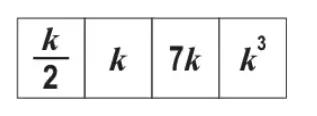
a. only k
b. Only k and 7 k
c. only k, 7 k and k3
d. all -k/2, 7k, k and k3
Ans. c) only k, 7 k and k3
Explanation:
If a prime number divides the square of an integer, then it must divide the integer itself.p | k2 ⇒ p | kp | k ⇒ p | 7kp | k ⇒ p | k3p may not divide k/2 if k is odd; p may not divide -k/2 if k is odd.
2. √n is a natural number such that n > 1.
Which of these can DEFINITELY be expressed as a product of primes?
i. √n
ii. n
iii. √n/2
a. only ii)
b. only i) and ii)
c. all - i), ii) and iii)
d. (cannot be determined without knowing n )
Ans. b) only i) and ii)
Explanation:
Given that, √n is a natural number such that n>1Let us consider n=2, then √n=√2 ∉ NIf n=4, then √n=√4=2∈NIf n=5, then √n=√5∉ NSo, we can say that √n is a natural number if n is a perfect square number.Let us consider n=16, then √n=4=2×2If n=16, it can be expressed as the product of primes as 16=2×2×2×2If n=9, then √n/2=3/2 which cannot be expressed as the product of primes.So, √n and n can be expressed as the product of primes.
3. ẞ and δ are positive integers. HCF of ẞ and 630 is 210. HCF of 6 and 110 is 55. Find the HCF of ß, 630, 8 and 110 using Euclid's division algorithm. Show your steps.
Ans. HCF of β and 630 is 210
HCF of δ and 110 is 55β
= 210a + β1, where a is a positive integer and β1 is the remainder
630 = 3*210
630 = 210*3 + β1
β1 = 0
HCF(630, 210) = 210
HCF(δ, 110) = 55
HCF(β, 630, δ, 110) = 55
4. Two representations of real numbers are shown below.
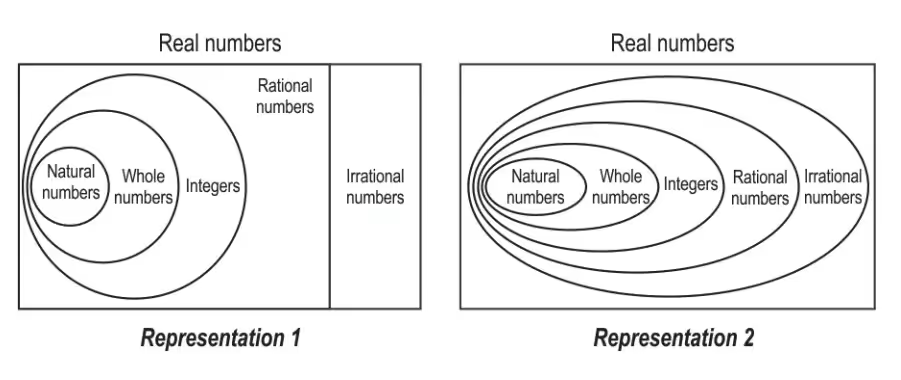
Which one is correct?
Ans. Both representations describe the structure of real numbers, but Representation 1 is more accurate and commonly accepted.
Explanation: Representation 1 (Correct):
- It clearly shows the hierarchy of number sets:
- Natural numbers ⊆ Whole numbers ⊆ Integers ⊆ Rational numbers.
- Rational numbers and Irrational numbers are disjoint sets, and together, they form the set of Real numbers.
- This matches the standard mathematical classification.
Representation 2 (Incorrect):
- It implies that all subsets (Natural numbers, Whole numbers, Integers, Rational numbers, and Irrational numbers) are overlapping without a proper hierarchy.
- This is misleading since, for example:
- Natural numbers are not part of irrational numbers.
Rational numbers and irrational numbers are mutually exclusive.
Therefore, Representation 1 correctly depicts the relationship among the sets of numbers.
5. GrowMore Plantations have two rectangular fields of the same width but different lengths. They are required to plant 84 trees in the smaller field and 231 trees in the larger field. In both fields, the trees will be planted in the same number of rows but in different numbers of columns.
i) What is the number of rows that can be planted in this arrangement the most? Show your work.
ii) If the trees are planted in the number of rows obtained in part (i), how many columns will each field have?
Ans. Given that, there are two rectangular fields of the same width but different lengths
They are required to plant 84 trees in the smaller field and 231 trees in the larger field.
In both fields, the trees will be planted in the same number of rows but in a different number of columns.
We need to find the most number of rows that can be planted in this arrangement.
To find the maximum number of rows that can be planted in this arrangement, we need to find the H.C.F of the trees planted in both the fields.
To find the H.C.F, we can use prime factorisation method.
84=2×2×3×7
231=7×3×11
So, H.C.F is the product of the common prime factors that have the least or smallest power.
H.C.F=21
Hence, the maximum number of rows that can be planted in this arrangement is 21
If the rows are 21, the number of trees planted in the smaller field is 84, then the number of columns is 4
If the rows are 21, the number of trees planted in the larger field is 231, then the number of columns is 11
Hence, the columns each field has are 4, 11
6. M and N are positive integers such that M = p2q3r and N = p3q2, where p, q,r are prime numbers.
Find LCM(M, N) and HCF(M, N).
Ans. Given, M and N are positive integers such that M=p2q3r and N=p3q2 where p, q, r are prime numbers.
Prime Factorisation of M=p×p×q×q×q×r
Prime Factorisation of N=p×p×p×q×q
We know that, The product of the prime factors with the highest powers is the L.C.M of the given numbers.
So, the L.C.M of M and N is p3q3r
We know that, H.C.F of the numbers is the product of common prime factors that have the least or smallest power.
So, the H.C.F of M and N is p2q2
7. The number 58732045 is divided by a number between 3256 and 3701.
State true or false for the below statements about the remainder and justify your answer.
i) The remainder is always less than 3701.
ii) The remainder is always more than 3256.
iii) The remainder can be any number less than 58732045.
Ans. When the number 58732045 is divided by a number between 3256 and 3701, the following statements are true or false:
- Statement i: True, the remainder is always less than 3701
- Statement ii: False, the remainder can be less than 3256
- Statement iii: False, the remainder is limited by the divisor, which is much smaller than 58732045
In any division, the remainder is always less than the divisor. If the remainder is greater than or equal to the divisor, the division is incorrect.
The number being divided is called the dividend, the number it is being divided by is called the divisor, and the result of the division is called the quotient.
8. (n2 + 3 n - 4) can be expressed as a product of only two prime factors where n is a natural number. Find the value(s) of n for which the given expression is an even composite number. Show your work and give valid reasons.
Ans. Given expression is fx=n2+3n-4
Using the middle-term splitting method, we can write the expression as:
n2+3n-4 = n2+4n-n-4
n2+4n-n-4 = nn+4-1n+4
fx=n -1n+4
It is given that the given expression is an even composite number.We know that, an even composite number is a number that are divisible by 2 and have more than 2 factors.For the given expression to be an even composite number, we need to equate n-1=2 or n+4=2
When n+4=2⇒n=-2 which is not possible.
Then n-1=2⇒n=3
Hence, the value of n for which the given expression is an even composite number is 3
9. The HCF of k and 93 is 31, where k is a natural number.
Which of these CAN be true for SOME VALUES of k?i) k is a multiple of 31. ii) k is a multiple of 93. iii) k is an even number. iv) k is an odd number.
- only ii) and iii)
- only i), ii) and iii)
- only i), iii) and iv)
- all i), ii), iii) and iv)
Ans. c) only i), iii) and iv)
Explanation
Given, H.C.F of k and 93 is 31
Prime factorisation of 93=3×31
We know that, H.C.F or Highest Common Factor is the greatest number that divides each of the two or more numbers.For example: H.C.F of 24 and 36 is 12
Prime Factorisation of 24=2×2×2×3=12×2
Prime Factorisation of 36=2×2×3×3=12×3
So, we can say that both the numbers will be the multiple of 12
Similarly, in the problem, we can say that, k and 93 will be a multiple of 31Multiples of 31=31, 62, 93, 124,...
So, k can be either an odd or even number.Hence, (i), (iii) or (iv) are true.
10. The prime factorisation of a prime number is the number itself.
How many factors and prime factors does the square of a prime number have?
Ans. We know that, a prime number is the number that have only two factors: one and the number itself.
Let us consider the prime factorisation of 5 which is a prime number.5 has only two factors, 1 and 5
Thus, the only prime factor of 5 is the number itself.
Let us consider the square of a prime number 5 which is 25
Factors of 25=1, 5, 25
Prime Factors of 25=5×5
Hence, the square of a prime number have 3 factors and 1 prime factors.
Some More Important Question Answers of Class 10 Maths Ch - 1
Q1. Find HCF(252, 198) using Euclid’s Division Algorithm.
Ans. Euclid’s algorithm means:
- Divide the larger number by the smaller.
- Replace the larger number by the smaller, and the smaller by the remainder.
- Repeat until the remainder becomes 0.
- The last non-zero remainder is the HCF.
Step 1: Divide 252 by 198.
252 ÷ 198 = 1, remainder = 54
So, 252 = 198 × 1 + 54
Step 2: Divide 198 by 54.
198 ÷ 54 = 3, remainder = 36
So, 198 = 54 × 3 + 36
Step 3: Divide 54 by 36.
54 ÷ 36 = 1, remainder = 18
So, 54 = 36 × 1 + 18
Step 4: Divide 36 by 18.
36 ÷ 18 = 2, remainder = 0
The last non-zero remainder = 18.
HCF(252,198) = 18
Q2. Find LCM of 36, 48 and 60 by Prime Factorization.
Ans. We break each number into prime factors:
36 = 2 × 2 × 3 × 3 = 2² × 3²
48 = 2 × 2 × 2 × 2 × 3 = 2⁴ × 3
60 = 2 × 2 × 3 × 5 = 2² × 3 × 5
Now, LCM = product of primes with highest power:
= 2⁴ × 3² × 5
= 16 × 9 × 5 = 720
LCM = 720
Q3. Prove that √3 is Irrational.
Ans. We will prove by contradiction.
Step 1: Assume √3 is rational.
So √3 = a/b, where a and b are integers with no common factors (gcd=1).
Step 2: Square both sides:
3 = a² / b²
⇒ a² = 3b²
Step 3: This shows a² is divisible by 3 ⇒ a must also be divisible by 3.
So, let a = 3k.
Step 4: Substitute:
(3k)² = 3b²
⇒ 9k² = 3b²
⇒ b² = 3k²
⇒ b divisible by 3.
So both a and b are divisible by 3. But this contradicts our assumption that gcd(a,b)=1.
Hence, √3 cannot be rational.
√3 is Irrational.
Q4. Find HCF and LCM of 270 and 192.
Ans. First use Euclid’s algorithm for HCF.
Step 1: Divide 270 by 192.
270 ÷ 192 = 1, remainder = 78
So, 270 = 192 × 1 + 78
Step 2: Divide 192 by 78.
192 ÷ 78 = 2, remainder = 36
So, 192 = 78 × 2 + 36
Step 3: Divide 78 by 36.
78 ÷ 36 = 2, remainder = 6
So, 78 = 36 × 2 + 6
Step 4: Divide 36 by 6.
36 ÷ 6 = 6, remainder = 0
So, HCF = 6.
Now, LCM = (Product of numbers) ÷ HCF
= (270 × 192) ÷ 6
= 51840 ÷ 6 = 8640
HCF = 6, LCM = 8640
Q5.Question: Two gardens have 96 and 168 saplings. The saplings must be planted in equal rows (columns may differ). Find:
(i) Maximum number of rows possible
(ii) Columns in each garden
Ans. Step 1: Find HCF(96,168).
96 = 2⁵ × 3
168 = 2³ × 3 × 7
Common = 2³ × 3 = 8 × 3 = 24
So, rows = 24
Step 2: Find columns = Total ÷ Rows.
Garden 1: 96 ÷ 24 = 4 columns
Garden 2: 168 ÷ 24 = 7 columns
Rows = 24, Columns = 4 and 7
Q6. Prove that HCF(a,b) × LCM(a,b) = a × b (for any two positive integers a and b).
Ans. Step 1: Let HCF of a and b = d.
So we can write:
a = d × x, b = d × y, where x and y are integers and gcd(x,y)=1.
Step 2: LCM is the least common multiple.
So, LCM(a,b) = d × x × y.
Step 3: Multiply HCF and LCM:
HCF × LCM = d × (dxy) = d² × x × y.
Step 4: Now check a × b:
a × b = (dx)(dy) = d² × x × y.
So, HCF × LCM = a × b. hence proved
Q7. Find HCF(84, 90, 126) using Prime Factorization.
Ans. Step 1: Prime factors.
84 = 2² × 3 × 7
90 = 2 × 3² × 5
126 = 2 × 3² × 7
Step 2: Take common prime factors with smallest powers.
- Common prime = 2¹
- Common prime = 3¹
So, HCF = 2 × 3 = 6
HCF - 6
Q8. Find the smallest positive integer k such that (15k + 4) is divisible by 7.
Ans. We need remainder = 0 when divided by 7.
Step 1: Work in mod 7.
15 ≡ 1 (mod 7).
So, 15k + 4 ≡ k + 4 (mod 7).Step 2: For divisibility by 7,
k + 4 ≡ 0 (mod 7)
⇒ k ≡ −4 ≡ 3 (mod 7).
Step 3: Smallest positive k = 3.
Check: 15×3 + 4 = 49 ÷ 7 = 7 exactly.
k = 3
Q9. Prove that ∛2 (cube root of 2) is Irrational.
Ans. Step 1: Assume ∛2 = a/b, in lowest terms.
Step 2: Cube both sides:
2 = a³ / b³
⇒ a³ = 2 b³.
Step 3: This shows a³ is even ⇒ a is even.
So let a = 2k.
Step 4: Substitute:
(2k)³ = 2 b³
⇒ 8k³ = 2b³
⇒ b³ = 4k³ ⇒ b even.
So both a and b are even ⇒ contradiction (not in lowest terms).
Hence, ∛2 is irrational.
∛2 is irrational
Q10. If p is prime and p divides ab, prove that p divides a or p divides b (Euclid’s Lemma).
Ans. Step 1: Assume p divides ab, but p does not divide a.
Step 2: Since p is prime and does not divide a ⇒ gcd(a,p)=1.
Step 3: By Euclid’s lemma, if gcd(a,p)=1, then p must divide b whenever p divides ab.
So either:
- p divides a, or
- p divides b.
Q11. Find the remainder when 123456 is divided by 9.
Ans. We know the divisibility rule: A number is divisible by 9 if the sum of digits is divisible by 9.
Step 1: Add digits.
1 + 2 + 3 + 4 + 5 + 6 = 21.
Step 2: Divide 21 by 9.
21 ÷ 9 = 2 remainder 3.
So, remainder = 3.
Q12. Find LCM(8, 9, 21).
Ans. Prime factors:
8 = 2³, 9 = 3², 21 = 3 × 7
LCM = 2³ × 3² × 7 = 504
Answer: 504
Q13. How many positive divisors does 360 have?
Ans. 360 = 2³ × 3² × 5¹
Number of divisors = (3+1)(2+1)(1+1) = 4×3×2 = 24
Answer: 24
Q14. Show that any two consecutive integers are co-prime.
Ans. Let numbers = n, n+1
Common divisor d divides both ⇒ d divides (n+1 – n) = 1
So d=1
Answer: Consecutive integers are always co-prime
Q15. Find HCF(1071, 462) using Euclid’s algorithm.
Ans. 1071 = 462×2 + 147
462 = 147×3 + 21
147 = 21×7 + 0
So HCF = 21
Answer: 21
Q16. Two gears have 72 and 54 teeth. After how many rotations of the 72-tooth gear will marked teeth meet again?
Ans. LCM(72, 54) = 216 teeth
Rotations of 72-tooth gear = 216 ÷ 72 = 3
Answer: After 3 rotations
Q17. Show that √2 + √3 is irrational.
Ans. Assume √2+√3 = r (rational).
Then √3 = r − √2.
Squaring ⇒ √2 = (r² −1)/(2r), which is rational.
Contradiction, since √2 is irrational.
Answer: Irrational
Q18. An army contingent of 1000 members is to march behind an army band of 56 members in a parade. The two groups are to march in the same number of columns. What is the maximum number of columns in which they can march?
Ans. 1000 =2x2x2x5x5x5
56 = 2x2x2x7
HCF of 1000 and 56 = 8
Maximum number of columns = 8.
How to Ace These Class 10 Real Numbers Important Questions
Since this chapter is theoretical in nature and often includes reasoning or proof-based questions, understanding the logic behind each concept is more important than memorising steps. Follow this preparation strategy for maximum results:
Step 1: Revise Euclid’s Division Lemma
Understand the statement and application of Euclid’s Division Lemma, which helps express any number in the form a = bq + r. Practice problems involving the calculation of HCF using this lemma.
Step 2: Learn the Fundamental Theorem of Arithmetic
Study how every composite number can be expressed as a product of prime factors in a unique way. Practise writing numbers as prime factorizations and use this concept in solving LCM and HCF questions.
Step 3: Understand Properties of Rational and Irrational Numbers
Learn how to prove that numbers like √2, √3, and √5 are irrational using contradiction. Revise examples where operations on rational and irrational numbers result in different outcomes.
Step 4: Study Decimal Expansions
Learn how the prime factorization of a number’s denominator determines whether its decimal expansion is terminating or non-terminating recurring. Practice identifying and converting between the two types.
Step 5: Practise Proof-Based Questions
Most exam questions in this chapter are proofs. Learn to structure answers logically with clear statements, reasons, and conclusions. Avoid skipping steps while solving.
Step 6: Relate Concepts with Real-Life Numbers
Connect properties of rational and irrational numbers with examples from real life and mathematical constants like π or √2 to make concepts easier to recall.
Why to Practice Class 10 Maths Chapter 1 Important Questions?
Real Numbers Lesson 10 important questions are very crucial for practice. Let us see a few benefits of using course 10 math CH 1 important questions:
Improving Conceptual Understanding of Questions
Practising Class 10 Ch 1 important questions help students pick up a deeper understanding of concepts. By working through different issues, understudies can discover different exam formats and different concepts, improving their overall grasp of the subject.
Boosts Problem-solving Skills
The standard practice of additional questions for Lesson 10 Maths Ch 1 permits students to create and improve their problem-solving skills. These questions frequently incorporate a mix of essential, intermediate, and advanced problems that challenge students to apply their information differently.
Exam Preparation
Focussing on Real Numbers Class 10 important questions with solutions is a viable way to get ready for exams. These questions are frequently comparable to those enquired in past year's papers, making them an important resource for students aiming to score well.
Frequently Asked Questions
Q1. How many marks are generally allotted to this chapter in Class 10 board exams?
Ans. This chapter usually carries 4 to 6 marks and often includes one proof-based question.
Q2. Which topics are most important for exams?
Ans. Euclid’s Division Lemma, Fundamental Theorem of Arithmetic, and proofs of irrational numbers are the most important.
Q3. How can I easily remember the steps of Euclid’s Division Lemma?
Ans. Remember the form a = bq + r and practise at least two examples of finding HCF using this formula.
Q4. What type of questions are asked from decimal expansions?
Ans. You are usually asked to determine whether a fraction’s decimal expansion is terminating or non-terminating recurring based on its denominator’s factors.
Q5. How can I improve my presentation in proof-based questions?
Ans. Write each step clearly, provide reasoning for every statement, and conclude with “Hence proved” to make your answer complete.












.svg)

