Science Chapter 10 of Class 9, Sound Waves: Characteristics and Applications, introduces the study of how sounds are produced, how they travel through various media, and how humans and animals perceive sound. Class 9 Science Ch 10 notes summarise all the important topics from the chapter so that students can easily understand and revise them for the final exam.
This page gives you access to the free PDFs for Class 9 Science Ch 10 notes. Additionally, it highlights the important items from the chapter to help students revise for the final exam.
Download Sound Waves: Characteristics and Applications Class 9 Notes PDF
Get the Class 9 Science Ch 10 notes PDF through the button below.

Class 9 Science Chapter 10 Notes at a Glance
Access all the important topics from the Class 9 Science Ch 10 notes. The following table provides all the important topics and subtopics of the chapter Sound Waves: Characteristics and Applications.
10.1 Propagation and Nature of Sound Waves
The Class 9 Science Ch 10 notes describe that vibrating objects produce sound waves, and sound travels through various materials. Mechanical waves require a physical medium. Sound propagates across solids, liquids, and gases in all directions.
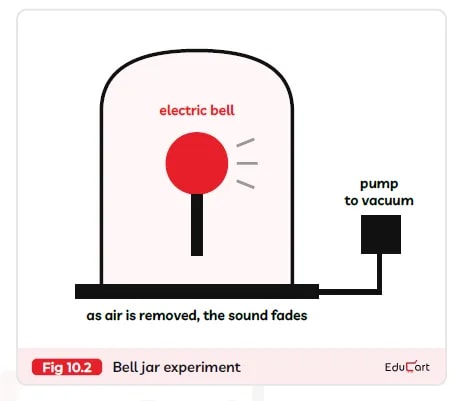
10.1.1 Requirement of a Material Medium (Solids, Liquids, Gases vs. Vacuum & Bell Jar Experiment)
Class 9 Science Ch 10 notes state that sound requires a material medium. The bell jar experiment proves that a vacuum blocks sound transmission. Adding to that, solids, liquids, and gases conduct sound waves effectively. Outer space lacks an air medium completely.
10.1.3 Compressions and Rarefactions (High and Low Density/Pressure Regions)
Compressions form high-density pressure regions. Rarefactions create low-density pressure areas. Alternating compressions and rarefactions constitute sound waves. Particles oscillate around mean positions constantly.
10.1.4 Energy Transfer Without Particle Flow (Slinky Analogy & Density–Distance Graphs)
Sound waves transfer energy exclusively. Medium particles do not travel forward. The Class 9 Science Ch 10 notes described the Slinky analogy. Slinky analogy demonstrates disturbance movement. Density-distance graphs represent wave variations visually.
10.2 Characteristics and Human Perception of Sound Waves
Class 9 Science Ch 10 notes state that sound waves possess distinct physical characteristics. Wavelength, frequency, and amplitude define waves. Humans perceive these properties as pitch and loudness. Subjective experiences vary among listeners.
10.2.1 Wavelength (λ), Frequency (ν), and Time Period (T = 1/ν)
According to the chapter, Sound Waves: Characteristics and Applications, wavelength measures the distance between consecutive crests. Frequency counts oscillations per second. Time period measures the duration per oscillation. Frequency and time period share an inverse relationship.
10.2.2 Amplitude, Wave Energy, and Sound Intensity
Amplitude measures maximum displacement. In Class 9 Science Ch 10 notes, it is also mentioned that larger amplitude carries higher wave energy. Sound intensity measures energy passing through a unit area. Distance decreases sound intensity steadily.
10.2.3 Speed of Sound (v = λν) and Effect of Medium, Temperature, and Humidity
Sound speed is the product of wavelength and frequency. Solids conduct sound fastest. Higher temperatures increase sound speeds. Humidity levels elevate wave propagation speeds further.
10.2.4 Human Perception (Pitch, Loudness in Decibels, Timbre/Overtones, and Audible Range: 20 Hz–20 kHz)
Frequency determines perceived sound pitch. Amplitude controls sound loudness levels. Overtones create unique instrument timbres. Human ears detect frequencies between 20 Hz and 20 kHz.
10.3 Reflection of Sound: Echo and Reverberation
Sound waves bounce off solid surfaces. Reflection follows standard optical reflection laws. Hard surfaces reflect sound effectively. Absorbing materials reduce unwanted sound reflections.
10.3.1 Laws of Reflection of Sound and Surface Effects (Reflection, Absorption, Scattering)
Incident and reflected angles remain equal. Hard surfaces reflect most of the sound. Soft materials absorb acoustic energy. Rough surfaces scatter sound waves in multiple directions.
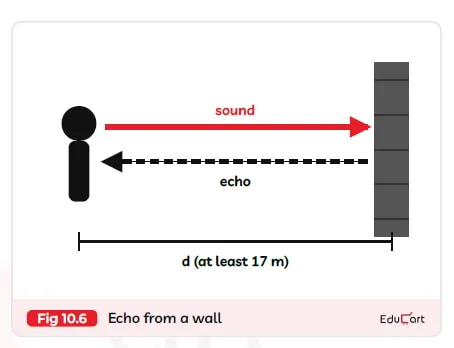
10.3.2 Echo Formation, Persistence of Hearing (0.1 s), and Minimum Distance Calculation (d = vt/2 ≥ 17 m)
Echoes require minimum time gaps. Human brains retain sound for 0.1 seconds. Reflecting surfaces must exceed 17 meters in distance. The formula calculates exact reflector positions.
10.3.3 Reverberation Due to Multiple Reflections (< 0.05 s) and Acoustic Control in Halls
Multiple reflections create prolonged reverberation sounds. Auditoriums use sound-absorbing acoustic panels. Upholstered seats minimise unwanted sound persistence. Architectural designs control indoor acoustics effectively.
10.3.4 Differences Between Echo and Reverberation
Echoes produce distinct repeated sounds. Reverberation causes blended prolonged noises. Time gaps distinguish both acoustic phenomena. Echoes need distant reflecting surfaces.
10.4 Infrasonic and Ultrasonic Waves and Their Applications
Sound waves: Characteristics and Applications notes summarise sound frequencies as they extend beyond human hearing. Infrasonic waves lie below the audible range. Ultrasonic waves exceed the upper frequency limits. Various industries utilise these specialised waves.
10.4.1 Infrasonic Waves (< 20 Hz) and Detection of Earthquakes, Volcanoes, and Storms
Infrasonic waves have frequencies below 20 Hz. Elephants detect low-frequency ground vibrations. Seismographs record natural earthquake waves. Infrasonic signals can help to detect volcanic eruptions and severe storms.
10.4.2 Medical and Industrial Uses of Ultrasound (> 20 kHz): Ultrasonography, Kidney Stones, Cleaning, and Flaw Detection
Ultrasound exceeds 20 Hz frequency limits. Medical professionals perform diagnostic ultrasonography. Industrial machines clean delicate parts. Technicians detect hidden metal block flaws.
10.4.3 Echolocation in Animals (Bats, Dolphins, and Whales)
Class 9 Science Ch 10 notes give the example of bats emitting ultrasonic echolocation pulses. Marine mammals navigate using sound reflections. Animals locate dark obstacles easily. Echolocation aids nocturnal hunting success.
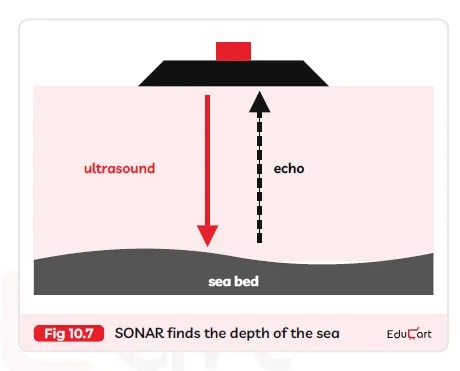
10.4.4 SONAR (Sound Navigation and Ranging) for Underwater Depth and Object Detection
Ships deploy SONAR systems underwater. These ultrasonic signals measure ocean depths. Other essential equipment, along with SONAR, detects submerged submarine objects. Further, Navigators calculate exact underwater distances.
Important Terms and Their Meanings
The Class 9 Science Ch 10 notes include various important terms students need to know. Read and remember all the important terms and their meanings in the table below to prepare for the final exam 2026-27.
Important Things to Remember from Sound Waves Characteristics and Applications Class 9
Along with the study of the Class 9 Science Ch 10 notes, students must remember a few important symbols, signs, SI units and their formulas. It’ll help them solve mathematical equations and score more in the final exam.
Recommended Study Materials for CBSE Class 9 Science
Get access to the various articles and study materials for free to prepare well for the Class 9 final exam.
FAQs
Q1. Where can students download Class 9 Science Chapter 10 Sound Waves notes PDF?
Ans. Students can download the free PDF of Sound Waves: Characteristics and Applications notes using the download button provided on this page.
Q2. What topics are covered in the Class 9 Science Chapter 10 notes?
Ans. The notes cover sound wave propagation, wave characteristics, human perception, reflection, echo, reverberation, infrasonic waves, ultrasound and SONAR applications.
Q3. Do the Sound Waves notes include important definitions and scientific formulas?
Ans. Yes. The notes include important terminology, symbols, SI units, wave equations, sound speed values, echo calculations and other revision points.
Q4. How are the Class 9 Science Chapter 10 notes organised?
Ans. The notes follow the chapter's NCERT sections, with topic-wise explanations, subtopics, important terms, definitions and a summary table of symbols and formulas.
Q5. How can students use these Sound Waves notes for exam preparation?
Ans. Students can use the PDF to revise important concepts, understand scientific terminology, remember formulas and review key values before attempting chapter-related questions.