Class 9 Ch 9 Atomic Foundations of Matter describes the fundamentals of matter. It includes the laws of conservation of mass and constant proportions. It also covers topics like Dalton’s atomic theory and how atoms form covalent and ionic bonds for stability.
This page is made to give free access to the Class 9 Science Ch 9 notes to clarify every topic from Chapter 9. It also highlights the important terms, symbols, formulas and SI units to prepare for the Class 9 final exam.
Download Atomic Foundations of Matter Class 9 Notes PDF 2026-27
Get Class 9 Science Ch 9 notes PDF for free through the button below. You can revise all the important topics of Atomic Foundations of Matter by downloading the PDF.

Check your email for your discount coupon.
Chapter 9 Atomic Foundations of Matter Notes at a Glance
Get a glance at all the important topics from Chapter 9, Atomic Foundations of Matter.
| NCERT section | Important topics and sub-topics |
|---|---|
| 9.1 | Laws of Chemical Combination |
| 9.1.1 | Law of Conservation of Mass |
| 9.1.2 | Experimental Verification in Physical and Chemical Changes (Open vs. Closed Systems) |
| 9.1.3 | Law of Constant Proportions / Proust's Law |
| 9.1.4 | Mass Ratio Calculations and Applications |
| 9.2 | How Atoms Combine: Covalent and Ionic Bonding |
| 9.2.1 | Covalent Bonding by Electron Sharing in Elements and Compounds |
| 9.2.2 | Naming Covalent Compounds Using Prefix Rules and Common Names |
| 9.2.3 | Ionic Bonding by Electron Transfer: Formation of Cations and Anions |
| 9.2.4 | 3-D Crystal Lattice Structure and Naming Ionic Compounds |
| 9.3 | Writing Chemical Formulas (Criss-Cross Method) |
| 9.3.1 | Writing Chemical Formulas of Covalent Compounds Using Valencies |
| 9.3.2 | Writing Chemical Formulas of Ionic Compounds by Criss-Crossing Charges |
| 9.3.3 | Simplifying Subscripts to the Simplest Whole-Number Ratio |
| 9.3.4 | Using Brackets for Multiple Polyatomic Ions in Chemical Formulas |
| 9.4 | Properties of Compounds and Mass Calculations |
| 9.4.1 | Solubility and Melting/Boiling Points of Ionic vs. Covalent Compounds |
| 9.4.2 | Electrical Conductivity in Solid, Molten, and Aqueous States |
| 9.4.3 | Calculating Molecular Mass of Covalent Compounds |
| 9.4.4 | Calculating Formula Unit Mass of Ionic Compounds |
9.1 Laws of Chemical Combination
Chapter 9: Atomic Foundations of Matter first introduces the fundamental laws of chemical combination.
- It states that foundational laws govern how various chemical elements react to form compounds.
- These laws also establish essential scientific principles regarding invariant mass and fixed mass ratios during physical and chemical transformations.
9.1.1 Law of Conservation of Mass
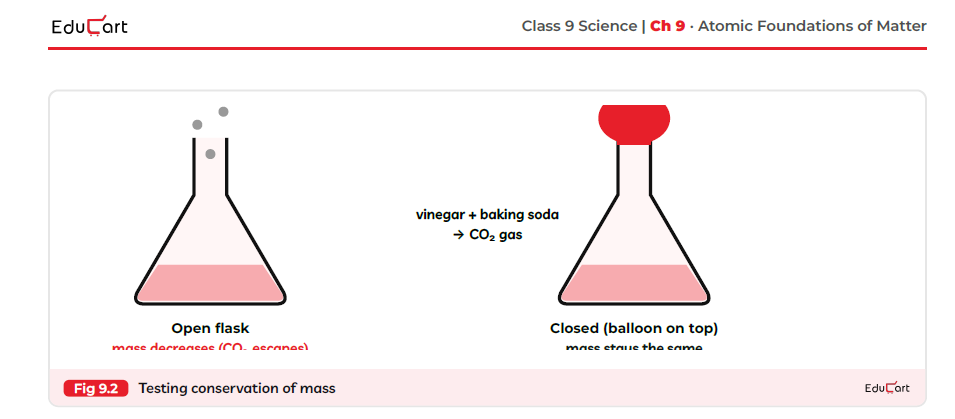
- French chemist Antoine Lavoisier discovered that matter is neither created nor destroyed in any chemical reaction.
- As a result, the total mass of the reacting substances is equal to the total mass of the resulting products.
9.1.2 Experimental Verification in Physical and Chemical Changes (Open vs. Closed Systems)
- As mentioned in the Atomic Foundations of Matter, controlled experiments validate mass conservation across changes.
- Class 9 Science Ch 9 notes cover the concept of closed systems. In this system, escaping gases such as carbon dioxide are trapped.
- This proves mass remains constant. On the other hand, open systems show noticeable losses when gases escape freely.
9.1.3 Law of Constant Proportions / Proust's Law
- According to French chemist Joseph Proust, chemical compounds always contain the same elements combined in a fixed mass ratio.
- This fixed proportion holds regardless of geographical origin or different laboratory preparation methods.
9.1.4 Mass Ratio Calculations and Applications
- As per Chapter 9, Atomic Foundations of Matter, mass ratio calculations apply fixed mass ratios. These help determine reactant quantities precisely.
- For instance, purified water invariably combines H and 02 in a strict one-to-eight mass ratio across all natural water sources.
9.2 How Atoms Combine: Covalent and Ionic Bonding
Atoms combine by sharing or transferring valence electrons to achieve electronic stability. This essential chemical bonding produces discrete molecules or extended crystal lattices. It possesses significantly lower overall system energy levels.
9.2.1 Covalent Bonding by Electron Sharing in Elements and Compounds
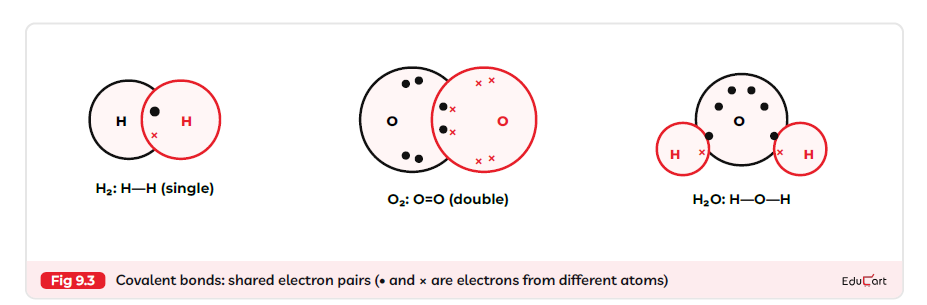
- According to the studies, atoms form strong covalent bonds by sharing valence electron pairs mutually.
- In covalent bonds, sharing one pair creates a single bond, while sharing two pairs forms a double bond in molecules like O2.
9.2.2 Naming Covalent Compounds Using Prefix Rules and Common Names
- Covalent nomenclature utilises specific Greek prefixes like mono, di, and tri to denote atom counts.
- Chemists end the second element name while retaining traditional names for common substances. For example: Carbon monoxide, Dinitrogen tetroxide, etc.
9.2.3 Ionic Bonding by Electron Transfer: Formation of Cations and Anions
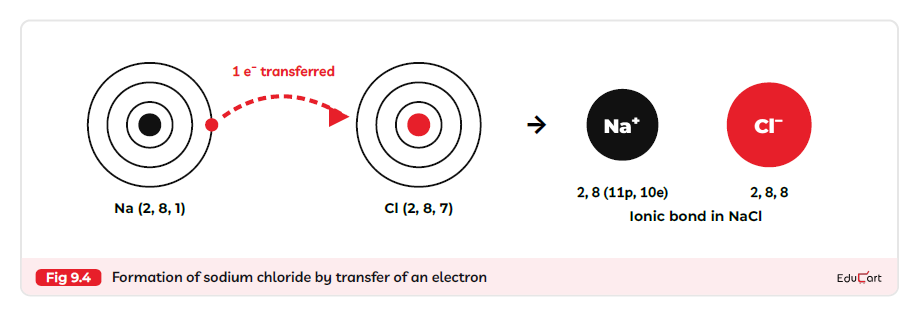
- Chapter 9 states that reactive metals lose valence electrons to form positively charged cations in reactions.
- Conversely, non-metals gain these transferred electrons to form negative anions. This establishes robust electrostatic attraction between oppositely charged ions.
9.2.4 3-D Crystal Lattice Structure and Naming Ionic Compounds
- Ionic compounds form repeating three-dimensional crystal lattices rather than isolated molecules.
- Ionic compounds' standard nomenclature places the metal cation first, followed immediately by monoatomic or complex polyatomic anions in chemical formulas.
9.3 Writing Chemical Formulas
The practical criss-cross method provides a rapid technique for writing chemical formulas. By crossing over valencies or ionic charges as subscripts, chemists accurately represent complex chemical compound compositions every time.
9.3.1 Writing Chemical Formulas of Covalent Compounds Using Valencies
- Chemists write covalent formulas by placing element symbols side by side, identifying their respective combining valencies.
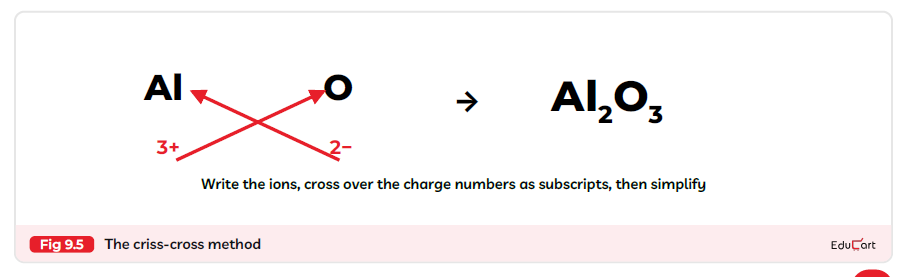
- They then criss-cross these values into subscripts to reflect precise atom ratios accurately.
9.3.2 Writing Chemical Formulas of Ionic Compounds by Criss-Crossing Charges
- According to the chapter Atomic Foundations of Matter, writing ionic formulas requires placing the positive cation first, followed by the negative anion.
- Chemists criss-cross their respective ionic charge numbers downward to generate correct formula subscripts very reliably indeed.
9.3.3 Simplifying Subscripts to the Simplest Whole-Number Ratio
Chemical formulas must always represent the simplest whole-number ratio of constituent atoms or ions. Therefore, chemists divide all criss-crossed subscripts by any common mathematical factor to simplify them fully.
9.3.4 Using Brackets for Multiple Polyatomic Ions in Chemical Formulas
- Chemists enclose polyatomic ions in parentheses whenever chemical formulas require two or more of the same ion group.
- They place the numerical subscript outside the bracket to indicate the total quantity clearly.
9.4 Properties of Compounds and Mass Calculations
According to Chapter 9, distinct chemical bonding types dictate physical compound properties. Ionic compounds exhibit high melting points and aqueous solubility, whereas covalent compounds typically display low melting points and organic solvent solubility.
9.4.1 Solubility and Melting/Boiling Points of Ionic vs. Covalent Compounds
- Ionic compounds dissolve in water and possess high melting points due to strong inter-ionic forces.
- On the other hand, covalent compounds dissolve readily in organic solvents and exhibit low melting points quite consistently.
9.4.2 Electrical Conductivity in Solid, Molten, and Aqueous States
- Ionic compounds conduct electricity only when molten or dissolved in water because free-moving ions become available.
- Solid ionic crystals and covalent substances fail to conduct electricity under any test conditions.
9.4.3 Calculating Molecular Mass of Covalent Compounds (in Atomic Mass Units, u)
- Calculating molecular mass involves summing the atomic masses of all constituent atoms within a covalent molecule.
- It is expressed in unified atomic mass units relative to the standard carbon-12 scale quite precisely.
9.4.4 Calculating Formula Unit Mass of Ionic Compounds
- Calculating formula unit mass requires adding the atomic masses of all constituent ions present in the simplest empirical formula unit of an ionic crystal lattice, measured in atomic mass units.
Important Terms and Their Meanings From Chapter 9 Atomic Foundations of Matter
While preparing with the Atomic Foundations of Matter Class 9 notes, check out the important terms and their meanings in the chapter. It may help you to revise and recall smoothly for the final exam.
| Important Term | Meaning |
|---|---|
| Law of Conservation of Mass | Matter is neither created nor destroyed in a chemical reaction. Total mass remains unchanged. |
| Law of Constant (Definite) Proportions | Elements in a compound always combine in a fixed ratio by mass, regardless of source. |
| Postulate | A postulate is a fundamental assumption accepted as truth without formal proof. |
| Atom | Atoms are tiny, indivisible particles of matter participating in chemical reactions. |
| Molecule | A molecule is the electrically neutral group of two or more atoms existing independently and showing substance properties. |
| Chemical Bond | A chemical bond is the force holding atoms together to form stable arrangements. |
| Covalent Bond | A chemical bond formed by sharing electron pairs between atoms is referred to as a covalent bond. |
| Single Bond | A covalent bond formed by sharing one pair of electrons between two atoms is called a single bond. |
| Double Bond | A covalent bond formed by sharing two pairs of electrons between two atoms. |
| Covalent Compound | A covalent compound is a compound formed by atoms sharing electrons. |
| Atomic (Nuclear) Energy | Atomic (Nuclear) energy is enormous energy released when atomic nuclei split or combine. |
| Ion | An ion is a charged chemical species formed when an atom loses or gains electrons. |
| Cation | A cation is the positively charged ion formed when an atom loses electrons. |
| Anion | An anion is a negatively charged ion formed when an atom gains electrons. |
| Ionic Bond | Electrostatic attraction holding oppositely charged ions together is called an ionic bond. |
| Crystal Structure | Regular, repeating 3-D arrangement of oppositely charged ions in an ionic solid. |
| Crystal Lattice | Visual representation of a crystal structure showing ions as points or dots. |
| Polyatomic Ion | Charged ion formed by two or more covalently bonded atoms acting as a single unit. |
| Valency | Combining capacity of an atom or ion. |
| Chemical Formula | Symbolic representation showing constituent elements and their atom ratios in a compound. |
| Molecular Mass | Sum of atomic masses of all atoms in a molecule (in unified atomic mass units, u). |
| Formula Unit | Simplest whole-number ratio of ions in an ionic compound. |
| Formula Unit Mass | It is the sum of atomic masses of all atoms in a formula unit of an ionic compound (in u). |
Important Things to Remember from Chapter 9 Atomic Foundations of Matter
The Atomic Foundations of Matter chapter involves some important formulas, SI units, rules and principles. These must be understood and remembered to score high on the final exam.
| Category | Topic / Concept | Details & Examples |
|---|---|---|
| Formulas & Equations | Molecular Mass (Covalent Compounds) | Sum of atomic masses of all constituent atoms. Example H2O = (1 u × 2) + (16 u × 1) = 18 uCO2 = (12 u × 1) + (16 u × 2) = 44 u. |
| Formulas & Equations | Formula Unit Mass (Ionic Compounds) | Sum of atomic masses of all atoms in a formula unit. Example Na2O = (23 u × 2) + (16 u × 1) = 62 u CaCl2 = 40 u + (2 × 35.5 u) = 111 u. |
| Formulas & Equations | Criss-Cross Rule | Crossover the valency or charge numbers of combining ions as subscripts (e.g., Al3+ and O2- yield Al2O3). |
| SI Units | Unified Atomic Mass Unit (u) | Standard unit used to express atomic, molecular, and formula unit masses. |
| Important Dates & Events | 1789 - Antoine Lavoisier | Proposed the Law of Conservation of Mass (known as the Father of Modern Chemistry). |
| Important Dates & Events | 1808 - John Dalton | Presented Dalton's Atomic Theory to explain the laws of chemical combination. |
| Rules & Principles | Law of Conservation of Mass | Matter can neither be created nor destroyed in a chemical reaction: the total mass of reactants equals the total mass of products. |
| Rules & Principles | Law of Constant Proportions | Also called Law of Definite Proportions or Proust's Law, a compound always contains the same elements in a fixed ratio by mass regardless of source (e.g., H2O is 18). |
| Rules & Principles | Dalton's Atomic Theory Postulates | Matter consists of tiny indivisible atomsAtoms cannot be created/destroyed, atoms of an element are identical in mass/properties. Atoms combine in simple whole-number ratios. |
| Rules & Principles | Octet / Stability Rule | Atoms lose, gain, or share valence electrons to achieve a stable octet (2 electrons in K-shell, 8 in outer shells). |
| Diagrams & Examples | Physical vs. Chemical Changes | Physical: dissolving salt in water or tearing paper (mass unchanged). Chemical: vinegar + baking soda producing CO2 gas (mass unchanged in a closed system). |
| Diagrams & Examples | Covalent & Ionic Bonding | Covalent (sharing): Single bonds (H2, Cl2, HCl), double bonds (O2, CO2), H2O. Ionic (transfer): NaCl is formed via electron transfer from Na to Cl, forming a 3-D crystal lattice. |
| Key Differences | Bonding Mechanism | Ionic: Transfer of electrons creating electrostatic attraction between ions. Covalent: Sharing of electron pairs between atoms. |
| Key Differences | State & Structure | Ionic: Forms 3-D crystal lattices rather than discrete molecules. Covalent: Exist as independent, discrete molecules. |
| Key Differences | Solubility | Ionic: Generally soluble in water, insoluble in kerosene or petrol. Covalent: Mostly insoluble in water (except sugar), soluble in kerosene or petrol. |
| Key Differences | Melting & Boiling Points | Ionic: High due to strong inter-ionic attractions. Covalent: Low due to weaker intermolecular forces. |
| Key Differences | Electrical Conductivity | Ionic: Do not conduct as solids (ions fixed), conduct when dissolved in water or molten (ions free to move). Covalent compounds do not conduct in solid, molten, or aqueous states (lack ions). |
Recommended Articles Materials For CBSE Class 9 Science
Get access to the various articles and study materials for free to prepare well for the Class 9 final exam.
Recommended Study Materials For CBSE Class 9 Science
Students are also advised to use the recommended study materials for CBSE Class 9 Science. The table below provides highly beneficial books brought by Educart to strengthen exam preparation.
| Book | Link |
|---|---|
| Question Banks | Check Books |
| OneShot Question Banks | Check Books |
| Sample Papers | Check Books |
| Solved Papers | Check Books |
| Educart PRAYAS | Check Books |
Frequently Asked Questions
Q1. Where can students download Class 9 Science Chapter 9 notes PDF?
Ans. Students can download the free PDF of Atomic Foundations of Matter notes using the download button provided on this page.
Q2. What topics are covered in Atomic Foundations of Matter Class 9 notes?
Ans. The notes cover laws of chemical combination, covalent and ionic bonding, chemical formulas, properties of compounds and molecular mass calculations.
Q3. Do the Chapter 9 Science notes include important definitions and formulas?
Ans. Yes. The notes include important chemical terms, definitions, the criss-cross rule, molecular mass calculations, formula unit mass and SI units.
Q4. How are the Atomic Foundations of Matter notes organised?
Ans. The notes follow the NCERT chapter sections and include topic-wise explanations, subtopics, important terminology, formulas, examples and comparison tables.
Q5. How can students use these notes to prepare for the Class 9 Science final exam?
Ans. Students can use the notes to revise chemical laws, understand bonding, practise formula writing and review important concepts and calculations.

To Download PDF
Please verify your Whatsapp number first,
so you can download this pdf immediately
Please type a valid 10 digit whatsapp number
Send OTP
OTP sent, check your whatsapp
Your OTP is incorrect, Please enter valid OTP


.avif)

.avif)
.avif)

.avif)