
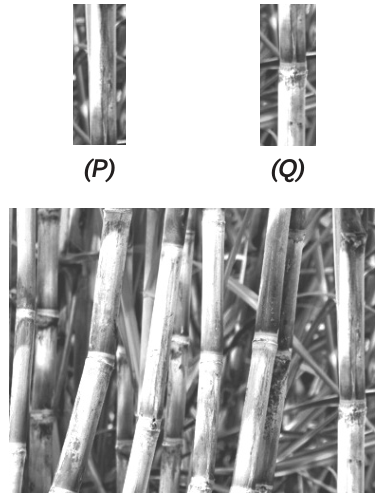
Sohan designed an experiment for the regeneration of sugarcane, where he used cuttings to grow sugarcane. He used two types of cuttings, type 'P' and type 'Q' as shown in the given figure. After a few weeks, type 'Q' cuttings sprouted and developed into sugarcane plants, whereas the type 'P' cuttings did not sprout.
(A) Why were the type 'Q' cuttings able to grow as sugarcane but type 'P' could not?
(B) What difference was present in type 'Q' compared to type 'P'?
(C) What observation or measurement was made to determine whether this change had an effect?
(D) What parameters should be kept the same for both types of cuttings to ensure a fair comparison?
(A) Type 'Q' cuttings were able to grow because they contained a node with a bud or eye. This bud has meristematic cells that can divide and differentiate to form new shoots, roots and other tissues required for growth. Type 'P' cuttings lacked a node or bud, so they could not sprout and develop into new sugarcane plants.
(B) Type 'Q' cuttings had nodes with buds or eyes containing meristematic cells, whereas type 'P' cuttings lacked nodes and consisted only of internodal regions. The presence of these actively dividing cells in the buds enabled type 'Q' cuttings to sprout and regenerate into new sugarcane plants.
(C) The effect was determined by observing whether new shoots sprouted from the cuttings. Additional measurements such as the time taken for sprouting, the number of shoots formed, and shoot length, could also be used to assess growth.
(D) To ensure a fair comparison, the following parameters should be kept constant:
(1) Same soil type and composition of soil.
(2) Same length and size of cuttings.
(3) Same supply of water.
(4) Same light intensity and temperature.
(5) Same depth and time of planting.
(6) Cuttings taken from the same sugarcane variety.
Keeping these variables constant ensures that the observed differences are due to the presence or absence of nodes.