
Plot a graph between the age of a tree (in years) on the x-axis and the diameter of the tree (in cm) along with the number of annual rings formed over time on the y-axis, using the data given in the table.
Table: Data related to the age of a teak tree, and corresponding increase in the diameter of stem and number of annual rings
| S. No. | Age of the Teak Tree (Years) | DBH (Diameter at Breast Height) of Tree (cm) | Number of Annual Rings Formed |
|---|---|---|---|
| (1) | 5 | 4 | 5 |
| (2) | 10 | 8 | 10 |
| (3) | 20 | 24 | 20 |
| (4) | 25 | 28 | 25 |
| (5) | 30 | 32 | 30 |
| (6) | 40 | 40 | 40 |
(A) Analyse the graph in terms of the diameter of the stem over time and share the interpretation.
(B) What is the relation between the diameter of the teak tree to the annual rings formed?
(C) Which specialised tissue is responsible for the girth of the stem and where is it located?
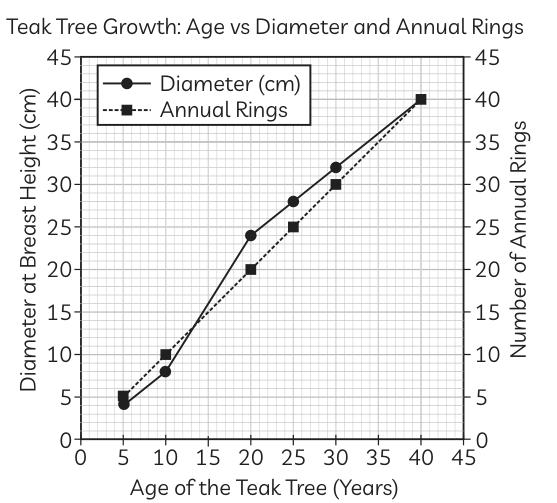
(A) The graph shows that the diameter of the teak tree stem increases with age. At 5 years, the diameter is 4 cm, and it reaches 40 cm by 40 years. The increase is fastest between 10 and 20 years, after which the stem continues to thicken steadily. This increase occurs due to secondary growth caused by cambium activity, which adds new tissues and increases the girth of the stem, providing greater support over time.
(B) There is a direct and positive relationship between the diameter of the teak tree and the number of annual rings formed. As the number of annual rings increases, the diameter of the stem also increases. This is because each annual ring represents one year of secondary growth, during which the cambium adds new layers, mainly secondary xylem, increasing the girth of the stem. However, the increase in diameter may not be exactly equal every year, as the growth rate can vary with age and environmental conditions.
(C) The lateral meristem, mainly the cambium, is responsible for the increase in girth of the stem. It is located along the sides of the stem, especially between the xylem and phloem. Its actively dividing cells produce new tissues, mainly secondary xylem and phloem, which increase the thickness of the plant body.