
Given figure shows stages 0 to 3 of the Sierpiński square carpet. Stage 0 of this fractal is a square sheet of paper. To construct Stage 1, each side of the square is trisected and the points of trisection of opposite sides are joined to obtain nine smaller squares. The centre square is then removed and the 8 smaller squares are retained, leaving a square hole in the centre. The same process is repeated on the eight smaller shaded squares to obtain Stage 2 and so on.
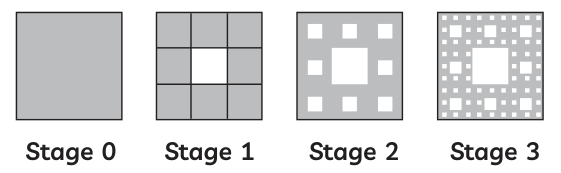
Look at given figure and try to answer the following questions.
(A) How many shaded squares are there in Stages 0 to 3?
(B) Can you predict the number of shaded squares in Stages 4 and 5?
(C) Can you find a rule for the number of shaded squares at the stage? Write the explicit formula as well as the recursive formula for the number of shaded squares at any stage.
(D) Suppose the area of the square in Stage 0 is 1 square unit. What is the area of the shaded region in Stages 1, 2 and 3? What will be the area of the shaded region in Stages 4 and 5? Find the explicit as well as the recursive formula for the area of the shaded region at the stage. What happens to this area as , the number of stages, goes on increasing? [Page No. 194]
At each stage, every shaded square is divided into 9 equal smaller squares, the centre one is removed, and the remaining 8 are kept shaded. So, at every step the count multiplies by 8, and the area multiplies by .
(A) Stage 0 has 1 shaded square.
Stage 1 has 8.
Stage 2 has .
Stage 3 has .
So, the counts are 1, 8, 64, 512.
(B) Stage 4: .
Stage 5: .
So, stage 4 has 4096 shaded squares and stage 5 has 32,768 shaded squares.
(C) The sequence is: 1, 8, 64, 512, ...
This is a GP with
Explicit formula:
Here, stage 0 corresponds to .
Recursive formula:
(D) Area: Stage 0 has area 1 sq. unit.
After each step, 8 of 9 equal sub-squares
are retained, so the area multiplies by .
As increases, the area keeps decreasing and gets closer and closer to , but it is never exactly .