
Observe the Sierpiński triangle.
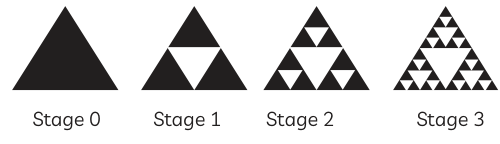
(A) How many black triangles are there in Stages 0 to 3?
(B) Predict the number at Stages 4 and 5.
(C) Find a rule for the number of black triangles at the stage.
(D) Suppose the area of the triangle (that is, the black region) in Stage 0 is 1 square unit. What is the area of the black region in Stages 1, 2 and 3? What will be the area of the black region in Stages 4 and 5? Find a rule for the area of the black region at the stage. What happens to this area as , the number of stages, goes on increasing? [Page No. 189]
(A) Counting the black triangles, Stages 0, 1, 2 and 3 contain 1, 3, 9 and 27 black triangles respectively, because each black triangle is replaced by three smaller ones at the next stage.
(B) Continuing the rule, Stage 4 has and Stage 5 has black triangles.
(C) The numbers 1, 3, 9, 27, 81, 243 are all powers of 3 (), and the exponent matches the stage number. So, the number of black triangles at the th stage is .
(As a recursive rule: and .)
(D) At each stage the central piece is removed, leaving of the previous black area. So the area is multiplied by every stage:
So, the area at the -th stage is square units. Since is less than 1, multiplying by it again and again makes the area smaller and smaller, getting closer and closer to 0 as increases.
In other words, the number of black triangles grows very rapidly while the total black area shrinks towards zero.