Chapter 8
Predicting What Comes Next: Exploring Sequences and Progressions
CBSE Class 9
Mathematics Solutions
Educart Mathematics class Class 9 NCERT Exemplar cover
Question:

Question image

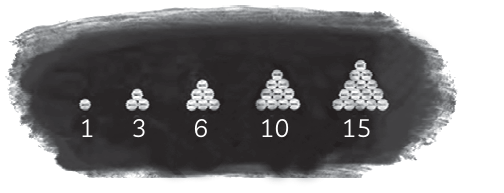
Let us revisit the sequence tnt_{n} of triangular numbers 1, 3, 6, 10, 15, \dots shown in the given figure. Note that the nnth term of this sequence is the sum of the first nn natural numbers. Thus, tn=n(n+1)2t_{n} = \frac{n(n + 1)}{2}.

Can you use this to find the 10th10^{\text{th}}, 17th17^{\text{th}} and 80th80^{\text{th}} triangular numbers?                                                             [Page No. 185]

Answer: Verified

Yes. Each triangular number is the sum of the first nn natural numbers, so tn=n(n+1)2t_n = \frac{n(n+1)}{2}.

t10=10×112=1102=55t_{10} = \frac{10 \times 11}{2} = \frac{110}{2} = 55

t17=17×182=3062=153t_{17} = \frac{17 \times 18}{2} = \frac{306}{2} = 153

t80=80×812=64802=3240t_{80} = \frac{80 \times 81}{2} = \frac{6480}{2} = 3240

Download Free PDF
(All Q's of this Chapter solved)
More NCERT Questions