
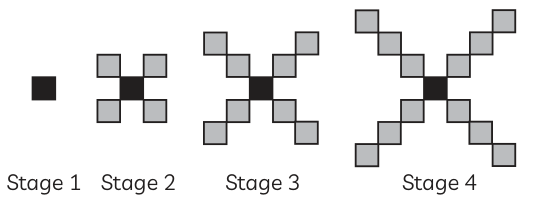
Can you predict the number of squares in Stages 5 and 6 of the pattern (3, 6, 12, 24)? In Stages 10, 11 and 12?
In Stage 20? At any stage? How is this different from the growing pattern in given figure? [Page No. 186]
The counts 3, 6, 12, 24 form a geometric progression with first term and common ratio (each term is double the one before). So the term is .
So, Stage 5 has 48 and Stage 6 has 96; Stages 10, 11 and 12 have 1536, 3072 and 6144; and Stage 20 has 1572864. At any stage the count is .
In given figure, the pattern increases by a fixed amount (+4) at each stage. Such a sequence is an arithmetic progression, which grows steadily and whose graph is a straight line.
In contrast, the present pattern increases by a fixed factor () at each stage. Such a sequence is a geometric progression, which grows much more rapidly and whose graph is not a straight line.
Thus, arithmetic progressions exhibit constant differences, whereas geometric progressions exhibit constant ratios.