

To Download PDF
Please verify your Whatsapp number first,
so you can download this pdf immediately


 Send OTP
.svg)
.avif)

Starting Class 11 Maths honestly feels like someone suddenly changed the difficulty level without warning. One day you’re solving simple Class 10 equations! and the next day you’re staring at strange symbols, long chapters, and questions that look like mini-puzzles. And trust me - everyone feels this in the beginning. You’re not alone.
The good part? Once you slowly get the hang of the basics and start solving the right questions, Class 11 Maths stops feeling scary. It becomes predictable, doable, and sometimes even fun because you start seeing patterns.
In this blog, you’ll find:
In the table given below, we have provided the links to downloadable PDFs of chapter-wise important questions for class 11 mathematics and that too for different categories of marks.
Q1. Rationalise the denominator: 1/(√3 − 1)
Ans. To rationalise the denominator, we multiply by the conjugate because conjugates eliminate square roots using the identity (a − b)(a + b) = a² − b².
So multiply numerator and denominator by (√3 + 1):
1 × (√3 + 1)/((√3 − 1)(√3 + 1))
The denominator becomes: 3 − 1 = 2
Thus the rationalised form is (√3 + 1)/2.
Having a rational denominator is important because it makes further algebraic operations (like adding fractions, solving equations, or simplifying expressions) much easier and avoids unnecessary radicals in final answers.
Q2. Find the domain of f(x) = 1/(x² − 4)
Ans. The domain is all x-values for which the function is defined. This expression becomes undefined wherever the denominator equals zero.
Solve x² − 4 = 0 → x² = 4 → x = 2 and x = −2. These values make the denominator zero, so they must be excluded from the domain.
Therefore, the domain is all real numbers except ±2.
In graphs, these x-values show up as vertical asymptotes, where the curve shoots upward/downward. That’s why domain-checking is essential in rational functions.
Q3. Expand (2x − 3)³ using the Binomial Theorem
Ans. The identity (a − b)³ expands to a³ − 3a²b + 3ab² − b³.
Here a = 2x and b = 3.
Compute step-by-step:
a³ = (2x)³ = 8x³
3a²b = 3(2x)²(3) = 3(4x²)(3) = 36x²
3ab² = 3(2x)(9) = 54x
b³ = 3³ = 27
Putting the signs and terms correctly: 8x³ − 36x² + 54x − 27
This expansion technique is frequently used when simplifying polynomial expressions, forming equations, and solving higher-degree problems.
Q4. Convert 135° to radians
Ans. To convert degrees to radians, multiply by π/180 because a full circle is 180° = π radians.
So: 135 × π/180 = (135/180)π
Divide numerator and denominator by 45 → 3π/4
Thus, 135° = 3π/4 radians.
Radians are essential because calculus formulas for derivatives, integrals, and limits use radians by default.
Q5. Evaluate sin²45° + cos²45°
Ans. sin45° = √2/2 and cos45° = √2/2.
Squaring both: (√2/2)² = 1/2
Now add them: 1/2 + 1/2 = 1
This is one of the most fundamental trigonometric identities and is the base for proving identities like tan²θ + 1 = sec²θ.
Q6. Find the distance between (3, 4) and (7, 1)
Ans. Use the distance formula: √[(x₂ − x₁)² + (y₂ − y₁)²]
Differences: 7 − 3 = 4 and 1 − 4 = −3
Squares: 4² = 16, (−3)² = 9
Add: 16 + 9 = 25
√25 = 5
This formula is a direct application of the Pythagorean theorem on the coordinate plane, treating the difference in x and y as the legs of a right triangle.
Q7. Find the slope of the line joining (2, 5) and (6, 9)
Ans. Slope m = (change in y)/(change in x)
= (9 − 5)/(6 − 2) = 4/4 = 1
A slope of 1 means that for every 1 unit you move right, the line moves up by 1 unit. It represents a 45° inclination and is important in understanding how steep or mild a line is.
Q8. If A = {1, 2, 3} and B = {3, 4}, find A ∪ B
Ans. Union combines all distinct elements from both sets.
A gives 1, 2, 3
B gives 3, 4
Combine without repetition: {1, 2, 3, 4}
Union is frequently used in probability when events occur using “OR”.
Q9. Prove that tanθ × cotθ = 1
Ans. tanθ = sinθ/cosθ
cotθ = cosθ/sinθ
Multiplying: (sinθ/cosθ)(cosθ/sinθ)
The sinθ and cosθ cancel crosswise, leaving 1.
This identity is used often to reduce expressions and simplify trigonometric equations.
Q10. Find log₂16
Ans. log₂16 asks: “2 raised to what power gives 16?”
Since 2⁴ = 16, log₂16 = 4.
This is the basic concept of logarithms: converting from exponential form to exponent form.
Q11. Solve: 2x + 5 = 17
Ans. Subtract 5 from both sides → 2x = 12
Divide both sides by 2 → x = 6
This simple linear solving technique forms the foundation of solving complex algebraic equations and systems.
Q12. Find the equation of the line with slope 2 passing through (1, 3)
Ans. Use point–slope formula: y − y₁ = m(x − x₁)
→ y − 3 = 2(x − 1)
Expand: y − 3 = 2x − 2
Rearrange: y = 2x + 1
This form allows quick graphing and helps construct lines from limited information.
Q13. Find the derivative of x³
Ans. Using the power rule d/dx(xⁿ) = nxⁿ⁻¹
Derivative of x³ = 3x²
This shows how fast the function x³ is changing at any point, a core idea in calculus.
Q14. Find the derivative of sinx
Ans. The derivative of sinx is cosx.
This is a standard result used heavily in trigonometric calculus, physics, and periodic motion problems.
Q15. Integrate 3x² dx
Ans. Using ∫xⁿ dx = xⁿ⁺¹/(n+1):
∫3x² dx = 3 × (x³/3) = x³ + C
Integration finds accumulated quantities like area under curves or displacement from velocity.
Q16. Evaluate ∫(1/x) dx
Ans. Integral = ln|x| + C
Absolute value is important because ln(x) alone is only defined for x > 0, but ln|x| works for negative x as well.
Q17. A matrix has 2 rows and 3 columns. What is its order?
Ans. Order is written as rows × columns.
So the matrix is of order 2 × 3.
Order determines if matrix multiplication is possible, because inner dimensions must match.
Q18. Find determinant of |3 1; 5 2|
Ans. Determinant = ad − bc
= (3×2) − (1×5) = 6 − 5 = 1
A determinant of 1 means the matrix is invertible and represents no area scaling (area preserved).
Q19. Find the area of triangle with vertices (0,0), (4,0), (0,3)
Ans. These points form a right triangle with right angle at (0,0).
Base = 4 (from 0 to 4 on x-axis)
Height = 3 (from 0 to 3 on y-axis)
Area = 1/2 × base × height = 1/2 × 4 × 3 = 6
This method is quicker than using the coordinate geometry formula.
Q20. Find the midpoint of (8, 2) and (4, 6)
Ans. Midpoint averages the x-coordinates and y-coordinates:
x-midpoint = (8 + 4)/2 = 12/2 = 6
y-midpoint = (2 + 6)/2 = 8/2 = 4
So the midpoint is (6, 4).
Midpoints help locate centres of line segments and bisectors.
Q21. Solve the quadratic equation x2 - 5x + 6 = 0 using factorisation
Ans: We split the middle term so that two numbers multiply to 6 and add to -5.
Numbers: -2 and -3
Rewrite the equation: x2 - 2x - 3x + 6 = 0
Group terms:
x(x - 2) - 3(x - 2) = 0
Factor (x - 2):
(x - 2)(x - 3) = 0
So the solutions are:
x = 2 and x = 3
Q22. Prove that (sinA - cosA)2 + (sinA + cosA)2 = 2
Ans: Expand both squares:
(sinA - cosA)2 = sin2A - 2sinAcosA + cos2A
(sinA + cosA)2 = sin2A + 2sinAcosA + cos2A
Add them:
sin2A + sin2A = 2sin2A
cos2A + cos2A = 2cos2A
The -2sinAcosA and +2sinAcosA cancel.
Total sum = 2sin2A + 2cos2A
Take 2 common:
2(sin2A + cos2A)
But sin2A + cos2A = 1
So final answer = 2(1) = 2
Q23. Find tan 75 degrees using the angle-sum formula
Ans: 75 degrees = 45 degrees + 30 degrees
Use formula:
tan(a + b) = (tan a + tan b)/(1 - tan a tan b)
tan 45 = 1
tan 30 = 1/√3
Substitute: tan 75 = (1 + 1/√3)/(1 - 1/√3)
Take LCM: numerator = (√3 + 1)/√3
denominator = (√3 - 1)/√3
√3 cancels: tan 75 = (√3 + 1)/(√3 - 1)
Rationalise denominator:
Multiply top and bottom by (√3 + 1):
tan 75 = ((√3 + 1)2)/((3 - 1))
Expand numerator:
(√3 + 1)2 = 3 + 2√3 + 1 = 4 + 2√3
Denominator = 2
Final answer = (4 + 2√3)/2 = 2 + √3
Q24. Find coordinates of the point dividing A(2,3) and B(6,7) internally in ratio 1:3
Ans: Use section formula:
(mx2 + nx1)/(m + n), (mx2 + nx1)/(m + n))
Here x1=2, y1=3, x2=6, y2=7
Ratio = 1:3 → m=1, n=3
x = (16 + 32)/4 = (6 + 6)/4 = 12/4 = 3
y = (17 + 33)/4 = (7 + 9)/4 = 16/4 = 4
Point = (3, 4)
Q25. Show that points (1, 2), (4, 6), and (7, 10) are collinear
Ans: Points are collinear if slopes between each pair are equal.
Slope AB = (6 - 2)/(4 - 1) = 4/3
Slope BC = (10 - 6)/(7 - 4) = 4/3
Since slopes are equal, all points lie on the same straight line.
Hence, they are collinear.
Q26. Find log(1/1000) in base 10
Ans: 1/1000 = 10(-3)
So log base 10 (10(-3)) = -3
This is because log base a (ax) = x.
Q27. If f(x) = √(9 - x2), find its domain
Ans: The expression under the square root must be >= 0.
9 - x2 >= 0
x2 <= 9
Take square root:
-3 <= x <= 3
So the domain is all x from -3 to 3.
Q28. Evaluate integral of (2x + 3) dx
Ans: Integrate term-by-term:
Integral of 2x dx = x2
Integral of 3 dx = 3x
Final answer: x2 + 3x + C
Geometric meaning: It represents the area under the straight line y = 2x + 3.
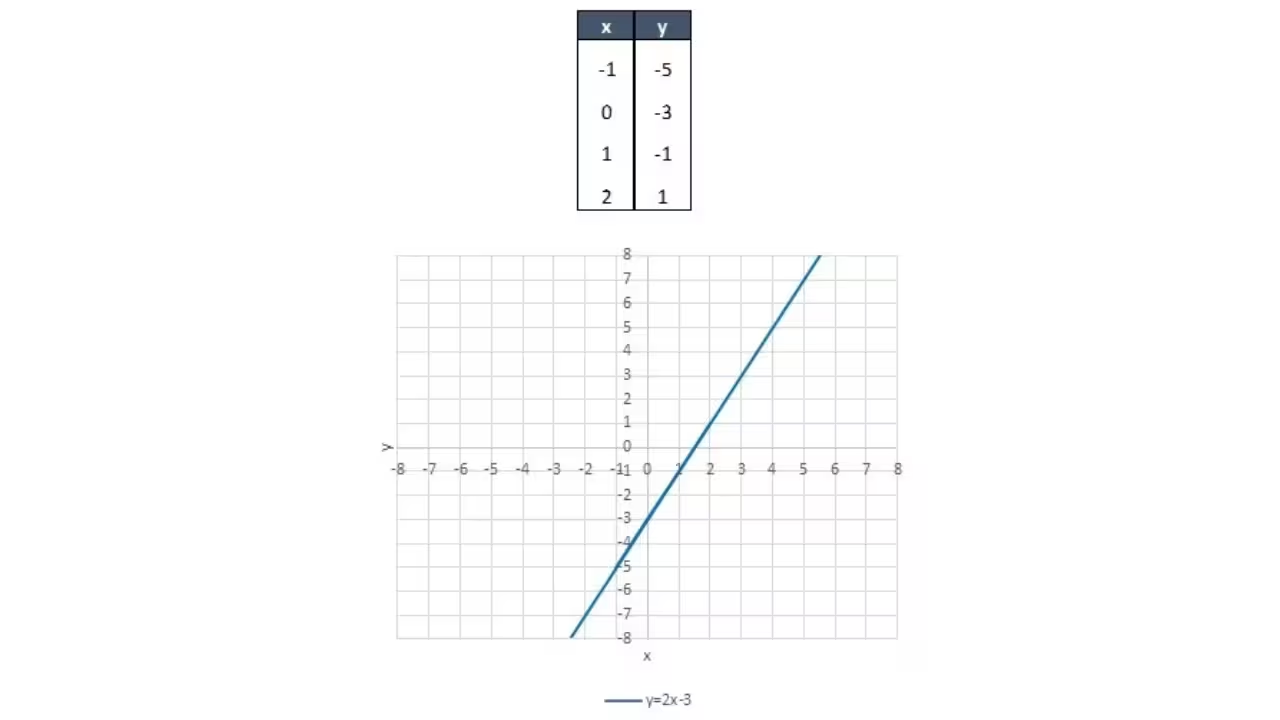
Q29. Find the area of triangle with points (1,1), (5,1), (3,4)
Ans: The base is horizontal from (1,1) to (5,1).
Base length = 5 - 1 = 4
Height is vertical distance from (3,4) to line y = 1
Height = 4 - 1 = 3
Area = 1/2 x base x height = 1/2 x 4 x 3 = 6
Q30. For matrix A = [[1,2],[3,4]], compute A + A and 2A
Ans: A + A means add each element with itself:
[1+1, 2+2], [3+3, 4+4] = [2, 4], [6, 8]
Now find 2A (scalar multiplication):
Multiply each element by 2: [2, 4], [6, 8]
Both answers match because adding A twice is the same as multiplying by 2.
Q1. Solve the quadratic equation x² − 5x + 6 = 0 using factorisation.
Q2. Prove that (sinA − cosA)² + (sinA + cosA)² = 2.
Q3. Find the value of tan 75° using the angle-sum formula.
Q4. If A(2, 3), B(6, 7), find the coordinates of the point dividing AB internally in ratio 1:3.
Q5. Using the distance formula, show that points (1, 2), (4, 6), and (7, 10) are collinear.
Q6. Find the value of log(1/1000) in base 10.
Q7. If f(x) = √(9 − x²), find its domain and explain why.
Q8. Evaluate ∫ (2x + 3) dx and interpret the geometric meaning.
Q9. Find the area of the triangle formed by points (1, 1), (5, 1), and (3, 4).
Q10. For the matrix A = [[1, 2], [3, 4]], compute A + A and 2A.
These Class 11 Maths questions are important because they help you understand what your school exams actually expect. Instead of feeling lost in long chapters and new formulas, these problems show you the exact type of questions that usually appear in mid-terms and pre-boards.
Studying Maths becomes much simpler when you follow a steady routine instead of jumping between topics. These tips help you learn concepts without feeling overloaded:
Q1. How do Class 11 Maths important questions improve exam performance?
Ans. They show the exact patterns CBSE repeats and the type of reasoning expected. Practising them helps you write stepwise answers, justify steps properly, and reduce algebra/geometry errors , boosting overall exam confidence.
Q2. How should I use important questions during revision?
Ans. Try each question without peeking at the solution. Then compare, note mistakes, and keep a small “error notebook.” Re-attempt weak questions after a few days this builds stronger recall.
Q3. Are important questions enough for the full syllabus?
Ans. No. They support NCERT, not replace it. Do NCERT examples, exercises, and past-year papers first, then use important questions for exam-style practice.
Q4. How do I study long chapters like Trigonometric Functions or Straight Lines?
Ans. Break them into smaller chunks. Study identities, formulas, and concepts separately. In coordinate geometry, practise basics like slope, distance and section formula repeatedly. Draw diagrams to visualise and avoid mistakes.
Q5. How can I avoid silly mistakes in Maths exams?
Ans. Write every step clearly, check signs and brackets, and avoid rushing. Use the last few minutes to re-check final answers , most mistakes come from speed, not understanding.



.svg)

