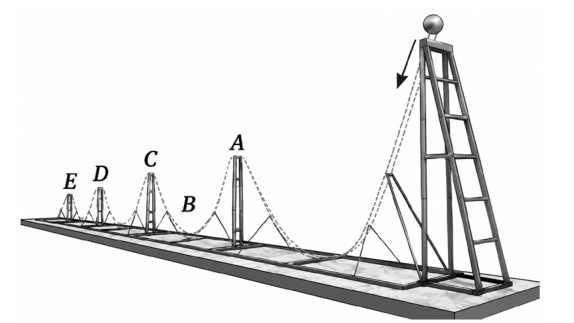
You may have seen an exhibit like that in given figure in a science park, where a ball is released from the highest point. Describe how the kinetic energy and potential energy change at points A, B and C. Why do subsequent points, such as C, D and E, usually have lower heights compared to the previous ones? Could it have anything to do with the energy lost due to friction?
[Pg. No. 129]
At point A, the ball is at a higher position, so its potential energy is high and kinetic energy is less. At point B, the ball is near the lowest point. Here, most of the potential energy changes into kinetic energy, so kinetic energy is maximum and potential energy is minimum.
At point C, the ball rises again, so some kinetic energy changes back into potential energy. Thus, potential energy increases and kinetic energy decreases.
The heights of subsequent points like C, D and E become smaller because some energy is lost due to friction and air resistance. This lost energy is converted into heat and sound energy, so the ball cannot rise to the same height again.