You are given a chemical reaction in which zinc reacts with dilute hydrochloric acid to form zinc chloride and hydrogen gas. Design and perform an experiment to test the hypothesis that mass is conserved during the chemical reaction. [Pg. No. 166]
Aim: To test the hypothesis that mass is conserved during the reaction between zinc and dilute hydrochloric acid.
Hypothesis: The total mass of the products will be exactly equal to the total mass of the reactants, because matter is neither created nor destroyed in a chemical reaction.
Chemical reaction: Zn + 2HCl → ZnCl₂ + H₂↑
Materials required: A conical flask, a tight-fitting rubber cork, a small test tube (ignition tube), thread, zinc granules, dilute hydrochloric acid, and an electronic weighing balance.
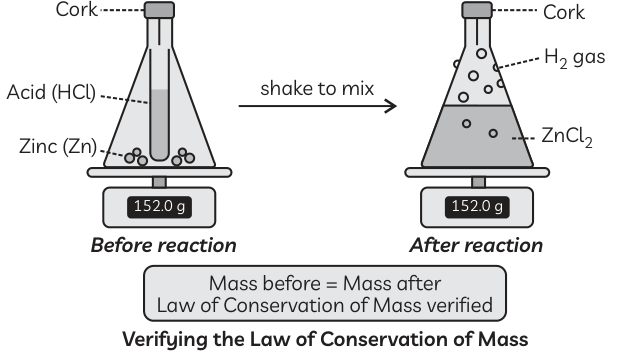
Here is the apparatus setup and what you should observe. Now here is the full experiment, step by step.
Procedure:
(1) Take a few zinc granules in a clean, dry conical flask.
(2) Pour some dilute hydrochloric acid into a small test tube. Carefully lower this test tube into the conical flask using a thread, keeping it upright so the acid does not spill onto the zinc yet.
(3) Close the mouth of the flask tightly with the rubber cork so that the system is completely airtight — this is the most important step.
(4) Place the sealed flask on the weighing balance and note the initial mass ( ).
(5) Now tilt and gently shake the flask so that the acid mixes with the zinc and the reaction begins. You will see bubbling.
(6) Keeping the flask corked, place it back on the balance and note the final mass ( ).
Observations: As soon as the acid touches the zinc, there is brisk effervescence (bubbles of hydrogen gas), the flask feels slightly warm, and the zinc slowly dissolves. On weighing, the initial and final readings are equal — for example, g and g.
Result and conclusion: Since , the total mass of the flask and its contents is the same before and after the reaction. This proves the hypothesis — mass is conserved during the chemical reaction, which is exactly what the Law of Conservation of Mass states: in a chemical reaction, mass can neither be created nor destroyed.