An element X has six electrons in its outer shell and forms a diatomic molecule.
(A) Why would that be so?
(B) What kind of bond would it form?
(C) Draw the structure of the molecule it would form.
(D) A certain other element Y has two electrons in its second shell. Draw the structure of the molecule that X would form with Y.
Element X has 6 electrons in its outermost shell, so its electronic configuration is 2, 6 (atomic number 8). Therefore, X is oxygen (O).
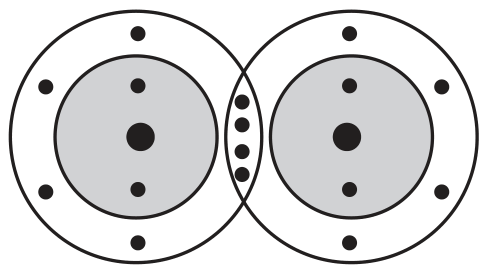
(A) Element X (oxygen) has 6 electrons in its outermost shell and needs 2 more electrons to complete its octet. To attain stability, two oxygen atoms share two pairs of electrons with each other, forming a diatomic molecule (O₂).
(B) Since both atoms attain stability by sharing electrons, the bond formed is a double covalent bond, represented as O=O.
(C) Structure of the molecule X₂ or (O₂):
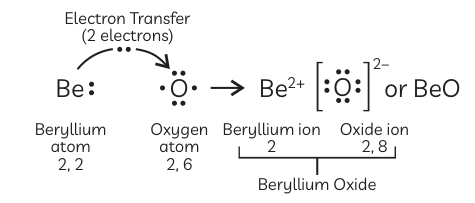
(D) Element Y has 2 electrons in its second shell, so its electronic configuration is 2, 2 (atomic number 4). Therefore, Y is beryllium (Be).
Element Y losses its 2 electrons and the element X (oxygen) gains these 2 electrons to complete its octet. This transfer of electrons leads in the formation of BeO (beryllium oxide) which is an ionic compound.