
When the pole of a bar magnet is brought close to a magnetic compass, the bar magnet and the compass needle (which is also a magnet) exert a magnetic force on each other. As per Newton's third law of motion, both the forces are equal in magnitude and opposite in direction. However, the compass needle moves, whereas the bar magnet does not move as shown in the given figure. Explain why.
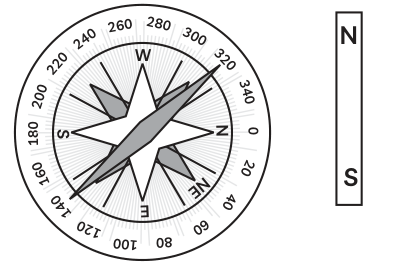
According to Newton's third law of motion, the bar magnet and the compass needle exert equal and opposite magnetic forces on each other. However, the effect of a force depends not only on its magnitude but also on the mass of the object on which it acts. The compass needle is very light and is free to rotate about a pivot. Therefore, even a small magnetic force can easily make it move. On the other hand, the bar magnet has much greater mass and is usually held firmly in the hand or fixed in position. Due to its larger mass and resistance to motion, the same force is not sufficient to produce noticeable movement in the bar magnet.
Hence, the compass needle moves, while the bar magnet appears to remain at rest.