
Use the Baudhāyana-Pythagoras theorem to show theorem: Chords of a circle having the same length are all at the same distance from the centre of the circle must be true. [Page No. 104]
Theorem: Chords of a circle having the same length are all at the same distance from the centre of the circle.
Let AB and FG be two chords of a circle with centre C, such that AB = FG. Let E and H be the feet of perpendiculars from C to AB and FG respectively.
Since, the perpendicular from the centre of a circle to a chord of the circle bisects the chord.
E and H are midpoints of AB and FG.
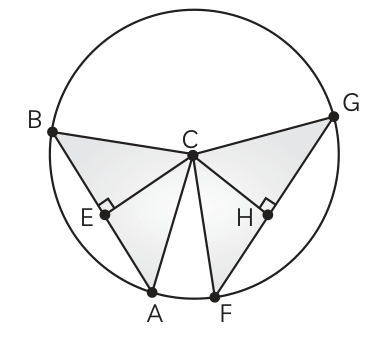
Since AB = FG, we get AE = FH.
Also, CA = CF = (radii of the circle).
In the right triangle CEA (right-angled at E), by the Baudhāyana–Pythagoras theorem:
Similarly, in right triangle CHF:
Since AB = FG, we have , and therefore CE = CH.
Hence, equal chords are equidistant from the centre.
Concept Applied
Equal chords of a circle are equidistant from the centre, and chords equidistant from the centre are equal (proved using the Baudhāyana–Pythagoras theorem).