
The potential energy-displacement graph of a 0.5 kg ball moving along a frictionless track is shown in the given figure. At O, the velocity of the ball is 0 ms⁻¹ and potential energy is 30 J. Calculate the velocity of the ball at P, Q and R.
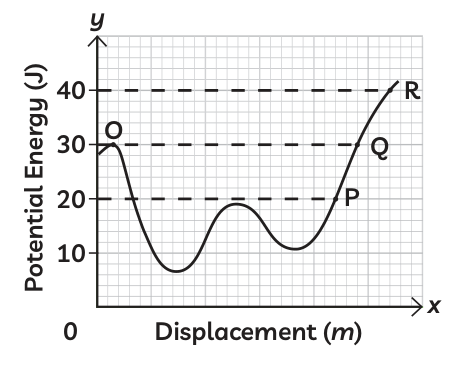
Given:
Mass of ball,
At point O:
Potential energy = 30 J
Therefore, total mechanical energy of the ball:
Since the track is frictionless, mechanical energy remains constant.
At point P:
From the graph, potential energy at P = 20 J
Kinetic energy at P:
Therefore, velocity at P is 6.3 ms
At point Q:
From the graph, potential energy at Q = 30 J
Hence,
Therefore, velocity at Q is:
At point R:
From the graph, potential energy at R = 40 J
Since the total mechanical energy of the ball is only 30 J, the ball cannot reach point R.
Therefore, velocity at R cannot be calculated because the ball never reaches R.