Chapter 1
Orienting Yourself: The Use of Coordinates
CBSE Class 9
Mathematics Solutions
Educart Mathematics class Class 9 NCERT Exemplar cover
Question:

Plot the points A(2,1),B(1,2),C(2,1),\mathrm{A}(2, 1), \mathrm{B}(-1, 2), \mathrm{C}(-2, -1), and D(1,2)\mathrm{D}(1, -2) in the coordinate plane. Is ABCD\mathrm{ABCD} a square? Can you explain why? What is the area of this square?

Answer: Verified

Plotting of points A (2, 1), B (-1, 2), C (-2, -1), and D (1, -2) in the coordinate plane is given as:
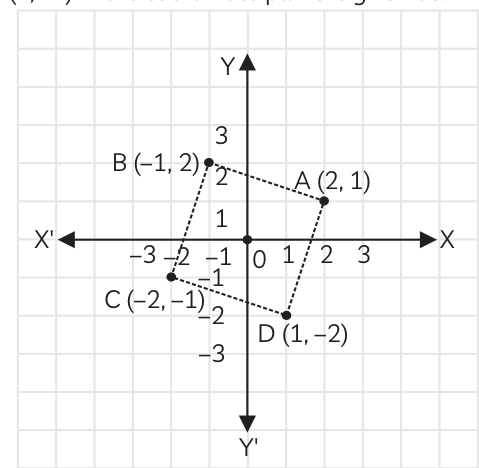
Answer image

A square is a quadrilateral whose four sides are equal and whose adjacent sides are perpendicular.
Using distance formula,

AB=(12)2+(21)2=9+1=10AB = \sqrt{(-1 - 2)^2 + (2 - 1)^2} = \sqrt{9 + 1} = \sqrt{10}

BC=(2(1))2+(12)2=1+9=10BC = \sqrt{(-2 - (-1))^2 + (-1 - 2)^2} = \sqrt{1 + 9} = \sqrt{10}

CD=(1(2))2+(2(1))2=9+1=10CD = \sqrt{(1 - (-2))^2 + (-2 - (-1))^2} = \sqrt{9 + 1} = \sqrt{10}

DA=(21)2+(1(2))2=1+9=10DA = \sqrt{(2 - 1)^2 + (1 - (-2))^2} = \sqrt{1 + 9} = \sqrt{10}

All four sides equal 10\sqrt{10} , so ABCD is at least a rhombus.

AC=(22)2+(11)2=16+4=20AC = \sqrt{(-2 - 2)^2 + (-1 - 1)^2} = \sqrt{16 + 4} = \sqrt{20}

BD=(1(1))2+(22)2=4+16=20BD = \sqrt{(1 - (-1))^2 + (-2 - 2)^2} = \sqrt{4 + 16} = \sqrt{20}

Since, all sides and diagonals are equal, therefore, it is a square.

Area of square = (side)2=(10)2=10 sq. units(\text{side})^2 = (\sqrt{10})^2 = 10 \text{ sq. units} .

Download Free PDF
(All Q's of this Chapter solved)
More NCERT Questions