
On a graph sheet, mark the x-axis and y-axis and the origin O. Mark points from (-7, 0) to (13, 0) on the x-axis and from (0, -15) to (0, 12) on the y-axis. (Use the scale 1 cm = 1 unit.) Using given figure, answer the given questions.
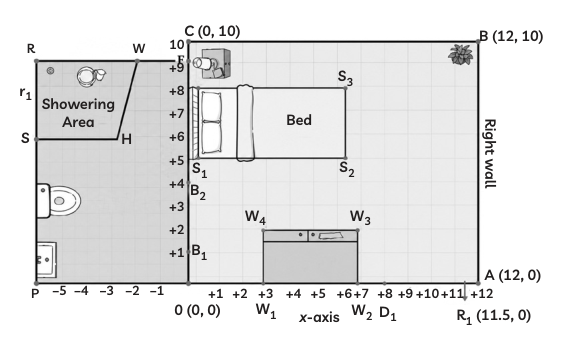
(A) Place Reiaan's rectangular study table with three of its feet at the points (8, 9), (11, 9) and (11, 7).
(i) Where will the fourth foot of the table be?
(ii) Is this a good spot for the table?
(iii) What is the width of the table? The length? Can you make out the height of the table?
(B) If the bathroom door has a hinge at B₁ and opens into the bedroom, will it hit the wardrobe? Are there any changes you would suggest if the door is made wider?
(C) Look at Reiaan's bathroom.
(i) What are the coordinates of the four corners O, F, R, and P of the bathroom?
(ii) What is the shape of the showering area SHWR in Reiaan's bathroom? Write the coordinates of the four corners.
(iii) Mark off a 3 ft × 2 ft space for the washbasin and a 2 ft × 3 ft space for the toilet. Write the coordinates of the corners of these spaces.
(D) Other rooms in the house:
(i) Reiaan’s room door leads from the dining room which has the length 18 ft and width 15 ft. The length of the dining room extends from point P to point A. Sketch the dining room and mark the coordinates of its corners.
(ii) Place a rectangular 5 ft × 3 ft dining table precisely in the centre of the dining room. Write down the coordinates of the feet of the table. [Page No. 7]
(A) (i) The three given feet form three corners of a rectangle. Label them:
, , .
is horizontal (same ).
is vertical (same ).
So, the missing vertex must be horizontally level with and vertically level with .
Thus, .
(ii) Yes, it is a good spot. The table is placed inside the bedroom, away from the door and clear of the bed. It is positioned near the wall.
(iii) Dimensions:
Length (along ) = ft.
Width (along ) = ft.
The height of the table cannot be determined from this floor-plan figure. The plan only shows the top-view (floor view). Heights are vertical and are not represented on a 2-D coordinate plane.
(B) Let's look at it Mathematically
The door stretches from to . Its width is feet.
- If it swings fully open into the room (90° angle), the outer edge traces a path that reaches a maximum distance of 2.5 units into the room ().
- The wardrobe starts at point , which is at .
- Since 2.5 is strictly less than 3, No, the door will not hit the wardrobe. It will miss it by half a foot.
Suggestion: If the door is made 3 feet or wider, it will smash into the wardrobe. To prevent this, we could suggest either of these things
1. Reversing the hinge so the door swings outward into the bathroom instead.
2. Installing a sliding "pocket door" that slides into the wall.
3. Moving the wardrobe further to the right.
(C) The bathroom lies to the left of the -axis i.e., in the region . Since, bathroom is 6 ft wide 9 ft tall, attached to the left wall of the bedroom.
(i) Bathroom corners:
(bottom-right shared with the bedroom's bottom-left corner)
(top-right of bathroom)
(top-left of bathroom)
(bottom-left of bathroom)
(ii) Let's look at the Shape
Here, SWHR has 4 sides. So, it is a quadrilateral and, RW & SH are parallel. Now, we know that a Quadrilateral with one pair of opposite sides parallel is a trapezium.
Thus, SWHR is a trapezium and, its Coordinates: , , , .
(iii) Washbasin (3 ft 2 ft) and toilet (2 ft 3 ft). One reasonable layout uses the lower half of the bathroom:
Washbasin corners: , , , [3 ft along , 2 ft along ].
Toilet corners: , , , [2 ft along , 3 ft along ].
(Other reasonable placements are acceptable as long as the objects fit inside the bathroom and do not overlap each other or the showering area.)
(D) (i) P and A are points of the existing plan.
Since, P = (-6, 0) (bottom-left of the bathroom) and A = (12, 0) (bottom-right of the bedroom).
So, length PA = 12 - (-6) = 18 ft (matches the given length).
The dining room is on the outside of the bedroom/bathroom along the bottom wall i.e., in the region y ≤ 0.
Its length (18 ft) is along the x-axis (from x = -6 to x = 12) and its width is 15 ft, so it extends 15 ft downward (y goes from 0 down to -15).
Four corners of the dining room:
P = (-6, 0), A = (12, 0), A' = (12, -15), P' = (-6, -15).
Hence, dining room corners P(-6, 0), A(12, 0), (12, -15), (-6, -15).
(ii) The centre of this rectangle is the midpoint of its diagonal:
Place a 5 ft × 3 ft table with its centre at (3, -7.5). Take the 5 ft side along the x-axis and the 3 ft side along the y-axis.
Then the four feet are at:
(3 - 2.5, -7.5 - 1.5) = (0.5, -9)
(3 + 2.5, -7.5 - 1.5) = (5.5, -9)
(3 + 2.5, -7.5 + 1.5) = (5.5, -6)
(3 - 2.5, -7.5 + 1.5) = (0.5, -6)
Hence, table feet: (0.5, -9), (5.5, -9), (5.5, -6), (0.5, -6).