
In the given figure, Reiaan's room is shown with points marking its corners. The - and -axes are marked in the figure. Point is the origin.
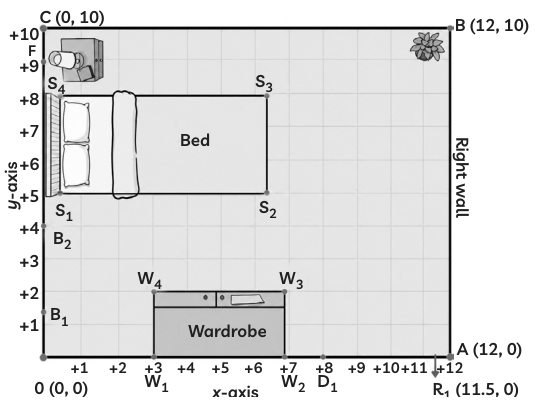
(A) If D₁R₁ represents the door to Reiaan's room, how far is the door from the left wall (the y-axis) of the room? How far is the door from the x-axis?
(B) What are the coordinates of D₁?
(C) If R₁ is the point (11.5, 0), how wide is the door? Do you think this is a comfortable width for the room door? If a person in a wheelchair wants to enter the room, will he/she be able to do so easily?
(D) If B₁ (0, 1.5) and B₂ (0, 4) represent the ends of the bathroom door, is the bathroom door narrower or wider than the room door? [Page No. 4]
(A) From the figure, lies on the bottom wall (the -axis) at .
So,
Distance of the door from the -axis (left wall) = 8 ft (the -coordinate of ).
Distance of the door from the -axis = 0 ft (the door is on the -axis itself).
(B) is on the -axis, i.e., .
From the figure, its -coordinate 8.
Thus, .
(C) Both and lie on the -axis, so the door width is the difference of -coordinates.
Width of door = (-coordinate of ) - (-coordinate of ) = ft.
A 3.5 ft wide door is quite comfortable, as standard residential doors are usually about 3 ft wide. A wheelchair typically requires a minimum clear width of about 32 inches, though 36 inches is recommended. Since 3.5 ft is well above this minimum width, a person in a wheelchair can enter easily.
(D) Both and lie on the -axis (). The door width is the difference of -coordinates.
Bathroom door width = ft.
The bathroom door (2.5 ft) is narrower than the room door (3.5 ft).