Chapter 5
I’m Up and Down, and Round and Round
CBSE Class 9
Mathematics Solutions
Educart Mathematics class Class 9 NCERT Exemplar cover
Question:

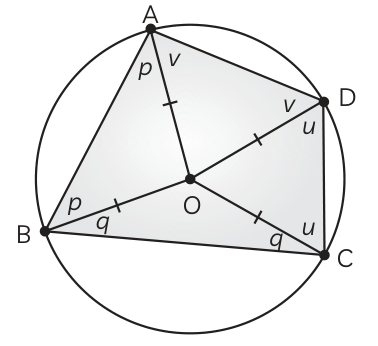
How would you use given figure to justify the statement that the sum of the opposite angles of a cyclic quadrilateral is 180180^\circ?

Question image

Answer: Verified

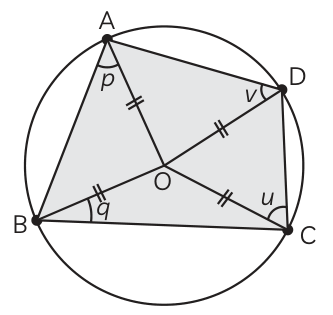
Given: ABCDABCD is a cyclic quadrilateral with centre OO.

Answer image

Since, OA=OB=OC=ODOA = OB = OC = OD [Radii of the same circle]

\therefore Triangles OABOAB, OBCOBC, OCDOCD and ODAODA are isosceles, so their base angles are equal:

OAB=OBA=p,OBC=OCB=q,OCD=ODC=u,ODA=OAD=v\begin{aligned} \angle OAB &= \angle OBA = p, \\ \angle OBC &= \angle OCB = q, \\ \angle OCD &= \angle ODC = u, \\ \angle ODA &= \angle OAD = v \end{aligned}

Now, the radius at each vertex divides that angle into two parts, so

A=p+v,B=p+q,C=q+u,D=u+v\begin{aligned} \angle A &= p + v, \\ \angle B &= p + q, \\ \angle C &= q + u, \\ \angle D &= u + v \end{aligned}

Since the sum of the angles of a quadrilateral is 360360^\circ,

A+B+C+D=3602(p+q+u+v)=360p+q+u+v=180\begin{aligned} \angle A + \angle B + \angle C + \angle D &= 360^\circ \\ 2(p + q + u + v) &= 360^\circ \\ \therefore p + q + u + v &= 180^\circ \end{aligned}

Therefore,

A+C=(p+v)+(q+u)=180B+D=(p+q)+(u+v)=180\begin{aligned} \angle A + \angle C &= (p + v) + (q + u) = 180^\circ \\ \angle B + \angle D &= (p + q) + (u + v) = 180^\circ \end{aligned}

Hence, the opposite angles of a cyclic quadrilateral are supplementary.

Hence proved.
Download Free PDF
(All Q's of this Chapter solved)
More NCERT Questions