
Can you explain why the converse to Theorem 4 is true, i.e., why does the perpendicular from the centre of a circle to a chord of the circle bisect the chord? [Page No. 101]
Let C be the centre and AB be a chord.
Let CM ⊥ AB with M on AB.
We need to show that AM = BM.
In triangles CMA and CMB,
CA = CB [Radii of the circle]
CM = CM [Common side]
∠CMA = ∠CMB = 90° [Given]
By RHS congruence, ΔCMA ≅ ΔCMB.
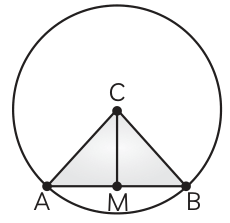
Hence, AM = BM [CPCT]
So, M is the midpoint of AB.
Therefore, the perpendicular from the centre to a chord bisects the chord.
Hence, proved.
Caution
Students should remember that the perpendicular from the centre of a circle to a chord bisects the chord; they should not assume that just any line drawn from the centre bisects a chord.