A particular element (X) has one electron in its third shell. There is another element (Y) with six electrons in its second shell.
(A) How many electrons does X tend to give or take to become stable?
(B) What kind of ion would it form?
(C) How many electrons does Y tend to give or take to become stable?
(D) What kind of ion would it form?
(E) If X and Y were to combine, what kind of bond would be formed?
(F) What would be the formula for the compound thus formed?
The electronic configuration of element X is 2, 8, 1 (atomic number 11), so X is sodium (Na). The electronic configuration of element Y is 2, 6 (atomic number 8), so Y is oxygen (O).
(A) Element X has only 1 electron in its outermost shell, so it tends to lose 1 electron to attain octet or stable configuration of noble elements.
(B) After losing 1 electron, X forms a positively charged cation (Na⁺).
(C) Element Y has 6 electrons in its outermost shell, so it tends to gain 2 electrons to complete its octet.
(D) After gaining 2 electrons, Y forms a negatively charged anion (O²⁻).
(E) Since X loses electron and Y gains electrons, the bond formed involves the transfer of electrons. The oppositely charged ions of X and Y are held together by electrostatic force and this kind of bond is called ionic bond.
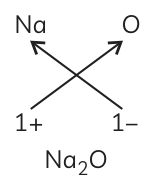
(F) Using the criss-cross method, the formula of the compound formed is Na₂O (sodium oxide).