A city has two main roads which cross each other at the centre of the city. These two roads are along the North–South (N–S) direction and East–West (E–W) direction. All the other streets of the city run parallel to these roads and are 200 m apart. There are 10 streets in each direction.
(A) Using 1 cm = 200 m, draw a model of the city in your notebook. Represent the roads/streets by single lines.
(B) There are street intersections in the model. Each street intersection is formed by two streets—one running in the N–S direction and another in the E–W direction. Each street intersection is referred to in the following manner: If the second street running in the N–S direction and 5th street in the E–W direction meet at some crossing, then we call this street intersection (2, 5). Using this convention, find:
(i) how many street intersections can be referred to as (4, 3).
(ii) how many street intersections can be referred to as (3, 4).
(A)
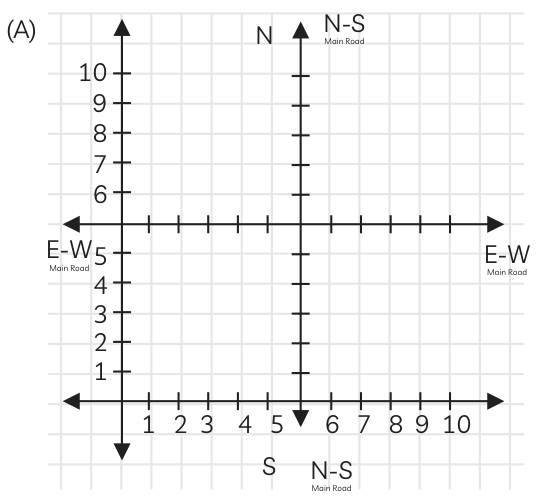
(B) The labelling fixes both the NS street (first coordinate) and the EW street (second coordinate). A single pair of perpendicular streets meet at exactly one point.
(i) '(4, 3)' means the 4th NS street and the 3rd EW street, this is a unique point. So, there is exactly one such intersection.
(ii) '(3, 4)' means the 3rd NS street and the 4th EW street, again a unique point. Exactly one such intersection.
Note: (4, 3) and (3, 4) are different intersections the order matters. This is exactly the same idea as ordered pairs in the Cartesian plane: unless .
### Caution
Students should remember the order of coordinates in an ordered pair. In , the first number is always the -coordinate (horizontal) and the second is the -coordinate (vertical). So is not the same as unless .