
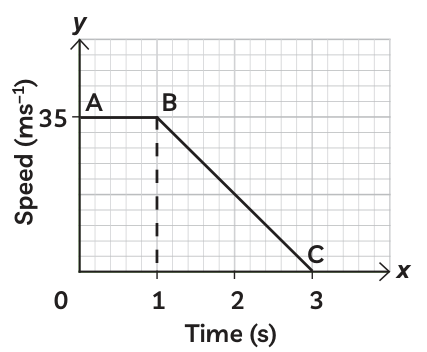
A 1000 kg car is moving along a road at a constant speed. Suddenly, the driver notices some obstruction ahead and applies the brakes to come to a complete stop. The graphical representation of motion of the car starting from the instant the driver spots the traffic ahead is shown in the given figure:
(A) Describe how the car moves between positions A and B.
(B) Calculate the kinetic energy of the car at A.
(C) State the work done by the brakes in bringing the car to a halt between B and C.
(D) What does the kinetic energy of the car transform into?
(A) Between A and B, the car moves with a constant speed of 35 ms because the graph is horizontal in this region.
(B) Given:
Mass of car,
Velocity at A,
Kinetic energy:
Therefore, the kinetic energy of the car at A is 612500 J.
(C) When the car comes to rest, its final kinetic energy becomes zero.
Work done by brakes:
Therefore, the work done by the brakes is -612500 J.
The negative sign shows that the brakes oppose the motion of the car.
(D) The kinetic energy of the car transforms mainly into heat energy due to friction between the brake pads and the wheels.