
Chapter 7
Work, Energy, and Simple Machines
CBSE Class 9
Science Solutions
Educart Science class Class 9 NCERT Exemplar cover
Question:

A 10.0 kg block is moving on horizontal floor with negligible friction. As shown in the given figure a variable force is applied on the block in its direction of motion from its position at 0 m till 4 m. If the block had a kinetic energy of 180 J when it was at 0 m, find the block's speed:

(A) at 0 m, and
(B) at 4 m.

Does the block have negative acceleration in any portion of its motion?
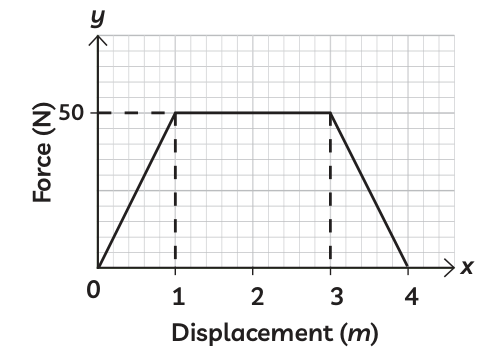
Question image

Answer: Verified

Given:
Mass of block, m = 10 kg
Initial kinetic energy at 0 m:
K.E. = 180 J
(A) Speed at 0 m:

Using, K.E.=12mv2\text{Using, } K.E. = \frac{1}{2}mv^2

180=12×10×v2180 = \frac{1}{2} \times 10 \times v^2

180=5v2180 = 5v^2

v2=36v^2 = 36

v=6 ms1v = 6 \text{ ms}^{-1}

Therefore, the speed of the block at 0 m is 6 ms1^{-1}

(B) Speed at 4 m:

Work done by the force = Area under the force-displacement graph.

From 0 m to 1 m:

Area of triangle=12×1×50\text{Area of triangle} = \frac{1}{2} \times 1 \times 50

=25 J= 25 \text{ J}

From 1 m to 3 m:

Area of rectangle=2×50\text{Area of rectangle} = 2 \times 50

=100 J= 100 \text{ J}

From 3 m to 4 m:

Area of triangle

=12×1×50= \frac{1}{2} \times 1 \times 50

=25 J= 25 \text{ J}

Total work done:

W=25+100+25W = 25 + 100 + 25

W=150 JW = 150 \text{ J}

Using work-energy theorem,

Final K.E.=Initial K.E.+W\text{Final K.E.} = \text{Initial K.E.} + W

=180+150= 180 + 150

=330 J= 330 \text{ J}

Now,

330=12×10×v2330 = \frac{1}{2} \times 10 \times v^2

330=5v2330 = 5v^2

v2=66v^2 = 66

v=66v = \sqrt{66}

v8.1 ms1v\thickapprox8.1\text{ ms}^{-1}

Therefore, the speed of the block at 4 m is: 8.1 ms1^{-1}.
The block does not have negative acceleration during any part of its motion because the applied force is always positive and acts in the direction of motion.


Download Free PDF
(All Q's of this Chapter solved)
More NCERT Questions