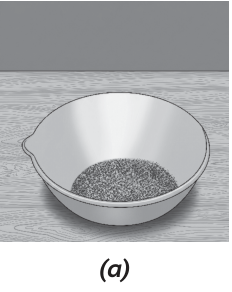
You are given a mixture of sand, common salt and naphthalene as shown in fig. (a). The fig. (b) depicts various steps used to separate the components of this mixture. Identify and write down the correct sequence of separation techniques.
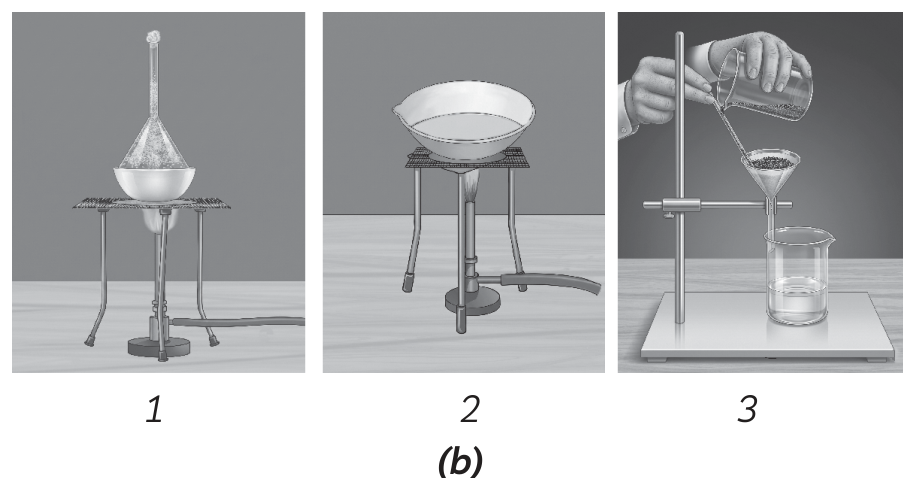
The given mixture contains three components: Sand (insoluble in water and non-sublimable), common salt (soluble in water and non-sublimable), and naphthalene (sublimable solid). Since each component has a different physical property, the mixture can be separated by carrying out three techniques in the following correct sequence:
Sublimation → Dissolution and Filtration → Evaporation
Step-1 (Sublimation): The mixture is first heated gently in a china dish with an inverted funnel placed over it and the mouth of the funnel is plugged with cotton, so as to prevent the escape of vapours. Naphthalene sublimes (changes directly from solid to vapour) and deposits as a solid on the cooler walls of the funnel, while sand and common salt remain in the china dish.
Step-2 (Dissolution and Filtration): Water is added to the remaining mixture of sand and salt. Salt dissolves in water, while sand does not. This mixture is then filtered. Sand remains as a residue on the filter paper, and the salt solution passes through as the filtrate.
Step-3 (Evaporation): The salt solution (filtrate) is heated in a china dish. The water evaporates, leaving behind pure common salt as a solid residue.
In this way, all three components naphthalene, sand, and common salt are separated successfully.