
What happens if the parallelogram is 'thin' (given in figure) and the foot of the perpendicular from C to AD does not lie on side AD? The construction then does not seem to work. How do we fix this 'gap'? [Page No. 131]
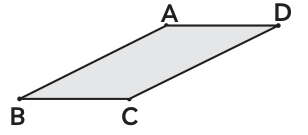
The cut-and-move construction (snip a right triangle off one end of the parallelogram and slide it to the other end to make a rectangle) only works when the foot of the perpendicular from C lands on the base AD itself. For a very slanted ('thin') parallelogram, that foot falls outside AD, so there is no right triangle sitting over the base to cut and move, and the construction breaks down.
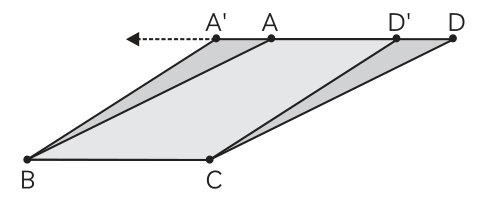
The fix is to replace the thin parallelogram with a less-slanted one of the same area. Choose a point D' on DA close to D, and a point A' on DA extended beyond A with A'A = D'D. Then A'BCD' is again a parallelogram with the same base length and the same height as ABCD. Since , the bit added on one side exactly balances the bit removed on the other, so A'BCD' has the same area as ABCD. The new parallelogram leans less, so the perpendicular foot is more likely to land on its base. If it still doesn't, repeat the step, each repetition makes the figure less slanted until the foot lands on the base, and then the rectangle construction works. So, the formula base height holds for thin parallelograms too.