The figure shows a quarter circle in a square. Its centre is at one vertex, and it passes through two adjacent vertices. There are two semicircles on two adjacent sides as diameters. They create the shaded regions A and B.
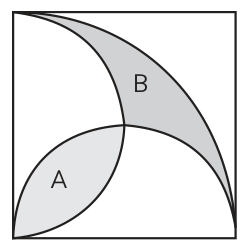
Show that A and B have equal area.
Let the side of the square be .
Then, the quarter circle has radius , each semicircle has radius .
The area of the quarter circle is .
The area of each semicircle is .
So, the total area of the two semicircles is
Hence, Area of quarter circle = Sum of areas of the two semicircles.
Now observe the figure carefully:
Region A is the overlap (common part) of the two semicircles.
Region B is the part of the quarter circle left after removing the parts covered by the semicircles.
Inside the square:
(sum of semicircle areas) = A + (parts outside A) and
quarter circle area = B + (same parts outside A)
Since the total areas are equal, subtracting the common remaining parts gives
Therefore, Area of region A = Area of region B.