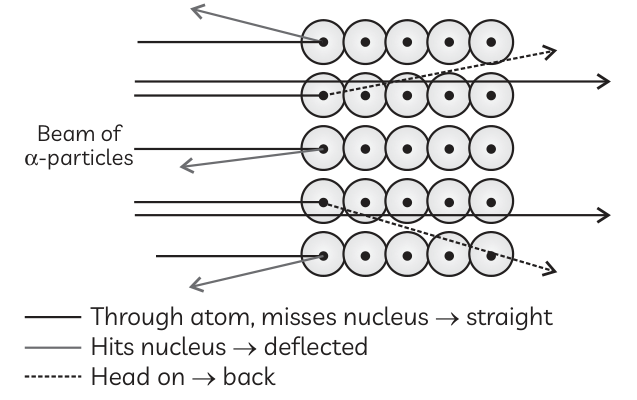
Observe the given figure of the gold foil experiment. Predict the observations you would expect if the gold foil in the experiment were made thicker. Also, draw a simple diagram to show the observations you expect. (Hint: Compare thin foil vs thick foil. How does the thickness affect the chances of hitting a nucleus?)
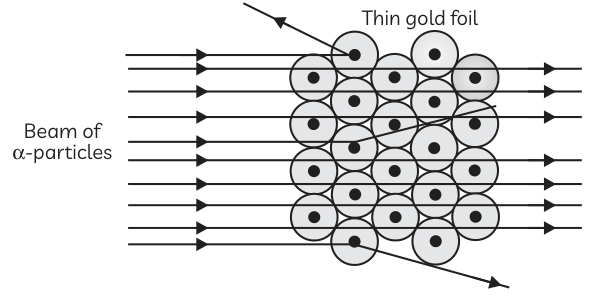
In Rutherford's gold foil experiment, an exceptionally thin gold foil was used so that most -particles could pass through the mostly empty space inside atoms.
If the gold foil were made thicker, the -particles would pass through more layers of gold atoms, increasing the chances of coming close to positively charged nuclei. Hence, fewer -particles would pass straight through, more would undergo small-angle deflections, and the chances of large-angle deflections or backscattering would increase. In a very thick foil, -particles may also lose much of their kinetic energy due to repeated interactions and may even be stopped inside the foil.
Table: Comparison of Thin vs Thick Foil
| Thin foil | Thick foil |
|---|---|
| Most -particles go straight. | Fewer -particles go straight. |
| Few -particles are slightly deflected. | More -particles are deflected. |
| Very few -particles bounce back. | There are more chances of large deflection or bouncing back. |
| Scattering pattern is clearer. | Multiple scattering may make the pattern broader and less clear. |
Thick gold foil – Frequent deflections, straight beams pass through the atoms