
Magnesium is essential for many biological processes, including muscle contraction. For an atom of magnesium with a mass number of 24 and atomic number 12, determine the number of (A) protons, (B) neutrons, (C) electrons, and also illustrate the arrangement of electrons in a magnesium atom.
Given that magnesium atom has atomic number (Z) = 12 and the mass number (A) = 24
(A) The number of protons in an atom is equal to its atomic number. Therefore, magnesium has 12 protons.
(B) The number of neutrons can be calculated as:
Therefore, magnesium has 12 neutrons.
(C) Since the atom is electrically neutral, the number of electrons is also equal to the number of protons. Hence, magnesium has 12 electrons.
The electronic configuration of magnesium is 2, 8, 2. This means K-shell has 2 electrons, L-shell has 8 electrons and M-shell has 2 electrons.
This can be illustrated by the given figure as follows:
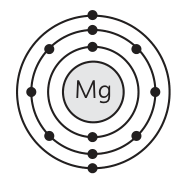
Electron Distribution in Magnesium Atom