
Look at the first three stages of a growing pattern of hexagons made using matchsticks. A new hexagon gets added at every stage which shares a side with the last hexagon of the previous stage.
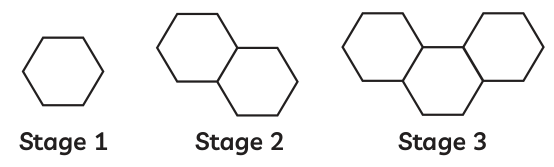
(A) Draw the next two stages of the pattern. How many matchsticks will be required at these stages?
(B) Complete the following table.
(C) Find a rule to determine the number of matchsticks required for the stage.
(D) How many matchsticks will be required for the stage of the pattern?
(E) Can 200 matchsticks form a stage in this pattern? Justify your answer.
Stage 1: one hexagon 6 matchsticks.
Stage 2: two hexagons sharing a side matchsticks.
Stage 3: three hexagons matchsticks.
Each new stage adds 5 matchsticks.
Stage 4: matchsticks.
Stage 5: matchsticks
(A)
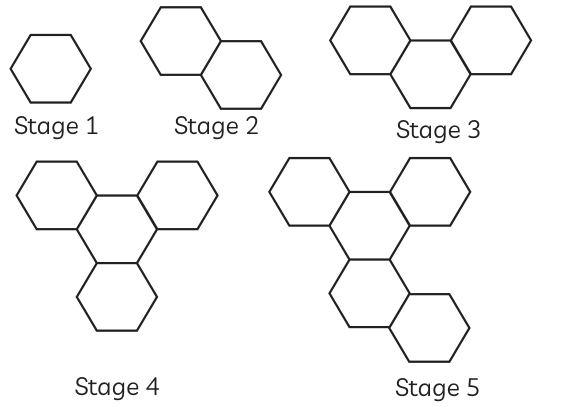
(B) Table of values:
(C) General rule: Number of matchsticks =
(D) stage: matchsticks.
(E)
, which is not a whole number.
So, 200 matchsticks cannot exactly form a stage of this pattern.