Chapter 6
Measuring Space: Perimeter and Area
CBSE Class 9
Mathematics Solutions
Educart Mathematics class Class 9 NCERT Exemplar cover
Question:

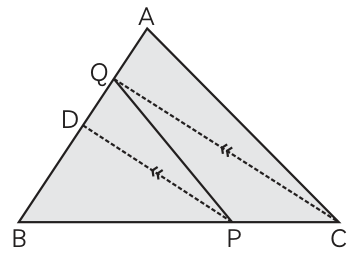
In ΔABC\Delta ABC, DD is the midpoint of ABAB. PP is any point on BCBC, and QQ is a point on ABAB such that CQPDCQ \parallel PD.

PQPQ is joined in the given figure. Prove that Area(ΔBPQ)=12Area(ΔABC)\text{Area}(\Delta BPQ) = \frac{1}{2} \text{Area}(\Delta ABC).                       [page No. 143]

Question image

Answer: Verified

Given:

D is the midpoint of ABP is any point on BC
Q is a point on AB
CQ || PD

To prove: Area(ΔBPQ)=12Area(ΔABC)\text{To prove: } \text{Area}(\Delta\text{BPQ}) = \frac{1}{2} \text{Area}(\Delta\text{ABC})

Step 1: Since D is midpoint of AB

AD=DBAD = DB

So, AB=2DBAB = 2DB

Step 2: Use the property of parallel lines

Since CQ || PD.

Triangles Δ\DeltaBPD and Δ\DeltaBCQ are similar.

Therefore, BDBQ=BPBC\text{Therefore, } \frac{BD}{BQ} = \frac{BP}{BC}

But, BD=AB2\text{But, }BD=\frac{AB}{2}

Hence, AB2BQ=BPBC\text{Hence, } \frac{AB}{2BQ} = \frac{BP}{BC}

Cross-multiplying: AB . BC = 2(BQ . BP)

Step 3: Compare areas

Area of ΔABC=12(AB)(height from C)\text{Area of } \Delta\text{ABC} = \frac{1}{2} (\text{AB})(\text{height from C})

Area of ΔBPQ=12(BQ)(height from P)\text{Area of } \Delta\text{BPQ} = \frac{1}{2} (\text{BQ})(\text{height from P})

Since both heights correspond proportionally from the similar triangles relation obtained above, we get

2Area(ΔBPQ)=Area(ΔABC)2 \text{Area}(\Delta\text{BPQ}) = \text{Area}(\Delta\text{ABC})

Hence, proved.

Download Free PDF
(All Q's of this Chapter solved)
More NCERT Questions