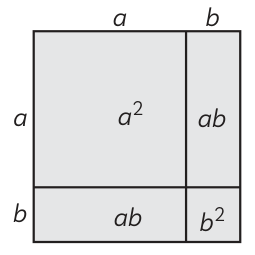
Identities in algebra can sometimes be shown as area relationships. For example:
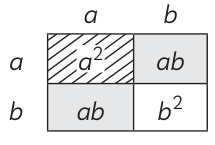
The figure shown corresponds to the identity (a+b)2=a2+2ab+b2. Do you see how? Draw figures corresponding to the identities (a+b)(a−b)=a2−b2 and (a+b+c)2=a2+b2+c2+2ab+2bc+2ca.
Answer:
Verified
Identity 1: (a+b)(a−b)=a2−b2
We need two rectangles: one of size (a+b)×a and one of size (a+b)×b, then subtract the second from the first.
Step 1: Draw a rectangle of width (a+b) and height a:
Area=a×a+b×a=a2+ab
Step 2: Draw a rectangle of width (a×b) and height b and subtract:
Area=a×b+b2=ab+b2
Combined area model (a+b)×(a−b):
Blue (a2) = kept area.
Red (ab,ab) = two equal rectangles that cancel.
Orange (b2) = removed.
Net Area=a2+ab−ab−b2=a2−b2
(a+b)(a−b)=a2−b2
Identity 2:
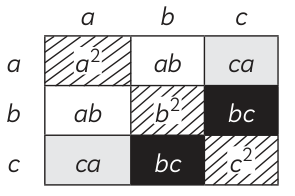
(a+b+c)2=a2+b2+c2+2ab+2bc+2ca
Represent (a+b+c)2 as the area of a square with side (a+b+c). Divide each side into three parts a,b,c. This creates a 3×3 grid of nine rectangles: